Objectives and constraints

Two leading thinkers of management in the twentieth century were Peter Drucker and W. Edwards Deming. Drucker developed the idea of management by objective that would eventually evolve into OKRs. In this approach, effective managers identify operational goals that can be operationalized (that’s the objective), identify metrics to measure to determine if progress is being made towards the goals (those are the key results), and then set targets for the metrics.

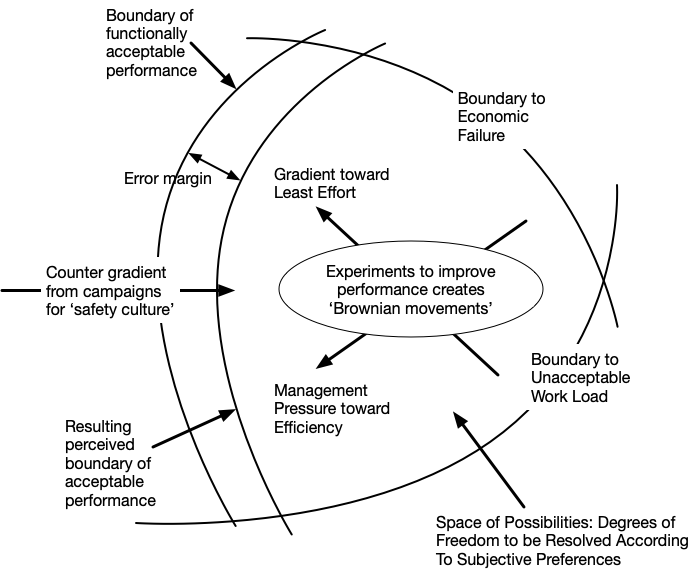
Deming was vehemently opposed to management by objective. Rather, he saw an organization as a system. If you wanted to improve the output of a system, you had to study it to figure out what the limiting factor was. Only once you understood the constraints that limited your system, could you address them by changing the system.

In the tech world, Drucker has clearly won out. His legacy can be seen in the adoption of OKRs by many tech companies (most famously, Intel and Google).

I’m in Deming’s camp, but I can understand why Drucker won. Drucker’s approach is much easier to put into practice than Deming’s. Specifically, Drucker gave managers an explicit process they could follow. On the other hand, Deming…, well, here’s a quote from Deming’s book Out of the Crisis:

Eliminate management by objective. Eliminate management by numbers, numerical goals. Substitute leadership.

I can see why a manager reading this might be frustrated with his exhortation to replace a specific process with “leadership”. But understanding a complex system is hard work, and there’s no process that can substitute for that. If you don’t understand the constraints that limit your system, how will you ever address them?

Why do config changes keep coming up in major incidents?

Recently, Vijay Chidambaram (a CS professor at UT Austin) asked me, “Why do so many outages involve configuration changes?”

Me, a few years ago, making a similar observation

I didn’t have a good explanation for him, and I still don’t. I’m using this post as an exercise of thinking out loud about possible explanations for this phenomenon.

It’s an illusion

It might be that config changes are not somehow more dangerous, it just seems like they are. Perhaps we only notice the writeups where a config change is mentioned, but we don’t remember the writeups that don’t involve a config change. Or perhaps it’s a base rate illusion, where config changes tend to be involved in incidents more often than code changes simply because config changes are more common than code changes.

I don’t believe this hypothesis: I think the config change effect is a real one.

Config changes as second-class

In the recent Salesforce incident, the writeup noted that:

For many of Salesforce’s systems, the deployment pipelines have built-in stagger and canary requirements that are automated. For Salesforce’s DNS systems, the automation and enforcement of staggering through technology is still being built. For this configuration change and script, the stagger process was still manual.  

If an organization has the ability to stage their changes across different domains, I’d wager heavily that they supported staged code deployments before they supported staged configuration change. That’s certainly true at Netflix, where Spinnaker had support for regional rollout of code changes well before it had support for regional rollout of config changes.

This one feels like a real contributor to me. I’ve found that deployment tooling tends to support code changes better than config change: there’s just more engineering effort put into making code changes safer.

Config changes are hard to stage

In the case of the Salesforce incident, the configuration change could theoretically have been staged. However, it may be that configuration changes by their nature are harder to roll out in a staged fashion. Configuration is more likely to be inherently global than code.

I’m really not sure about this one. I have no sense as to how many config changes can be staged.

Config changes are hard to test

Have you ever written a unit test for a configuration value? I haven’t. It might be that config-change related problems only manifest when deployed into a production environment, so you couldn’t catch them at a smaller scope like a unit test.

I suspect this hypothesis plays a significant role as well.

Mature systems are more config-driven

Perhaps the sort of systems that are involved in large-scale outages at big tech companies are the more mature, reliable systems. These are the types of software that have evolved over time to enable operators to control more of their behavior by specifying policy in configuration.

This means that an operator is more likely to be able to achieve a desired behavior change via config versus code. And that sounds like a good thing. We all know that hard-coding things is bad, and changing code is dangerous. In the limit, we wouldn’t have to make any code changes at all to achieve the desired system behavior.

So, perhaps the fact that config changes are more commonly implicated in large-scale outages is a sign of the maturity of the systems?

I have no idea about this one. It seems like a clever hypothesis, but perhaps it’s too clever.

Subverting the process

Recently, Salesforce released a public incident writeup for a service outage that happened in mid-May. There’s a lot of good stuff in here (DNS! A config change!), but I want to focus on one aspect of the writeup, a contributing factor described in the writeup as Subversion of the Emergency Break Fix (EBF) process.

Here are some excerpts from that section of the writeup (emphasis in the original):


An [Emergency Break Fix] is an unplanned and urgent change that is required to prevent or remediate a Severity-0, a Severity-1, or a Severity-2 incident… Non-urgent changes, i.e. those which do not require immediate attention, should not be deployed as EBFs.

In this situation, there was no active or imminent Severity-0, Severity-1 or Severity-2 incident, so the EBF process should not have been used, and standard Salesforce stagger processes should not have been ignored. 

By following an emergency process, this change avoided the extensive review scrutiny that would have occurred had it been made as a standard change under the Salesforce Change Traffic Control (CTC) process. … In this case, the engineer subverted the known policy and the appropriate disciplinary action has been taken to ensure this does not happen in the future.


What was the engineer thinking? “ a reader wonders. I certainly did. People make decisions for reasons that make sense to them. I have no idea what the engineer’s reasoning was here, because there’s not even a hint of that reasoning alluded to here.

Is this process commonly circumvented by engineers for some reason? (i.e., was this situation actually more common than the writeup lets on?) Alternately, was the engineer facing atypical time pressure? If so, what was the nature of the time pressure?

One of the functions of public writeups is to give customers confidence in the organization’s ability to deal with future incidents. This section had the opposite effect, it filled me with dread. It communicates to me that the organization is not interested in understanding how actual work is done.

Woe be it to the next engineer caught in the double bind where there will be consequences if they don’t work quickly enough and there will be consequences if they don’t conform to a process that slows them down so much that they can’t get their work done quickly enough.

Naming names in incident writeups

In a recent Twitter thread, Alex Hidalgo from Nobl9 made the following observation about his incident reports:

I take the opposite approach: I never write any of my reports anonymously. Instead, I explicitly specify the names of all of the people involved. I wanted to write a post on why I do that.

I understand the motivation for providing anonymity. We feel guilt and shame when our changes contribute to an incident. The safety literature refers to this as second victim phenomenon. We don’t write down an engineer’s name in a report because we don’t want to exacerbate the second victim effect. Also, the incident is about the system, not the particular engineer.

The reason I take the opposite approach of naming names is that I want to normalize the fact that incidents are aspects of the system, not the individuals. I feel like providing anonymity implicitly sends the signal that “the names are omitted to protect the guilty.”

My strategy in doing these writeups is to lean as heavily as I can into demonstrating to the reader that all actions taken by the engineers involved were reasonable in the moment. I want them to read the writeup and think, “This could have been me!”. I want to try to get the organization to a point where there is no shame in contributing to an incident, it’s an inevitable aspect of the work that we do.

In order to do this well, I try to write these up as much as possible from the perspective of the people involved. I find it really helps make the writeups look less judge-y (“normative”, in the jargon) by telling the story from the perspective of the individual, and calling attention to the systemic aspects.

And so, while I think Alex and I are both trying to get to the same place, we’re taking different routes.

Incident analysis as guerrilla case study research

Today I tweeted this:

To which Sasha Rosenbaum asked:

This post is my response.

We seldom have time for introspection at work. If we’re lucky, we have the opportunity to do some kind of retrospective at the end of a project or sprint. But, generally speaking, we’re too busy working to spend time examining that work.

One exception to this is incidents: organizations are willing to spend effort on introspection after an incident happens. That’s because incidents are unsettling: people feel uneasy that the system failed in a way they didn’t expect.

And so, an organization is willing to spend precious engineering cycles in order to rid itself of the uneasy feeling that comes with a system failing unexpectedly. Let’s make sure this never happens again.

Incident analysis, in the learning from incidents in software (LFI) sense, is about using an incident as an opportunity to get a better understanding of how the overall system works. It’s a kind of case study, where the case is the incident. The incident acts as a jumping-off point for an analyst to study an aspect of the system. Just like any other case study, it involves collecting and synthesizing data from multiple sources (e.g., interviews, chat transcripts, metrics, code commits).

I call it a guerrilla case study because, from the organization’s perspective, the goal is really to get closure, to have a sense that all is right with the world. People want to get to a place where the failure mode is now well-understood and measures will be put in place to prevent it from happening again. As LFI analysts, we’re exploiting this desire for closure to justify spending time examining how work is really done inside of the system.

Ideally, organizations would recognize the value of this sort of work, and would make it explicit that the goal of incident analysis is to learn as much as possible. They’d also invest in other types of studies that look into how the overall system works. Alas, that isn’t the world we live in, so we have to sneak this sort of work in where we can.

The British General’s problem

Half a league, half a league,
Half a league onward,
All in the valley of Death
Rode the six hundred.
“Forward, the Light Brigade!
Charge for the guns!” he said:
Into the valley of Death
Rode the six hundred.

“Forward, the Light Brigade!”
Was there a man dismay’d?
Not tho’ the soldier knew
Some one had blunder’d:
Theirs not to make reply,
Theirs not to reason why,
Theirs but to do and die:
Into the valley of Death
Rode the six hundred.

Cannon to right of them,
Cannon to left of them,
Cannon in front of them
Volley’d and thunder’d;
Storm’d at with shot and shell,
Boldly they rode and well,
Into the jaws of Death,
Into the mouth of Hell
Rode the six hundred.

Flash’d all their sabres bare,
Flash’d as they turn’d in air
Sabring the gunners there,
Charging an army, while
All the world wonder’d:
Plunged in the battery-smoke
Right thro’ the line they broke;
Cossack and Russian
Reel’d from the sabre-stroke
Shatter’d and sunder’d.
Then they rode back, but not
Not the six hundred.

Cannon to right of them,
Cannon to left of them,
Cannon behind them
Volley’d and thunder’d;
Storm’d at with shot and shell,
While horse and hero fell,
They that had fought so well
Came thro’ the jaws of Death,
Back from the mouth of Hell,
All that was left of them,
Left of six hundred.

When can their glory fade?
O the wild charge they made!
All the world wonder’d.
Honor the charge they made!
Honor the Light Brigade,
Noble six hundred!

The Charge of the Light Brigade, Alfred Lord Tennyson

One of the challenges of building distributed systems is that communications channels are unreliable. This challenge is captured in what is known as the Two Generals’ Problem. It goes something like this:

Two generals from the same army are camped at opposite sides of a valley. The enemy troops are stationed in the valley. The generals need to coordinate their attack in order to succeed. Neither general will risk their troops unless they know for certain that the other general will attack at the same time.

They only mechanism the generals have to communicate is by sending messages via carrier pigeon that fly over the valley. The problem is that enemy archers in the valley are sometimes able to shoot down these carrier pigeons, and so a general sending a message has no guarantee that it will be received by the other general.

Two generals at opposing sides of a valley
One general sends a message to another across the valley via carrier pigeon

The first general sends the message: Let’s attack Monday at dawn, and waits for an acknowledgment. If he doesn’t get an acknowledgment, he can’t be certain the message was received, and so he can’t attack. He receives an acknowledgment in return. But now he thinks, “What if the other general doesn’t know I’ve received the acknowledgment? He knows I won’t carry out the attack unless I know for certain that he agrees to the plan, and he doesn’t know whether I’ve received an acknowledgment or not. I’d better send a message acknowledging the message.”

This becomes an infinite regress problem: it turns out that no number of acknowledgments and acknowledgment-of-acknowledgments that can ensure that the two generals have common knowledge (“I know that he knows that I know that he knows…”) when communicating over an unreliable channel.

One implicit assumption of the Two Generals’ Problem is that when a message is received, it is understood perfectly by the recipient. In the world of real systems, understanding the intent of a message is often a challenge. I’m going to call this the British General’s Problem, in honor of General Raglan.

Raglan was a British general during the Crimean War. The messages he sent to Lord Lucan at the front were misinterpreted, and these misinterpretations contributed to a disastrous attack by British Light Calvary against fortified Russian troops, famously memorialized in Alfred Lord Tennyson’s poem at the top of this post.

Stick figure holding a doc and confused by it
Lord Lucan is confused by General Raglan’s message

Tim Harford tells the story of the misunderstanding, and the different personalities involved in the affair, in the wonderful episode of the Cautionary Tales podcast The Curse of Knowledge meets the Valley of Death.

This story is a classic example of a common ground breakdown, a phenomenon described in the famous paper Common Ground and Coordination in Joint Activity by Gary Klein, Paul Feltovich, Jeffrey Bradshaw and David Woods. In the paper, the authors describe how common ground is necessary for people to coordinate effectively to achieve a shared goal. A common ground breakdown happens when a misunderstanding occurs among the people coordinating.

If you do operations work, and you’ve been involved in remediating an incident while communicating over Slack, you’ve experience the challenge of maintaining common ground. Because common ground breakdowns are common, coordination requires ongoing effort to repair this common ground. This is the topic of Laura Maguire’s PhD thesis: Controlling the Costs of Coordination in Large-scale Distributed Software Systems (which, I must admit, I haven’t yet read).

The British General’s problem is a reminder of the challenges we inevitably face in socio-technical systems. The real problem is not unreliable channels: it’s building and maintaining the shared understanding in order to get the coordination work done.

Dog smartness

One of my hobbies is learning Yiddish. Growing up Jewish in Montreal, I attended a parochial elementary school that taught Yiddish (along with French and Hebrew), but dropped it after that. A couple of years ago, I discovered a Yiddish teacher in my local area and I started taking classes for fun.

Our teacher recently introduced us to a Yiddish expression, hintish-kloog, which translates literally as “dog smartness”. It refers to a dog’s ability to sniff out and locate food in all sorts of places.

This made me think of the kind of skill required to solve operational problems during the moment. It’s a very different kind of skill than, say, constructing abstractions during software development. Instead, it’s more about employing a set of heuristics to try to diagnose the issue, hunting through our dashboards to look for useful signals. “Did something change recently? Are errors up? Is the database healthy?”

My teacher noted that that many of the more religious Jews tend to look down on owning a dog, and so hintish-kloog is meant in a pejorative sense: this isn’t the kind of intelligence that is prized by scholars. This made me think about the historical difference in prestige between development and operations work, where skilled operations work is seen as a lower form of work than skilled development work.

I’m glad that this perception of operations is changing over time, and that more software engineers are doing the work of operating their own software. Dog smartness is a survival skill, and we need more of it.

Author’s note: I initially had the Yiddish wording incorrect, this post has been updated with the correct wording.

Putting on a different hat

(This post was inspired by a conversation I had with a colleague).

On the evening before the launch of the Challenger Space Shuttle, representatives from NASA and the engineering contractor Thiokol held a telecon where they were concerned about the low overnight temperatures at the launch site. The NASA and Thiokol employees discussed whether to proceed with the launch or cancel it. On the call, there’s an infamous exchange between two Thiokol executives:

It’s time to take off your engineering hat and put on your management hat.

Senior Vice President Jerry Mason to Vice President of Engineering Robert Lund

The quote implies a conflict between the prudence of engineering and management’s reckless indifference to risk. The story is more complex than this quote suggests, as the sociologist Diane Vaughan discovered in her study of NASA’s culture. Here’s a teaser of her research results:

Contradicting conventional understandings, we find that (1) in every [Flight Readiness Review], Thiokol engineers brought forward recommendations to accept risk and fly and (2) rather than amoral calculation and misconduct, it was a preoccupation with rules, norms, and conformity that governed all facets of controversial managerial decisions at Marshall during this period.

Diane Vaughan, The Challenger Launch Decision

But this blog post isn’t about the Challenger, or the contrasts between engineering and management. It’s about the times when we need to change hats.

I’m a fan of the you-build-it-you-run-it approach to software services, where the software engineers are responsible for operating the software they write. But solving ops problems isn’t like solving dev problems: the tempo and the skills involved are different, and they require different mindsets.

This difference is particularly acute for a software engineer when a change that they made contributed to an ongoing incident. Incidents are high pressure situations, and even someone in the best frame of mind can struggle with the challenges of making risky decisions under uncertainty. But if you’re thinking, “Argh, the service is down, and it’s all my fault!“, then your effectiveness is going to suffer. Your head’s not going to be in the right place.

And yet, these moments are exactly when it’s most important to be able to make the context switch between dev work and ops work. If someone took an action that triggered an outage, chances are good that they’re the person on the team who is best equipped to remediate, because they have the most context about the change.

Being the one who pushed the change that takes down the service sucks. But when we are most inclined to spend mental effort blaming ourselves is exactly when we can least afford to. Instead, we have to take off the dev hat, put on the ops hat, and do we can to get our head in the game. Because blaming ourselves in the moment isn’t going to make it any easier to get that service back up.

Some quick thoughts on Citi’s $900M OOPSie

Making the rounds is the story of how Citi accidentally transferred $900 million dollars to various hedge funds. Citi then asked the funds to reverse the mistaken transfer, and while some of the funds did, others said, “no, it’s ours, and we’re keeping it”, and Citi took them to court, and lost. The wonderful finance writer Matt Levine has the whole story. At this center of this is horrible UX associated with internal software, you can see screenshots in Levine’s writeup. As an aside, several folks on the Hacker News thread recognized the UI widgets as having been built with Oracle Forms.

However, this post isn’t about a particular internal software package with lousy UX. (There is no shortage of such software packages in the world, ask literally anyone who deals with internal software).

Instead, I’m going to explore two questions:

  1. How come we don’t hear about these sorts of accidental financial transactions more often?
  2. How come financial organizations like Citibank don’t invest in improving internal software UX for reducing risk?

I’ve never worked in the financial industry, so I have no personal experience with this domain. But I suspect that accidental financial transactions, while rare, do happen from time to time. But what I suspect happens most of the time is that the institution that initiated the accidental transaction reaches out and explains what happens to the other institution, and they transfer the money back.

As Levine points out, there’s no finders keepers rule in the U.S. I suspect that there aren’t any organizations that have a risk scenario with the summary, “we accidentally transfer an enormous sum of money to an organization that is legally entitled to keep it.” because that almost never happens. This wasn’t a case of fraud. This was a weird edge case in the law where the money transferred was an accidental repayment of a loan in full, when Citi just meant to make an interest payment, and there’s a specific law about this scenario (in fact, Citi didn’t really want to make a payment at all, but they had to because of a technical issue).

Can you find any other time in the past where an institution accidentally transferred funds and the recipient was legally permitted to keep the money? If so, I’d love to hear it.

And, if it really is the case that these sorts of mistakes aren’t seen as a risk, then why would an organization like Citi invest in improving the usability of their internal tools? Heck, if you read the article, you’ll see that it was actually contractors that operate the software. It’s not like Citi would be more profitable if they were able to improve the usability of this software. “Who cares if it takes a contractor 10 minutes versus 30 minutes?” I can imagine an exec saying.

Don’t get me wrong: my day job is building internal tools, so I personally believe these tools add value. And I imagine that financial institutions invest in the tooling of their algorithmic traders, because correctness and development speed go directly to their bottom lines. But the folks operating the software that initiates these sorts of transactions? That’s just grunt work, nobody’s going to invest in improving those experiences.

In short, these systems don’t fall over all of the time because the systems aren’t just made up of horrible software. They’re made up of horrible software, and human beings who can exercise judgment when something goes wrong and compensate. Most of the time, that’s good enough.

Slack’s Jan 2021 outage: a tale of saturation

Laura Nolan of Slack recently published an excellent write-up of their Jan. 4, 2021 outage on Slack’s engineering blog.

One of the things that struck me about this writeup is the contributing factors that aren’t part of this outage. There’s nothing about a bug that somehow made its way into a production, or an accidentally incorrect configuration change, or how some corrupt data ended up in the database. On the other hand, it’s an outage story with multiple examples of saturation.

Saturation is a phrase often used by the safety science researcher David Woods: it refers to a system that is reaching the limit of what it can handle. If you’ve done software operations work, I bet you’ve encountered resource exhaustion, which is an example of saturation.

Saturation plays a big role in Woods’s model of the adaptive universe. In particular, in socio-technical systems, people will adapt in order to reduce the risk of saturation. In this post, I’m going to walk Laura’s write-up, highlighting all of the examples of saturation and how the system adopted to it. I’m going purely from the text of the original write-up, which means I’ll likely get some things wrong here.

Slack runs their infrastructure on AWS. In the beginning, they (like, I presume, all small companies) started with a single AWS account. And, initially, this worked out well.

In the beginning, Slack’s AWS footprint fit nicely into one account and VPC: that’s one happy cloud!

However, as Slack grew, it encountered it problems. Here’s a quote from Slack’s blog post Building the Next Evolution of Cloud Networks at Slack by Archie Gunasekara:

As our customer base grew and the tool evolved, we developed more services and built more infrastructure as needed. However, everything we built still lived in one big AWS account. This is when our troubles started. Having all our infrastructure in a single AWS account led to AWS rate-limiting issues, cost-separation issues, and general confusion for our internal engineering service teams.

That cloud isn’t looking so happy anymore

The above quote makes reference to three different categories of saturation. The first is a traditional sort of limit we software folks think of: they were running into AWS rate limits associated with an individual AWS account.

The other two limits are cognitive: the system made it harder for humans to deal with separating out costs and, it led to confusion for internal teams. I still see these as a form of saturation: as a system gets more difficult for humans to deal with, it effectively increases the cost of using the system, and it makes errors more likely.

And so, the Slack Cloud Engineering team adapted to meet this saturation risk by adopting AWS child accounts. From the linked blog post again:

Now the service teams could request their own AWS accounts and could even peer their VPCs with each other when services needed to talk to other services that lived in a different AWS account.

Multiple happy child accounts

With continued growth, they eventually reached saturation again. Once again, this was the “it’s getting too hard” sort of saturation:

Having hundreds of AWS accounts became a nightmare to manage when it came to CIDR ranges and IP spaces, because the mis-management of CIDR ranges meant that we couldn’t peer VPCs with overlapping CIDR ranges. This led to a lot of administrative overhead.

VPC peering with multiple VPCs increases the cognitive load on the networking engineers

To deal with this risk of saturation, the cloud engineering team adapted again. They reached for new capabilities: AWS shared VPCs and AWS Transit Gateway Inter-Region Peering. By leveraging these technologies, they were able to design a network architecture that addressed their problems:

This solved our earlier issue of constantly hitting AWS rate limits due to having all our resources in one AWS account. This approach seemed really attractive to our Cloud Engineering team, as we could manage the IP space, build VPCs, and share them with our child account owners. Then, without having to worry about managing any of the overhead of setting up VPCs, route tables, or network access lists, teams were able to utilize these VPCs and build their resources on top of them.

Example of a transit gateway connecting multiple VPCs. Obviously, this does not accurately depict Slack’s actual network architecture.

Fast forward several months later. From Laura Nolan’s post:

On January 4th, one of our Transit Gateways became overloaded. The TGWs are managed by AWS and are intended to scale transparently to us. However, Slack’s annual traffic pattern is a little unusual: Traffic is lower over the holidays, as everyone disconnects from work (good job on the work-life balance, Slack users!). On the first Monday back, client caches are cold and clients pull down more data than usual on their first connection to Slack. We go from our quietest time of the whole year to one of our biggest days quite literally overnight. Our own serving systems scale quickly to meet these kinds of peaks in demand (and have always done so successfully after the holidays in previous years). However, our TGWs did not scale fast enough.

Traffic surge overwhelms the transit gateway

This is as clear an example of saturation as you can get: the incoming load increased faster than the transit gateways were able to cope. What’s really fascinating from this point on is the role that saturation plays in interactions with the rest of the system.

As too many of us know, clients experience a saturated network as an increase in latency. When network latency goes up, the threads in a service spend more of their time sitting there waiting for the bits to come over the network, which means that CPU utilization goes down.

Slack’s web tier autoscales on CPU utilization, so when the network started dropping packets, the instances in the web tier spent more of their time blocked, and CPU went down, which triggered the AWS autoscaler to downscale the web tier.

A server’s CPU utilization falls as it waits for packets that are being dropped by the overloaded transit gateway

However, the web tier has a scaling policy that rapidly upscales if thread utilization gets too high. (At Netflix, we use the term hammer rule to describe these type of emergency scale-up rule).

Too many threads are in use, waiting for those packets. Time for the scale-up hammer!

Once the new instances come online, an internal Slack service named provision-service is responsible for setting up these new instances so that they can serve traffic. And here, we see more saturation issues (emphasis mine).

Provision-service needs to talk to other internal Slack systems and to some AWS APIs. It was communicating with those dependencies over the same degraded network, and like most of Slack’s systems at the time, it was seeing longer connection and response times, and therefore was using more system resources than usual. The spike of load from the simultaneous provisioning of so many instances under suboptimal network conditions meant that provision-service hit two separate resource bottlenecks (the most significant one was the Linux open files limit, but we also exceeded an AWS quota limit).

While we were repairing provision-service, we were still under-capacity for our web tier because the scale-up was not working as expected. We had created a large number of instances, but most of them were not fully provisioned and were not serving. The large number of broken instances caused us to hit our pre-configured autoscaling-group size limits, which determine the maximum number of instances in our web tier.

The provision service is saturated, as is the autoscaling group, although many of the instances aren’t serving traffic because they aren’t fully provisioned.

Through a combination of robustness mechanisms (load balancer panic mode, retries, circuit breakers) and the actions of human operators, the system is restored to health.

As operators, we strive to keep our systems far from the point of saturation. As a consequence, we generally don’t have much experience with how the system behaves as it approaches saturation. And that makes these incidents much harder to deal with.

Making things worse, we can’t ever escape the risk of saturation. Often we won’t know that a limit exists until the system breaches it.