
My book on Ansible is now done! You can get the ebook today, print edition should be out in a few weeks.
Category: Uncategorized
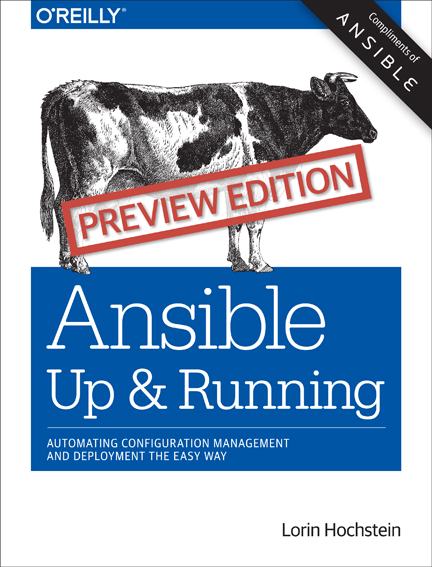
Ansible: Up and Running
I’m writing a book about Ansible. You can grab a free preview version of the book that contains the first three chapters.
Head banging odds ratio
Here’s an idea for a software engineering empirical study. My first thought was to use this to compare the productivity of web frameworks (e.g., Django, Rails, …), but really it could be used for any software development framework or language.
Pick a random sample of, say, Django developers and Rails developers. Send participants text messages at random times during the week (ask them in advance which range of times it’s OK to text them). The text message says:
Are you currently programming in the (Django|Rails) framework and banging your head against the wall?
- If yes, respond “1”
- If currently programming but not banging your head against the wall, respond “2”
- If not currently programming, respond “3”
At the end of the study, look at the ratio of “1” to “2” responses for each framework, to measure the odds ratio of “banging head against the wall : not banging head against the wall”.
Books I wish existed
Here are some technical books I’d like to read:
- OpenStack Networking: A Guide for the Perplexed
- OpenStack Internals
- PowerShell for Linux sysadmins
- Debugging Web Apps with the Chrome Developer Tools
Unfortunately, these books don’t exist.
Publications trump ideology
Dylan Matthews interviews Sasha Issenberg, the author of “The Victory Lab”, which is about how political campaigns are increasingly applying social science research techniques.
It turns out that Democrat campaigns tend to apply these techniques more than Republicans, unsurprisingly, since academic researchers with knowledge of these techniques tend to lean left. However, Matthews notes that a lot of the important research in this area was done during the campaign of Republican governor Rick Perry in 2006. And why is that? According to Issenberg:
The reason Perry developed that partnership is that he made them an unusual offer, which is that they could publish their work.
Via Kevin Drum.
A point of view is not a bad thing
In the North American tradition of journalism, it is considered inappropriate for journalists to have actual opinions about the news stories they are covering. But humans have opinions, and everybody knows that, so suppressing this is a ridiculous fiction. What’s pernicious about this tradition is that journalistic writing is more compelling when authors write in their own voice, instead of the detached view from nowhere shtick that Jay Rosen (rightly!) complains about. It’s even worse in analysis-type pieces, because the journalist is supposed to express their opinion in the piece, but aren’t allowed to do so explicitly, so what happens instead is they find sources they agree with, and then publish quotes from those sources.
This piece by Dave Weigel from a few days ago is an example of the kind of journalistic writing that becomes possible if a journalist writes in their own voice. Great stuff, and the Washington Post is much poorer for having let him go.
There is no toggle lock signal
Since I now work within walking distance of the house, our family downsized from two cars to one, with the expectation that we could use zipcar for those times when we both need a car.
Today was the first time I used the service, and I was pretty impressed with how well the workflow was thought out. A number of my questions about the service were quickly answered. (“How do you get in the car? There’s a scanner on the windshield that senses your Zipcard. Where do they put the keys so they don’t get lost? Keys are attached to a zipline mounted near the ignition. What about gas? There’s a debit gas card that lives in a special sleeve in the driver’s visor. How do they prevent gas card fraud? When you use the card, the pump requires you to input for your mileage and your zipcard number.”)
The first time I left the car, I locked it using the normal power door lock. When I tried to get back in by scanning my card, it locked the doors again instead of unlocking them. I swiped again, and I was in.
Why did scanning my card the first time lock the doors again? I don’t know for sure how the scanner mechanism is implemented, but I can take a guess. The scanner can send a “lock” or an “unlock” signal to the car, just like a regular key fob. However, it has no way to query the car for the state of the lock, so it has to keep the state of the lock’s internally. The first time I swiped my card, the scanner was in the “doors are locked” state, so it sent the unlock signal and switched to the “doors are unlocked” state. When I got out of the car and locked it with the power lock, the Zipcar scanner was still in the “doors are unlocked” state. When I came back and swiped, it thought the doors were unlocked and so it sent the “lock” signal and switched to the “doors are locked” state.
This problem could be avoided if the car could receive a “toggle lock” signal in addition to “lock” and “unlock”. In that case, the scanner wouldn’t need to keep state internally, and could always send out the “toggle lock” signal.
Alas, there is no “toggle lock” signal.
I predict controversy
Tumbling
I threw up a tumblr site for non-software-related jetsam and flotsam.
Transition
Today is my last day at ISI. Tomorrow, I start at Nimbis Services.
 Surfing Complexity