Here’s a brief excerpt from a talk by David Woods on what he calls the component substitution fallacy (emphasis mine):
claim of root cause is ex. of component substitution fallacy. All incidents that threaten failure reveal component weaknesses due to finite resources & tradeoffs -> easy to miss the critical systemic/emergent factors see min 25 https://t.co/OsYy2U8fsA
Everybody is continuing to commit the component substitution fallacy.
Now, remember, everything has finite resources, and you have to make trade-offs. You’re under resource pressure, you’re under profitability pressure, you’re under schedule pressure. Those are real, they never go to zero.
So, as you develop things, you make trade offs, you prioritize some things over other things. What that means is that when a problem happens, it will reveal component or subsystem weaknesses. The trade offs and assumptions and resource decisions you made guarantee there are component weaknesses. We can’t afford to perfect all components.
Yes, improving them is great and that can be a lesson afterwards, but if you substitute component weaknesses for the systems-level understanding of what was driving the event … at a more fundamental level of understanding, you’re missing the real lessons.
Seeing component weaknesses is a nice way to block seeing the system properties, especially because this justifies a minimal response and avoids any struggle that systemic changes require.
Whenever an incident happens, we’re always able to point to different components in our system and say “there was the problem!” There was a microservice that didn’t handle a certain type of error gracefully, or there was bad data that had somehow gotten past our validation checks, or a particular cluster was under-resourced because it hadn’t been configured properly, and so on.
These are real issues that manifested as an outage, and they are worth spending the time to identify and follow up on. But these problems in isolation never tell the whole story of how the incident actually happened. As Woods explains in the excerpt of his talk above, because of the constraints we work under, we simply don’t have the time to harden the software we work on to the point where these problems don’t happen anymore. It’s just too expensive. And so, we make tradeoffs, we make judgments about where to best spend our time as we build, test, and roll out our stuff. The riskier we perceive a change, the more effort we’ll spend on validation and rollout of the change.
And so, if we focus only on issues with individual components, there’s so much we miss about the nature of failure in our systems. We miss looking at the unexpected interactions between the components that enabled the failure to happen. We miss how the organization’s prioritization decisions enabled the incident in the first place. We also don’t ask questions like “if we are going to do follow-up work to fix the component problems revealed by this incident, what are the things that we won’t be doing because we’re prioritizing this instead?” or “what new types of unexpected interactions might we be creating by making these changes?” Not to mention incident-handling questions like “how did we figure out something was wrong here?”
In the wake of an incident, if we focus only on the weaknesses of individual components then we won’t see the systemic issues. And it’s the systemic will continue to bite us long after we’ve implemented all of those follow-up action items. We’ll never see the forest for the trees.
Unfortunately, the first few minutes were lost due to technical issues. You’ll just have to take my word for it that the missing part of my talk was truly astounding, a veritable tour de force.
Starting after World War II, the idea was culture is accelerating. Like the idea of an accelerated culture was just central to everything. I feel like I wrote about this in the nineties as a journalist constantly. And the internet seemed like, this is gonna be the ultimate accelerant of this. Like, nothing is going to accelerate the acceleration of culture like this mode of communication. Then when it became ubiquitous, it sort of stopped everything, or made it so difficult to get beyond the present moment in a creative way.
We software developers are infamous for our documentation deficiencies: the eternal lament is that we never write enough stuff down. If you join a new team, you will inevitably discover that, even if some important information is written down, there’s also a lot of important information that is tacit knowledge of the team, passed down as what’s sometimes referred to as tribal lore.
But writing things down has a cost beyond the time and effort required to do the writing: written documents are durable, which means that they’re harder to change. This durability is a strength of documentation, but it’s also a weakness. Writing things down has a tendency to ossify the content, because it’s much more expensive to update than tacit knowledge. Tacit knowledge is much more fluid: it adapts to changing circumstances much more quickly and easily than updating documentation, as anybody who has dealt with out-of-date written procedures can attest to.
Back when I was an engineering student, I wanted to know “How do the big companies develop software? How does it happen in the real world?”
Now that I work at a company that has to do large-scale software development, I understand better why it’s not something you can really teach effectively in a university setting. It’s not that companies doing large-scale software development are somehow better at writing software than companies that work on smaller-scale software projects. It’s that large-scale projects face challenges that small-scale projects don’t.
The biggest challenge at large-scale is coordination. My employer provides a single service, which means that, in theory, any project that anyone is working on inside of the company could potentially impact what anybody else is working on. In my specific case, I work on delivery tools, so we might be called upon to support some new delivery workflow.
You can take a top-down command-and-control style approach to the problem, by having the people at the top attempting to filter all of the information to just what they need, and them coordinating everyone hierarchically. However, this structure isn’t effective in dynamic environments: as the facts on the ground change, it takes too long for information to work its way up the hierarchy, adapt, and then change the orders downwards.
You can take a bottoms-up approach to the problem where you have a collection of teams that work autonomously. But the challenge there is getting them aligned. In theory, you hire people with good judgment, and provide them with the right context. But the problem is that there’s too much context! You can’t just firehose all of the available information to everyone, that doesn’t scale: everyone will spend all of their time reading docs. How do you get the information into the heads of the people that need it? becomes the grand challenge in this context.
It’s hard to convey the nature of this problem in a university classroom, if you’ve never worked in a setting like this before. The flurry of memos, planning documents, the misunderstandings, the sync meetings, the work towards alignment, the “One X” initiatives, these are all things that I had to experience viscerally, on a first-hand basis, to really get a sense of the nature of the problem.
Some reflections on running the podcast and Ronak has some eggciting news to share 🙂 Music: Vlad Gluschenko — Forest License: Creative Commons Attribution 3.0 Unported: https://creativecommons.org/licenses/by/3.0/deed.en
Jonathan Wondrusch (Block): Raising Ambition in the Singularity –
StaffEng
Jonathan joins Alex and David to talk about what actually changes when agents get good enough to do the work. He walks through the 60-service monorepo migration that convinced him the ceiling had moved, why "raising ambition" is now a real coaching conversation with his team, and how Block is using linters and LLM-as-judge to keep GraphQL API design honest.The conversation goes past the usual velocity story into the harder question: engineering is multiplayer, and most AI tooling is still single-player. Jonathan makes the case that the human touch points — design reviews, pairing, cross-functional feedback — are the part you have to deliberately protect, not the part you optimize away. Plus: adversarial code review with mixed models, why he'll let an agent write his code but not his voice, and the trap of low-hanging fruit that doesn't compound.https://x.com/JWondruschhttps://x.com/davidnoelromashttps://x.com/voidfiles
Jens Rasmussen was a giant in the field of safety science research. You can see still his influence on the field, in the writings of safety researchers such as Sidney Dekker, Nancy Leveson, and David Woods.
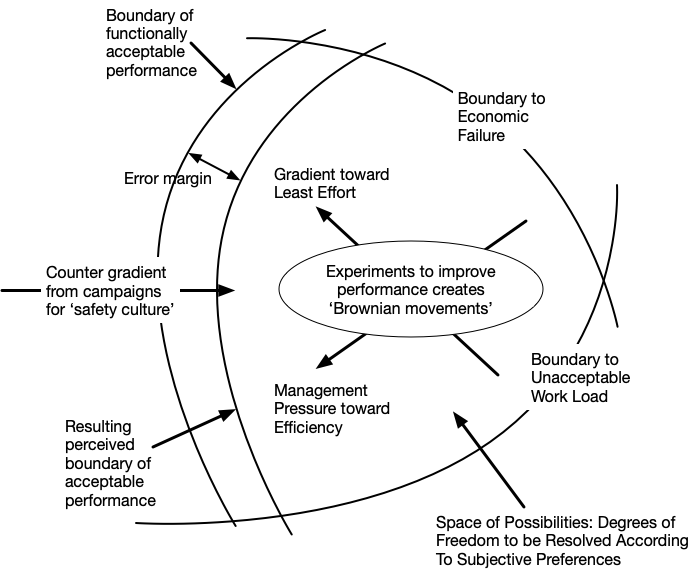
Reproduction of Fig. 3. The original caption reads: Under the presence of strong gradients behaviour will very likely migrate toward the boundary of acceptable performance
This model looks like it views the state of the system as a point in a state space. But, Rasmussen described it as a model of the humans working within the system. He used the term “work space” rather than “state space”. In addition, Rasmussen used the metaphor of a gas particle undergoing local random movements, a phenomenon known as Brownian motion.
Along with the random movements, Rasmussen saw envisioned different forces (he called them gradients) that influenced how the work system would move within the work space. One of these forces was pressure from management to get more work done in order to make the company more profitable. Woods refers to this phenomenon as “faster/better/cheaper pressure“. This is the arrow labeled Management Pressure toward Efficiency, which pushes away from the Boundary to Economic Failure.
One way to get more work done is to give people increasing loads of work. But people don’t like having more and more work piled on them, and so there is opposing pressure from the workforce to reduce the amount of work they have to do. This is the arrow labeled Gradient toward Least Effort which pushes away from the Boundary to Unacceptable Work Load.
The result of those two pressures is movement towards what the diagram labels “the Boundary of functionally acceptable performance”. This is the safety boundary, and we don’t know exactly where it is, which is why there’s a second boundary in the diagram labelled “Resulting perceived boundary of acceptable performance.” Accidents happen when we cross the safety boundary.
Boundary according to Woods
In David Woods’s work, he also writes about the role of boundaries in system safety, but despite this surface similarity, his model isn’t the same as Rasmussen’s.
Instead of a work space, Woods refers to an envelope. He uses terms like competence envelope or design envelope or envelope of performance. Woods has done safety research in aviation, and so I suspect he was influenced by the concept of a flight envelope in aircraft design.
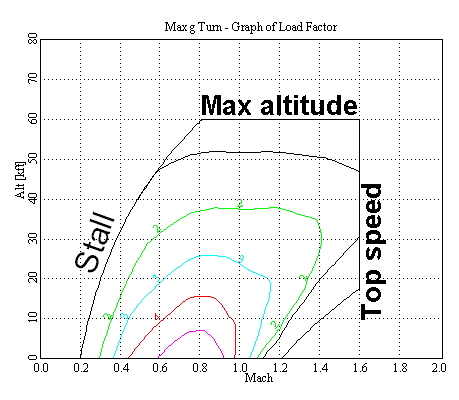
Diagram captioned Altitude envelope from the Wikipedia flight envelope page
The flight envelope defines a region in a state space that the aircraft is designed to function properly within. You can see in the diagram above that the envelope’s boundaries are defined by the stall speed, top speed, and maximum altitude. Bad things happen if you try to operate an aircraft outside of the envelope (hence the phrase pushing the envelope).
Woods’s competence envelope is a generalization of the idea of flight envelope to other types of systems. Any system has a range of inputs that it can handle: if you go outside that range, bad things happen.
Summarizing the differences
To Rasmussen, there is only one boundary in the work space related to accidents: the safety boundary. The other boundaries in the space generally aren’t even reachable, because of the natural pressure away from them. To Woods, the competence envelope is defined by multiple boundaries, and crossing any of them can result in an accident.
Both Rasmussen and Woods identified the role of faster/better/cheaper pressure in accidents. To Rasmussen, this pressure resulted in pushing the system to the safety boundary. But to Woods, this pressure changes the behavior at the boundary. Woods sees this pressure as contributing to brittleness, to systems that don’t perform well as they get close to the boundary of the performance envelope. Woods’s current work focuses on how systems can avoid being brittle by having the ability of moving the boundary as they get closer to it: expanding the competence envelope. He calls this graceful extensibility.
Here’s a question that all of us software developers face: How can we best use our knowledge about the past behavior of our system to figure out where we should be investing our time?
One approach is to use a technique from the SRE world called error budgets. Here are a few quotes from the How to Use Error Budgets chapter of Alex Hidalgo’s book: Implementing Service Level Objectives:
Measuring error budgets over time can give you great insight into the risk factors that impact your service, both in terms of frequency and severity. By knowing what kinds of events and failures are bad enough to burn your error budget, even if just momentarily, you can better discover what factors cause you the most problems over time. p71 [emphasis mine]
The basic idea is straightforward. If you have error budget remaining, ship new features and push to production as often as you’d like; once you run out of it, stop pushing feature changes and focus on relaiability instead. p87
Error budgets give you ways to make decisions about your service, be it a single microservice or your company’s entire customer-facing product. They also give you indicators that tell you when you can ship features, what your focus should be, when you can experiment, and what your biggest risk factors are. p92
The goal is not to only react when your users are extremely unhappy with you—it’s to have better data to discuss where work regarding your service should be moving next. p354
That sounds reasonable, doesn’t it? Look at what’s causing your system to break, and if it’s breaking too often, use that as a signal to address those issues that are breaking it. If you’ve been doing really well reliability-wise, an error budget gives you margin to do some riskier experimentation in production like chaos engineering or production load testing.
I have two issues with this approach, a smaller one and a larger one. I’ll start with the smaller one.
First, I think that if you work on a team where the developers operate their own code (you-build-it, you-run-it), and where the developers have enough autonomy to say, “We need to focus more development effort on increasing robustness”, then you don’t need the error budget approach to help you decide when and where to spend your engineering effort. The engineers will know where the recurring problems are because they feel the operational pain, and they will be able to advocate for addressing those pain points. This is the kind of environment that I am fortunate enough to work in.
I understand that there are environments where the developers and the operators are separate populations, or the developers aren’t granted enough autonomy to be able to influence where engineering time is spent, and that in those environments, an error budget approach would help. But I don’t swim in those waters, so I won’t say any more about those contexts.
To explain my second concern, I need to digress a little bit to talk about Herbert Heinrich.
Herbert Heinrich worked for the Travelers Insurance Company in the first half of the twentieth century. In the 1920s, he did a study of workplace accidents, examining thousands of claims made by companies that held insurance policies with Travelers. In 1931, he published his findings in a book: Industrial Accident Prevention: A Scientific Approach.
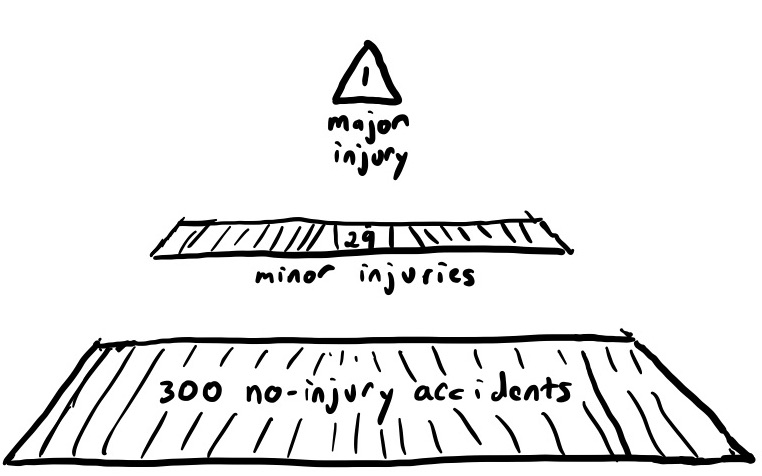
Heinrich’s work showed a relationship between the rates of near misses (no injury), minor injuries, and major injuries. Specifically: for every major injury, there are 29 minor injuries, and 300 no-injury accidents. This finding of 1:29:300 became known as the accident triangle.
One implication of the accident triangle is that the rate of minor issues gives us insight into the rate of major issues. In particular, if we reduce the rate of minor issues, we reduce the risk of major ones. Or, as Heinrich put it: Moral—prevent the accidents and the injuries will take care of themselves.
Heinrich’s work has since been criticized, and subsequent research has contradicted Heinrich’s findings. I won’t repeat the criticisms here (see Foundations of Safety Science by Sidney Dekker for details), but I will cite counterexamples mentioned in Dekker’s book:
So, what does any of this have to do with error budgets? At a glance, error budgets don’t seem related to Heinrich’s work at all. Heinrich was focused on safety, where the goal is to reduce injuries as much as possible, in some cases explicitly having a zero goal. Error budgets are explicitly not about achieving zero downtime (100% reliability), they’re about achieving a target that’s below 100%.
Here are the claims I’m going to make:
Large incidents are much more costly to organizations than small ones, so we should work to reduce the risk of large incidents.
Error budgets don’t help reduce risk of large incidents.
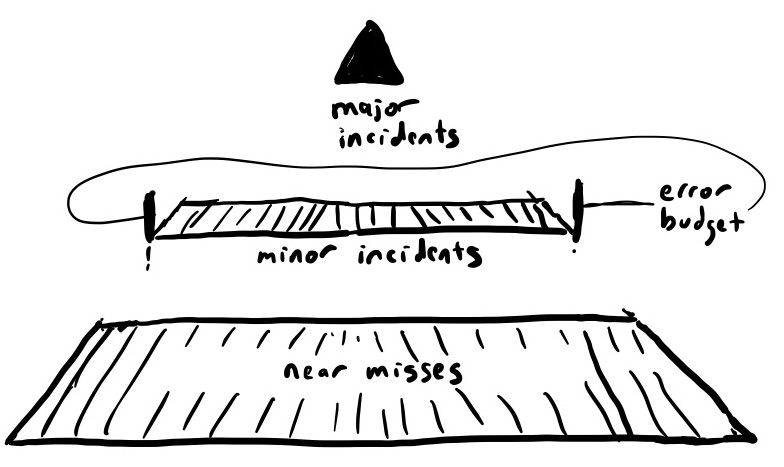
Here’s Heinrich’s triangle redrawn:
An error-budget-based approach only provides information on the nature of minor incidents, because those are the ones that happen most often. Near misses don’t impact the reliability metrics, and major incidents blow them out of the water.
Heinrich’s work assumed a fixed ratio between minor accidents and major ones: reduce the rate of minor accidents and you’d reduce the rate of major ones. By focusing on reliability metrics as a primary signal for providing insight into system risk, you only get information about these minor incidents. But, if there’s no relationship between minor incidents and major ones, then maintaining a specific reliability level doesn’t address the issues around major incidents at all.
An error-budget-based approach to reliability implicitly assumes there is a connection between reliability metrics and the risk of a large incident. This is the thread that connects to Heinrich: the unstated idea that doing the robustness work to address the problems exposed by the smaller incidents will decrease the risk of the larger incidents.
In general, I’m skeptical about relying on predefined metrics, such as reliability, for getting insight into the risks of the system that could lead to big incidents. Instead, I prefer to focus on signals, which are not predefined metrics but rather some kind of information that has caught your attention that suggests that there’s some aspect of your system that you should dig into a little more. Maybe it’s a near-miss situation where there was no customer impact at all, or maybe it was an offhand remark made by someone in Slack. Signals by themselves don’t provide enough information to tell you where unseen risks are. Instead, they act as clues that can help you figure out where to dig to get more details. This is what the Learning from Incidents in Software movement is about.
I’m generally skeptical of metrics-based approaches, like error budgets, because they reify. The things that get measured are the things that get attention. I prefer to rely on qualitative approaches that leverage the experiment judgment of engineers. The challenge with qualitative approaches is that you need to expose the experts to the information they need (e.g., putting the software engineers on-call), and they need the space to dig into signals (e.g., allow time for incident analysis).
Over the past few weeks, I’ve had the experience multiple times where I’m communicating with someone in a semi-synchronous way (e.g., Slack, Twitter), and I respond to them without having properly understood what they were trying to communicate.
In one instance, I figured out my mistake during the conversation, and in another instance, I didn’t fully get it until after the conversation had completed, and I was out for a walk.
In these circumstances, I find that I’m primed to respond based on my expectations, which makes me likely to misinterpret. The other person is rarely trying to communicate what I’m expecting them to. Too often, I’m simply waiting for my turn to talk instead of really listening to what they are trying to say.
It’s tempting to blame this on Slack or Twitter, but I think this principle applies in all synchronous or semi-synchronous communications: including face-to-face conversations. I’ve certainly experienced this when I’ve been in technical interviews, where my brain is always primed to think, “What answer is the interviewer looking for to that question?”
John Allspaw uses the term soak time to refer to the additional time it takes us to process the information we’ve received in a post-incident review meeting, so we can make better decisions about what the next steps are. I think it describes this phenomenon well.
Whether you call it soak time, l’esprit de l’escalier, or hammock-driven development, keep in mind that it takes time for your brain to process information. Give yourself permission to take that time. Insist on it.