AWS re:Invent talk on their Oct ’25 incident

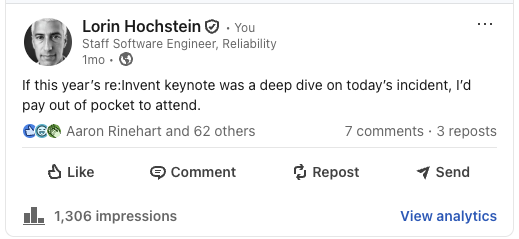
Last month, I made the following remark on LinkedIn about the incident that AWS experienced back in October.

To Amazon’s credit, there was a deep dive talk on the incident at re:Invent! OK, it wasn’t the keynote, but I’m still thrilled that somebody from AWS gave that talk. Kudos to Amazon leadership for green-lighting a detailed talk on the failure mode, and to Craig Howard in particular for giving this talk.

In my opinion, this talk is the most insightful post-incident public artifact that AWS has ever produced, and I really hope they continue to have these sorts of talks after significant outages in the future. It’s a long talk, but it’s worth it. In particular, it goes into more detail about the failure mode than the original write-up.

Tech that improves reliability bit them in this case

This is yet another example of a reliable system that fails through unexpected behavior of a subsystem whose primary purpose was to improve reliability. In particular, this incident involved the unexpected interaction of the following mechanisms, all of which are there to improve reliability.

  • Multiple enactor instances – to protect against individual enactor instances failing
  • Locking mechanism – to make it easier for engineers to reason about the system behavior
  • Cleanup mechanism – to protect against saturating Route 53 by using up all of the records
  • Transactional mechanism – to protect against the system getting into a bad state after a partial failure (this is “all succeeds or none succeeds”)
  • Rollback mechanism – to be able to recover quickly if a bad plan is deployed

These all sound like good design decisions to me! But in this case, they contributed to an incident, because of an unanticipated interaction with a race condition. Note that many of these are anticipating specific types of failures, but we can never imagine all types of failures, and the ones that we couldn’t imagine are the ones that bite us.

Things that made the incident hard

This talk not only discusses the failure itself, but also the incident response, and what made the incident response more difficult. This was my favorite part of the talk, and it’s the first time I can remember anybody from Amazon talking about the details of incident response like this.

Some of the issues that issues that Howard brought up:

  • They used UUIDs as identifiers for plans, which was difficult for the human operators to work with as compared to more human-readable identifiers
  • There were so many alerts firing that it took them fifteen minutes to look through all of them and find the one that told them what the underlying issue is
  • the logs that were outputted did not make it easy to identify the sequence of events that led to the incidents.

He noted that this illustrates how the “let’s add an alert” approach to dealing with previous incidents can actually hurt you, and that you should think about what will happen in a large future incident, rather than simply reacting to the last one.

Formal modeling and drift

This incident was triggered by a race condition, and race conditions are generally very difficult to identify in development without formal modeling. They had not initialized modeling this aspect of DynamoDB beforehand. When they did build a formal model (using TLA+) after the incident, they discovered that the original design didn’t have this race condition, but later incremental changes to the system did introduce it. This means that, at design time, if they had formally modeled the system, they wouldn’t have caught it then either, because it wasn’t there at design time.

Interestingly, they were able to use AI (Amazon Q, of course) to check correspondence between the model and the code. This gives me some hope that AI might make it a lot easier to keep models and implementation in sync over time, which would increase the value of maintaining these models.

Fumbling towards resilience engineering

Amazon is, well, not well known for embracing resilience engineering concepts.

Listening to this talk, there were elements of it that gestured in the direction of resilience engineering, which is why I enjoyed it so much. I already wrote about how Howard called out elements that made the incident harder. He also talked about how post-incident analysis can take significant time, and it’s a very different type of work than the heat-of-the-moment diagnostic work. In addition, there were some good discussion in the talk about tradeoffs. For example, he talked about caching tradeoffs in the context of negative DNS caching and how that behavior exacerbated this particular incident. He also spoke about how there are broader lessons that others can learn from this incident, even though you will never experience the specific race condition that they did. These are the kinds of topics that the resilience in software community has been going on about for years now. Hopefully, Amazon will get there.

And while I was happy that this talk spent time on the work of incident response, I wish it had gone farther. Despite the recognition earlier in the talk about how incident response was made more difficult by technical decisions, in the lessons learned section at the end, there was no discussion about “how do we design our system to make it easier for responders to diagnose and mitigate when the next big incident happens?”.

Finally, I still grit my teeth whenever I hear the Amazonian term for their post-incident review process: Correction of Error.

Brief thoughts on the recent Cloudflare outage

I was at QCon SF during the recent Cloudflare outage (I was hosting the Stories Behind the Incidents track), so I hadn’t had a real chance to sit down and do a proper read-through of their public writeup and capture my thoughts until now. As always, I recommend you read through the writeup first before you read my take.

All quotes are from the writeup unless indicated otherwise.

Hello saturation my old friend

The software had a limit on the size of the feature file that was below its doubled size. That caused the software to fail.

One thing I hope readers take away from this blog post is the complex systems failure mode pattern that resilience engineering researchers call saturation. Every complex system out there has limits, no matter how robust that system is. And the systems we deal with have many, many different kinds of limits, some of which you might only learn about once you’ve breached that limit. How well a system is able to perform as it approaches one of its limits is what resilience engineering is all about.

Each module running on our proxy service has a number of limits in place to avoid unbounded memory consumption and to preallocate memory as a performance optimization. In this specific instance, the Bot Management system has a limit on the number of machine learning features that can be used at runtime. Currently that limit is set to 200, well above our current use of ~60 features.

In this particular case, the limit was set explicitly.

thread fl2_worker_thread panicked: called Result::unwrap() on an Err value

As sparse as the panic message is, it does explicitly tell you that the problematic call site was an unwrap call. And this is one of the reasons I’m a fan of explicit limits over implicit limits: you tend to get better error messages than when breaching an implicit limit (e.g., of your language runtime, the operating system, the hardware).

A subsystem designed to protect surprisingly inflicts harm

Identify and mitigate automated traffic to protect your domain from bad bots. – Cloudflare Docs

The problematic behavior was in the Cloudflare Bot Management system. Specifically, it was in the bot scoring functionality, which estimates the likelihood that a request came from a bot rather than a human.

This is a system that is designed to help protect their customer from malicious bots, and yet it ended up hurting their customers in this case rather than helping them.

As I’ve mentioned previously, once your system achieves a certain level of reliability, it’s the protective subsystems that end up being things that bite you! These subsystems are a net positive, they help much more than they hurt. But they also add complexity, and complexity introduces new, confusing failure modes into the system.

The Cloudflare case is a more interesting one than the typical instances of this behavior I’ve seen, because Cloudflare’s whole business model is to offer different kinds of protection, as products for their customers. It’s protection-as-a-service, not an internal system for self-protection. But even though their customers are purchasing this from a vendor rather than building it in-house, it’s still an auxiliary system intended to improve reliability and security.

Confusion in the moment

What impressed me the most about this writeup is that they documented some aspects of what it was like responding to this incident: what they were seeing, and how they tried to made sense of it.

In the internal incident chat room, we were concerned that this might be the continuation of the recent spate of high volume Aisuru DDoS attacks:

Man, if I had a nickel every time I saw someone Slack “Is it DDOS?” in response to a surprising surge of errors returned by the system, I could probably retire at this point.

The spike, and subsequent fluctuations, show our system failing due to loading the incorrect feature file. What’s notable is that our system would then recover for a period. This was very unusual behavior for an internal error.

We humans are excellent at recognizing patterns based on our experience, and that generally serves us well during incidents. Someone who is really good at operations can frequently diagnose the problem very quickly just by, say, the shape of a particular graph on a dashboard, or by seeing a specific symptom and recalling similar failures that happened recently.

However, sometimes we encounter a failure mode that we haven’t seen before, which means that we don’t recognize the signals. Or we might have seen a cluster of problems recently that followed a certain pattern, and assume that the latest one looks like the last one. And these are the hard ones.

This fluctuation made it unclear what was happening as the entire system would recover and then fail again as sometimes good, sometimes bad configuration files were distributed to our network. Initially, this led us to believe this might be caused by an attack. 

This incident was one of those hard ones: the symptoms were confusing. The “problem went away, then came back, then went away again, then came back again” type of unstable incident behavior is generally much harder to diagnose than one where the symptoms are stable.

Throwing us off and making us believe this might have been an attack was another apparent symptom we observed: Cloudflare’s status page went down. The status page is hosted completely off Cloudflare’s infrastructure with no dependencies on Cloudflare. While it turned out to be a coincidence, it led some of the team diagnosing the issue to believe that an attacker may be targeting both our systems as well as our status page.

Here they got bit by a co-incident, an unrelated failure of their status page that led them to believe (reasonably!) that the problem must have been external.

I’m still curious as to what happened with their status page. The error message they were getting mentions CloudFront, so I assume they were hosting their status page on AWS. But their writeup doesn’t go into any additional detail on what the status page failure mode was.

But the general takeaway here is that even the most experienced operators are going to take longer to deal with a complex, novel failure mode, precisely because it is complex and novel! As the resilience engineering folks say, prepare to be surprised! (Because I promise, it’s going to happen).

A plea: assume local rationality

The writeup included a screenshot of the code that had an unhandled error. Unfortunately, there’s nothing in the writeup that tells us what the programmer was thinking when they wrote that code.

In the absence of any additional information, a natural human reaction is to just assume that the programmer was sloppy. But if you want to actually understand how these sorts of incidents actually happen, you have to fight this reaction.

People always make decisions that make sense to them in the moment, based on what they know and what constraints they are operating under. After all, if that wasn’t true, then they wouldn’t have made that decision. The only we can actually understand the conditions that enable incidents, we need to try as hard as we can to put ourselves into the shoes of the person who made that call, to understand what their frame of mind was at the moment.

If we don’t do that, we risk the problem of distancing through differencing. We say, “oh, those devs were bozos, I would never have made that kind of mistake”. This is a great way to limit how much you can learn from an incident.

Detailed public writeups as evidence of good engineering

The writeup produced by Cloudflare (signed by the CEO, no less!) was impressively detailed. It even includes a screenshot of a snippet of code that contributed to the incident! I can’t recall ever reading another public writeup with that level of detail.

Companies generally err on the side of saying less rather than more. After all, if you provide more detail, you open yourself up to criticism that the failure was due to poor engineering. The fewer details you provide, the fewer things people can call you out on. It’s not hard to find people online criticizing Cloudflare online using the details they provided as the basis for their criticism.

Now, I think it would advance our industry if people held the opposite view: the more details that are provided an incident writeup, the higher esteem we should hold that organization. I respect Cloudflare is an engineering organization a lot more precisely because they are willing to provide these sorts of details. I don’t want to hear what Cloudflare should have done from people who weren’t there, I want to hear us hold other companies up to Cloudflare’s standard for describing the details of a failure mode and the inherently confusing nature of incident response.

Quick thoughts on the recent AWS outage

AWS recently posted a public write-up of the us-east-1 incident that hit them this past Monday. Here are a couple of quick thoughts on it.

Reliability → Automation → Complexity → New failure modes

Our industry addresses reliability problems by adding automation so that the system can handle faults automatically. But here’s the thing: adding this sort of automation increases the complexity in the system. This increase in complexity due to more sophisticated automation brings two costs along with it. One cost is that the behavior of the system becomes more difficult to reason about. This is the “what is it currently doing, and why is it doing that?” problem that we operators face. The second cost of the increased complexity is that, while this automation eliminates a known class of failure modes, it simultaneously introduces a new class of failure modes. These new failure modes occur much less frequently than the class of failure modes that were eliminated, but when they do occur, they are potentially much more severe.

According to Amazon’s write-up, the triggering event was the unintentional deletion of DNS records related to the DynamoDB service due to a race condition. Even though DNS records were fully restored by 2:25 AM PDT, it wasn’t until 3:01 PM, over twelve and a half hours later, that Amazon declared that all AWS services had been fully restored.

There were multiple issues that complicated the restoration of different AWS services, but the one I want to call out here involved the Network Load Balancer (NLB) service. Delays in the propagation of network state information led to false health check failures: there were EC2 instances that were healthy, but that the NLB categorized as unhealthy because of the network state issue. From the report:

During the event the NLB health checking subsystem began to experience increased health check failures. This was caused by the health checking subsystem bringing new EC2 instances into service while the network state for those instances had not yet fully propagated. This meant that in some cases health checks would fail even though the underlying NLB node and backend targets were healthy. This resulted in health checks alternating between failing and healthy. This caused NLB nodes and backend targets to be removed from DNS, only to be returned to service when the next health check succeeded.

This pathological health check behavior led to availability zone DNS failovers, which reduced capacity and led to connection errors.

The alternating health check results increased the load on the health check subsystem, causing it to degrade, resulting in delays in health checks and triggering automatic AZ DNS failover to occur. For multi-AZ load balancers, this resulted in capacity being taken out of service. In this case, an application experienced increased connection errors if the remaining healthy capacity was insufficient to carry the application load.

Health checks are a classic example of an automation system that is designed to improve reliability. It’s not uncommon for an instance to go unhealthy for some reason, and being able to automatically detect when that happens and take the instance out of the load balancer means that your system can automatically handle failures in individual instances. But, as we see in this case, the presence of this reliability-improving automation made a particular problem (delay in network propagation state) even worse.

As a result of this incident, Amazon is going to change the behavior of the NLB logic in the case of health check failures.

For NLB, we are adding a velocity control mechanism to limit the capacity a single NLB can remove when health check failures cause AZ failover.

Note that this is yet another increase in automation complexity with the goal of improving reliability! That doesn’t mean that this is a bad corrective action, or that health checks are bad. Instead, my point here is that adding automation complexity to improve reliability always involves a trade-off. It’s very easy to forget about that trade-off if you focus only on the existing reliability problem you’re trying to tackle, and not even consider what new reliability problems you are introducing. Even if those new problems are rare, they can be extremely painful, as AWS can attest to.

I’ve written previously about failures due to reliability-improving automation. The other examples from my linked post are also from AWS incidents, but this phenomenon is in no way specific to AWS.

Surprise should not be surprising

Since this situation had no established operational recovery procedure, engineers took care in attempting to resolve the issue with [the DropletWorkflow Manager] without causing further issues.

The Amazon engineers didn’t have a runbook to handle this failure scenario, which meant that they had to improvise a recovery strategy during incident response. This is a recurring theme in large-scale incidents: they involve failures that nobody had previously anticipated. The only thing we can really predict about future high-severity incidents is that they are going to surprise us. We are going to keep encountering failure modes we never anticipated, over and over again.

It’s tempting to focus your reliability engineering resources on reducing the risk of known failure modes. But if you only prepare for the failure scenarios that you can think of, then you aren’t putting yourself in a better position to deal with the inevitable situation that you never imagined would ever happen. And the fact that you’re investing in reliability-improving-but-complexity-increasing automation means that you are planting the seeds of those future surprising failure modes.

This means that if you want to improve reliability, you need to invest in both the complexity-increasing reliability automation (robustness), and also in the capacity to be able to better deal with future surprises (resilience). The resilience engineering researcher David Woods uses the term net adaptive value to describe the ability of a system to deal with both predicted failure modes, and to adapt to effectively unpredicted failure modes.

Part of investing in resilience means building human-controllable leverage points so that engineers have a broad range of mitigation actions available to them during future incidents. That could mean having additional capacity on hand that you can throw at the problem, as well as having built in various knobs and switches. As an example from this AWS incident, part of the engineers’ response was to manually disable the health check behavior.

At 9:36 AM, engineers disabled automatic health check failovers for NLB, allowing all available healthy NLB nodes and backend targets to be brought back into service. This resolved the increased connection errors to affected load balancers.

But having these sorts of knobs available isn’t enough. You need your responders to have the operational expertise necessary to know when to use it. More generally, if you want to get better at dealing with unforeseen failure mode, you need to invest in improving operational expertise, so that your incident responders are best positioned to make sense of the system behavior when faced with a completely novel situation.

The AWS write-up focuses on the robustness improvements, the work they are going to do to be better prepared to prevent a similar failure mode from happening in the future. But I can confidently predict that the next large-scale AWS outage is going to look very different from this one (although it will probably involve us-east-1). It’s not clear to me from the write-up that Amazon has learned the lesson of how it important is to prepare to be surprised.

Caveat promptor

In the wake of a major incident, you’ll occasionally hear a leader admonish the engineering organization that we need to be more careful in the future in order to prevent such incidents from happening in the future. Ultimately, these sorts of admonishments don’t help improve reliability, because they miss an essential truth about the nature of work in organizations.

One of the big ideas from resilience engineering is the efficiency-thoroughness trade-off, also known as the ETTO Principle. The ETTO principle was first articulated by Erik Hollnagel, one of the founders of the field. The idea is that there’s a fundamental trade-off between how quickly we can complete tasks, and how thorough we can be when working on each individual task. Let’s consider the work of doing software development using AI agents through the lens of the ETTO principle.

Coding agents like Claude Code and OpenAI are capable of automatically generating significant amounts of code. Honestly, it’s astonishing what these tools are capable of today. But like all LLMs, while they will always generate plausiblelooking output, they do not always generate correct output. This means that a human needs to check an AI agent’s work to ensure that it’s generating code that’s up to snuff: a human has to review the code generated by the agent.

Screenshot of asking Claude about coding mistakes. Note the permanent warning at the bottom.

As any human software engineer will tell you, reviewing code is hard. It takes effort to understand code that you didn’t write. And larger changes are harder to review, which means that the more work that the agent does, the more work the human in the loop has to do to verify it.

If the code compiles and runs and all tests pass, how much time should the human spend on reviewing it? The ETTO principle tells us there’s a trade-off here: the incentives push software engineers towards completing our development tasks more quickly, which is why we’re all adopting AI in the first place. After all, if it ends up taking just as long to review the AI-generated code as it would have for the human reviewer to write it from scratch, then that defeats the purpose of automating the development task to begin with.

Maybe at first we’re skeptical and we spend more time reviewing the agent code. But, as we get better at working with the agents, and as the AI models themselves get better over time, we’ll figure out where the trouble spots of AI-generated code tend to pop up, and we’ll focus our code review effort accordingly. In essence, we’re riding the ETTO trade-off curve by figuring out how much review effort we should be putting in to and where that effort should go.

Eventually, though, a problem with AI-generated code will slip through this human review process and will contribute to an incident. In the wake of this incident, the software engineers will be reminded that AI agents can make mistakes, and that they need to carefully review the generated code. But, as always, such reminders will do nothing to improve reliability. Because, while AI agents change way that software developers work, they don’t eliminate the efficiency-thoroughness trade-off.

Two thought experiments

Here’s a thought experiment that John Allspaw related to me, in paraphrased form (John tells me that he will eventually capture this in a blog post of his own, at which time I’ll put a proper link).

Consider a small-ish tech company that has four engineering teams (A,B,C,D), where an engineer from Team A was involved in an incident (In John’s telling, the incident involves the Norway problem). In the wake of this incident, a post-incident write-up is completed, and the write-up does a good job of describing what happened. Next, imagine that the write-up is made available to teams A,B, and C, but not to team D. Nobody on team D is allowed to read the write-up, and nobody from the other teams is permitted to speak to team D about the details of the incident. The question is: are the members of team D at a disadvantage compared to the other teams?

The point of this scenario is to convey the intuition that, even though team D wasn’t involved in the incident, its members can still learn something from its details that makes them better engineers.

Switching gears for a moment, let’s talk about the new tools that are emerging under the label AI SRE. We’re now starting to see more tools that leverage LLMs to try to automate incident diagnosis and remediation, such as incident.io’s AI SRE product, Datadog’s Bits AI SRE, Resolve.ai (tagline: Your always-on AI SRE), and Cleric (tagline: AI SRE teammate). These tools work by reading in signals from your organization such as alerts, metrics, Slack messages, and source code repositories.

To effectively diagnose what’s happening in your system, you don’t just want to know what’s happening right now, but you also want to have access to historical data, since maybe there was a similar problem that happened, say, a year ago. While LLMs will have been trained with a lot of general knowledge about software systems, it won’t have been trained on the specific details of your system, and your system will fail in system-specific ways, which means that (I assume!) these AI SRE systems will work better if they have access to historical data about your system.

Here’s second thought experiment, this one my own: Imagine that you’ve adopted one of these AI SRE tools, but the only historical data of the system that you can feed your tool is the collection of your company’s post-incident write-ups. What kinds of details would be useful to an AI SRE tool in helping to troubleshoot future incidents? Perhaps we should encourage people to write their incident reports as if they will be consumed by an AI SRE tool that will use it to learn as much as possible about the work involved in diagnosing and remediating incidents in your company. I bet the humans who read it would learn more that way too.

Fixation: the ever-present risk during incident handling

Recent U.S. headlines have been dominated by school shootings. The bulk of the stories have been about the assassination of Charlie Kirk on the campus of Utah Valley University and the corresponding political fallout. On the same day, there was also a shooting at Evergreen High School in Colorado, where a student shot and injured two of his peers. This post isn’t about those school shootings, but rather, one that happened three years ago. On May 24, 2022, at Robb Elementary School in Uvalde, Texas, 19 students and 2 teachers were killed by a shooter who managed to make his way onto the campus.

Law enforcement were excoriated for how they responded to the Uvalde shooting incident: several were fired, and two were indicted on charges of child endangerment. On January 18, 2024, the Department of Justice released the report on their investigation of the shooting:  Critical Incident Review: Active Shooter at Robb Elementary School. According to the report, there were multiple things that went wrong during the incident. Most significantly, the police originally believed that the shooter had barricaded himself in an empty classroom, where in fact shooter was in a classroom with students. There were also communication issues that resulted in a common ground breakdown during the response. But what I want to talk about in this post is the keys.

The search for the keys

During the response to the Uvalde shooting, there was significant effort by the police on the scene to locate master keys to unlock rooms 111/112 (numbered p14, PDF p48, emphasis mine).

Phase III of the timeline begins at 12:22 p.m., immediately following four shots fired inside classrooms 111 and 112, and continues through the entry and ensuing gunfight at 12:49 p.m. During this time frame, officers on the north side of the hallway approach the classroom doors and stop short, presuming the doors are locked and that master keys are necessary.

The search for keys started before this, because room 109 was locked, and had children in it, and the police wanted to evacuate those children (numbered p 13, PDF p48):

By approximately 12:09 p.m., all classrooms in the hallways have been evacuated and/or cleared except rooms 111/112, where the subject is, and room 109. Room 109 is found to be locked and believed to have children inside.

If you look at the Minute-by-Minute timeline section of the report (numbered p17, PDF p50) you’ll see the text “Events: Search for Keys” appear starting at 12:12 PM, all of the way until 12:45 PM.

The irony here is that the door to room 111/112 may have never been locked to begin with, as suggested by the following quote (numbered p15, PDF p48), emphasis mine:

At around 12:48 p.m., the entry team enters the room. Though the entry team puts the key in the door, turns the key, and opens it, pulling the door toward them, the [Critical Incident Review] Team concludes that the door is likely already unlocked, as the shooter gained entry through the door and it is unlikely that he locked it thereafter.

Ultimately, the report explicitly calls out how the search for the keys led to delays in response (numbered p xxviii, PDF p30):

Law enforcement arriving on scene searched for keys to open interior doors for more than 40 minutes. This was partly the cause of the significant delay in entering to eliminate the threat and stop the killing and dying inside classrooms 111 and 112. (Observation 10)

Fixation

In hindsight, we can see that the responders got something very important wrong in the moment: they were searching for keys for a door that probably wasn’t even locked. In this specific case, there appears to have been some communicated-related confusion about the status of the door, as shown by the following (numbered p53, PDF p86):

The BORTAC [U.S. Border Patrol Tactical Unit] commander is on the phone, while simultaneously asking officers in the hallway about the status of the door to classrooms 111/112. UPD Sgt. 2 responds that they do not know if the door is locked. The BORTAC commander seems to hear that the door is locked, as they say on the phone, “They’re saying the door is locked.” UPD Sgt. 2 repeats that they do not know the status of the door.

More generally, this sort of problem is always going to happen during incidents: we are forever going to come to conclusions during an incident about what’s happening that turn out to be wrong in hindsight. We simply can’t avoid that, no matter how hard we try.

The problem I want to focus on here is not the unavoidable getting it wrong in the moment, but the actually-preventable problem of fixation. We “fixate” when we focus solely on one specific aspect of the situation. The problem here is not searching for keys, but on searching for keys to the exclusion of other activities.

During complex incidents, the underlying problem is frequently not well understood, and so the success of a proposed mitigation strategy is almost never guaranteed. Maybe a rollback will fix things, but maybe it won’t! The way to overcome this problem is to pursue multiple strategies in parallel. One person or group focuses on rolling back a deployment that aligns in time, another looks for other types of changes that occurred around the same time, yet another investigates the logs, another looks into scaling up the amount of memory, someone else investigates traffic pattern changes, and so on. By pursuing multiple diagnostic and mitigation strategies in parallel, we reduce the risk of delaying the mitigation of the incident by blocking on the investigation of one avenue that may turn out to not be fruitful.

Doing this well requires diversity of perspectives and effective coordination. You’re more likely to come up with a broader set of options to pursue if your responders have a broader range of experiences. And the more avenues that you pursue, the more the coordination overhead increases, as you now need to keep the responders up to date about what’s going on in the different threads without overwhelming them with details.

Fixation is a pernicious risk because we’re more likely to fixate when we’re under stress. Since incidents are stressful by nature, they are effectively incubators of fixation. In the heat of the moment, it’s hard to take a breath, step back for a moment, understand what’s been tried already, and calmly ask about what the different possible options are. But the alternative is to tumble down the rabbit hole, searching for keys to a door that is already unlocked.

Nothing fails like a history of success

The Axiom of Experience: the future will be like the past, because, in the past, the future was like the past. – Gerald M. Weinberg, An Introduction to General Systems Thinking

Last Friday, the San Francisco Bay Area Rapid Transit system (known as BART) experienced a multiple hour outage. Later that day, the BART Deputy General Manager released a memo about the outage with some technical details. The memo is brief, but I was honestly surprised to see this amount of detail in a public document that was released so quickly after an incident, especially from a public agency. What I want to focus on in this post is this line (emphasis mine):

Specifically, network engineers were performing a cutover to a new network switch at
Montgomery St. Station… The team had already successfully performed eight similar cutovers earlier this year.

This reminded me of something I read in the Buildkite writeup from an incident that happened back in January of this year (emphasis mine):

Given the confidence gained by initial load testing and the migrations already performed over the past year, we wanted to allow customers to take advantage of their seasonal low periods to perform shard migrations, as a win-win. This caused us to discount the risk of performing migrations during a seasonal low period and what impacts might emerge when regular peak traffic returned.

It also reminded me about the 2022 Rogers Telecommunications outage in Canada (emphasis mine, [redacted] comments in the original):

Rogers had assessed the risk for the initial change of this seven-phased process as “High”. Subsequent changes in the series were listed as “Medium.” [redacted] was “Low” risk based on the Rogers algorithm that weighs prior success into the risk assessment value. Thus, the risk value for [redacted] was reduced to “Low” based on successful completion of prior changes.

Whenever we make any sort of operational change, we have a mental model of the risk associated with the change. We view novel changes (I’ve never done something like this before!) as riskier than changes we’ve performed successfully multiple times in the past (I’ve done this plenty of times). I don’t think this sort of thinking is a fallacy: rather, it’s a heuristic, and it’s generally a pretty effective one! But, like all heuristics, it isn’t perfect. As shown in the examples above, the application of this heuristic can result in a miscalibrated mental model of the risk associated with a change.

So, what’s the broader lesson? In practice, our risk models (implicit or otherwise) are always miscalibrated: a history of past successes is just one of multiple avenues that can lead us astray. Trying to achieve a perfect risk model is like trying to deploy software that is guaranteed to have zero bugs: it’s never going to happen. Instead, we need to accept the reality that, like our code, our models of risk will always have defects that are hidden from us until it’s too late. So we’d better get damned good at recovery.

The problems that accountability can’t fix

Accountability is a mechanism that achieves better outcomes by aligning incentives, in particular, negative ones. Specifically: if you do a bad thing, or fail to do a good thing, under your sphere of control, then bad things will happen to you. I recently saw several LinkedIn posts that referenced the U.S. Coast Guard report on the OceanGate experimental submarine implosion. These posts described how this incident highlights the importance of accountability in leadership. And, indeed, the report itself references accountability five times.

However, I think this incident is an example of a type of problem where accountability doesn’t actually help. Here I want to talk about two classes of problems where accountability is a poor solution to addressing the problem, where the OceanGate accident falls into the second class.

Coordination challenges

Managing a large organization is challenging. Accountability is a popular tool in such organizations to ensure that work actually gets done, by identifying someone who is designated as the stuckee for ensuring that a particular task or project gets completed. I’ll call this top-down accountability. This kind of accountability is sometimes referred to, unpleasantly, as the “one throat to choke” model.

Darth Vader enforcing accountability

For this model to work, the problem you’re trying to solve needs to be addressable by the individual that is being held accountable for it. Where I’ve seen this model fall down is in post-incident work. As I’ve written about previously, I’m a believer in the resilience engineering model of complex systems failures, where incidents arise due to unexpected interactions between components. These are coordination problems, where the problems don’t live in one specific component, but, rather, how the components interact with each other.

But this model of accountability demands that we identify an individual to own the relevant follow-up incident work. And so it creates an incentive to always identify a root cause service, which is owned by the root cause team, who are then held accountable for addressing the issue.

Now, just because you have a coordination problem, that doesn’t mean that you don’t need an individual to own driving the reliability improvements around it. In fact, that’s why technical project managers (known as TPMs) exist. They act as the accountable individuals for efforts that require coordination across multiple teams, and every large tech organization that I know of employs TPMs. The problem I’m highlighting here, such as in the case of incidents, is that accountability is applied as a solution without recognizing that the problem revealed by the incident is a coordination problem.

You can’t solve a coordination problem by identifying one of the agents involved in the coordination and making them accountable. You need someone who is well-positioned in the organization, recognizes the nature of the problem, and has the necessary skills to be the one who is accountable.

Miscalibrated risk models

The other way people talk about accountability is about holding leaders such as politicians and corporate executives responsible for their actions, where there are explicit consequences for them acting irresponsibly, including actions such as corruption, or taking dangerous risks with the people and resources that have been entrusted to them. I’ll call this bottom-up accountability.

The bottom-up accountability enforcement tool of choice in France, circa 1792

This brings us back to the OceanGate accident of June 18, 2023. In this accident, the TITAN submersible imploded, killing everyone aboard. One of the crewmembers who died was Stockton Rush, who was both pilot of the vessel and CEO of OceanGate.

The report is a scathing indictment of Rush. In particular, it criticizes how he sacrificed safety for his business goals, ran an organization that lacked that the expertise required to engineer experimental submersibles, promoted a toxic workplace culture that suppressed signs of trouble instead of addressing them, and centralized all authority in himself.

However, one thing we can say about Rush was that he was maximally accountable. After all, he was both CEO and pilot. He believed so much that TITAN was safe that he literally put his life on the line. As Nassim Taleb would put it, he had skin in the game. And yet, despite this accountability, he still took irresponsible risks, which led to disaster.

By being the pilot, Rush personally accepted the risks. But his actual understanding of the risk, his model of risk, was fundamentally incorrect. It was wrong, dangerously so.

Rush assessed the risk index of the fateful dive at 35. The average risk index of previous dives was 36.

Assigning accountability doesn’t help when there’s an expertise gap. Just as giving a software engineer a pager does not bestow up them the skills that they need to effectively do on-call operations work, having the CEO of OceanGate also be the pilot of the experimental vehicle did not lead to him being able to exercise better judgment about safety.

Rush’s sins weren’t merely lack of expertise, and the report goes into plenty of detail about his other management shortcomings that contributed to this incident. But, stepping back from the specifics of the OceanGate accident, there’s a greater point here that making executives accountable isn’t sufficient to avoid major incidents, if the risk models that executives use to make decisions are are out of whack with the actual risks. And by risk models here, I don’t just mean some sort of formal model like the risk assessment matrix above. Everyone carries with them an implicit risk model in their heads: this is a mental risk model.

Double binds

While the CEO also being a pilot sounds like it should be a good thing for safety (skin in the game!), it also creates a problem that the resilience engineering folks refer to as a double bind. Yes, Rush had strong incentives to ensure he wasn’t taking stupid risks, because otherwise he might die. But he also had strong incentives to keep the business going, and those incentives were in direct conflict with the safety incentives. But double-binds are not just an issue for CEO-pilots, because anyone in the organization will feel pressure from above to make decisions in support of the business, which may cut against safety. Accountability doesn’t solve the problem of double-binds, it exacerbates them, by putting someone on the hook for delivering.

Once again, from the resilience engineering literature, one way to deal with this problem is through cross-checks. For example, see the paper Collaborative Cross-Checking to Enhance Resilience by Patterson, Woods, Cook, and Render. Instead of depending on a single individual (accountability), you take advantage of the different perspectives of multiple people (diversity).

You also need someone who is not under a double-bind who has the authority to say “this is unsafe”. That wasn’t possible at OceanGate, where the CEO was all-powerful, and anybody who spoke up was silenced or pushed out.

On this note, I’ll leave you with a six-minute C-SPAN video clip from 2003. In this clip, the resilience engineering David Woods spoke at a U.S. Senate hearing in the wake of the Columbia accident. Here he was talking about the need for an independent safety organization at NASA as a mechanism for guarding against the risks that emerge from double binds.

(I could not get it to embed, here’s the link: https://www.c-span.org/clip/senate-committee/user-clip-david-woods-senate-hearing/4531343)

(As far as I know, the new independent safety organization that Woods proposed was not created)

Easy will always trump simple

One of the early criticisms of Darwin’s theory of evolution by natural selection was about how it could account for the development of complex biological structures. It’s often not obvious to us how the earlier forms of some biological organ would have increase fitness. “What use”, asked the 19th century English biologist St. George Jackson Mivart, “is half a wing?”

One possible answer is that while half a wing might not be useful for flying, it may have had a different function, and evolution eventually repurposed that half-wing for flight. This concept, that evolution can take some existing trait in an organism that serves a function and repurpose it to serve a different function, is called exaptation.

Biology seems to be quite good at using the resources that it has at hand in order to solve problems. Not too long ago, I wrote a review of the book How Life Works: A User’s Guide to the New Biology by the British science writer Philip Ball. One of the main themes of the book is how biologists’ view of genes has shifted over time from the idea DNA-as-blueprint to DNA-as-toolbox. Biological organisms are able to deal effectively with a wide range of challenges by having access to a broad set of tools, which they can deploy as needed based on their circumstances.

We’ll come back to the biology, but for a moment, let’s talk about software design. Back in 2011, Rich Hickey gave a talk at the (sadly defunct) Strange Loop conference with the title Simple Made Easy (transcript, video). In this talk, Hickey drew a distinction between the concepts of simple and easy. Simple is the opposite of complex, where easy is something that’s familiar to us: the term he used to describe the concept of easy that I really liked was at hand. Hickey argues that when we do things that are easy, we can initially move quickly, because we are doing things that we know how to do. However, because easy doesn’t necessarily imply simple, we can end up with unnecessarily complex solutions, which will slow us down in the long run. Hickey instead advocates for building simple systems. According to Hickey, simple and easy aren’t inherently in conflict, but are instead orthogonal. Simple is an absolute concept, and easy is relative to what the software designer already knows.

I enjoy all of Rich Hickey’s talks, and this one is no exception. He’s a fantastic speaker, and I encourage you to listen to it (there are some fun digs at agile and TDD in this one). And I agree with the theme of his talk. But I also think that, no matter how many people listen to this talk and agree with it, easy will always win out over simple. One reason is the ever-present monster that we call production pressure: we’re always under pressure to deliver our work within a certain timeframe, and easier solutions are, by definition, going to be ones that are faster to implement. That means the incentives on software developers tilts the scales heavily towards the easy side. Even more generally, though, easy is just too effective a strategy for solving problems. The late MIT mathematics professor Gian-Carlo Rota noted that every mathematician has only a few tricks, and that includes famous mathematicians like Paul Erdős and David Hilbert.

Let’s look at two specific examples of the application of easy from the software world, specifically, database systems. The first example is about knowledge that is at-hand. Richard Hipp implemented the SQLite v1 as a compiler that would translate SQL into byte code, because he had previous experience building compilers but not building database engines. The second example is about an exaptation, leveraging an implementation that was at-hand. Postgres’s support for multi-version concurrency control (MVCC) relies upon an implementation that was originally designed for other features, such as time-travel queries. (Multi-version support was there from the beginning, but MVCC was only added in version 6.5).

Now, the fact that we rely frequently on easy solutions doesn’t necessarily mean that they are good solutions. After all, the Postgres source I originally linked to has the title The Part of PostgreSQL We Hate the Most. Hickey is right that easy solutions may be fast now, but they will ultimately slow us down, as the complexity accretes in our system over time. Heck, one of the first journal papers that I published was a survey paper on this very topic of software getting more difficult to maintain over time. Any software developer that has worked at a company other than a startup has felt the pain of working with a codebase that is weighed down by what Hickey refers to in his talk as incidental complexity. It’s one of the reasons why startups can move faster than more mature organizations.

But, while companies are slowed down by this complexity, it doesn’t stop them entirely. What Hickey refers to in his talk as complected systems, the resilience engineering researcher David Woods refers to as tangled. In the resilience engineering view, Woods’s tangled, layered networks inevitably arise in complex systems.

Hickey points out that humans can only keep a small number of entities in their head at once, which puts a hard limit on our ability to reason about our systems. But the genuinely surprising thing about complex systems, including the ones that humans build, is that individuals don’t have to understand the system for them to work! It turns out that it’s enough for individuals to only understand parts of the system. Even without anyone having a complete understanding of the whole system, we humans can keep the system up and running, and even extend its functionality over time.

Now, there are scenarios when we do need to bring to bear an understanding of the system that is greater than any one person possesses. My own favorite example is when there’s an incident that involves an interaction between components, where no one person understands all of the components involved. But here’s another thing that human beings can do: we can work together to perform cognitive tasks that none of us could do on their own, and one such task is remediating an incident. This is an example of the power of diversity, as different people have different partial understandings of the system, and we need to bring those together.

To circle back to biology: evolution is terrible at designing simple systems: I think biological systems are the most complex systems that we humans have encountered. And yet, they work astonishingly well. Now, I don’t think that we should design software the way that evolution designs organisms. Like Hickey, I’m a fan of striving for simplicity in design. But I believe that complex systems, whether you call them complected or tangled, are inevitable, they’re just baked in to the fabric of the adaptive universe. I also believe that easy is such a powerful heuristic that it is also baked in to how we build and involved systems. That being said, we should be inspired, by both biology and Hickey, to have useful tools at-hand. We’re going to need them.

Component defects: RCA vs RE

Let’s play another round where contrast the root-cause-analysis (RCA) perspective to the resilience engineering (RE) perspective. Today’s edition is about the distribution of potentially incident-causing defects across the different components in the system. Here, I’m using RCA nomenclature, since the kinds of defects that an RCA advocate would refer to as a “cause” in the wake of an incident would be called a “contributor” by the RE folks.

Here’s a stylized view of the world from the RCA perspective:

RCA view of distribution of potential incident-causing defects in the system

Note that there are a few particularly problematic components: we should certainly focus our reliability efforts on figuring out which of the components we should be spending our reliability efforts on improving!

Now let’s look at the RE perspective:

RE view of distribution of potential incident-contributing defects in the system

It’s a sea of red! The whole system is absolutely shot through with defects that could contribute to an incident!

Under the RE view, the individual defects aren’t sufficient to cause an incident. Instead, it’s an interaction of these defects with other things, including other defects. Because incidents arise due to interactions, RE types will stress the importance of understanding interactions across components over the details of the specific component that happened to contain the defect that contributed to the outage. After all, according to RE folks, those defects are absolutely everywhere. Focusing on one particular component won’t yield significant improvements under this model.

If you want to appreciate the RE perspective, you need to develop an understanding how it can be that the system is up right now despite the fact that it is absolutely shot through with all of these potentially incident-causing defects, as the RCA folks would call them. As an RE type myself, I believe that your system is up right now, and that it already contains the defect that will be implicated in the next incident. After that incident happens, the tricky part isn’t identifying the defect, it’s appreciating how the defect alone wasn’t enough to bring it down.