Now, here, you see, it takes all the running you can do, to keep in the same place. – Lewis Carroll, Through the Looking-Glass, and What Alice Found There
LLM coding may be revolutionizing software development productivity, but it doesn’t seem to be generating the same sorts of gains in software reliability yet. Two events that caught my eye today, although only one is directly related to LLMs.
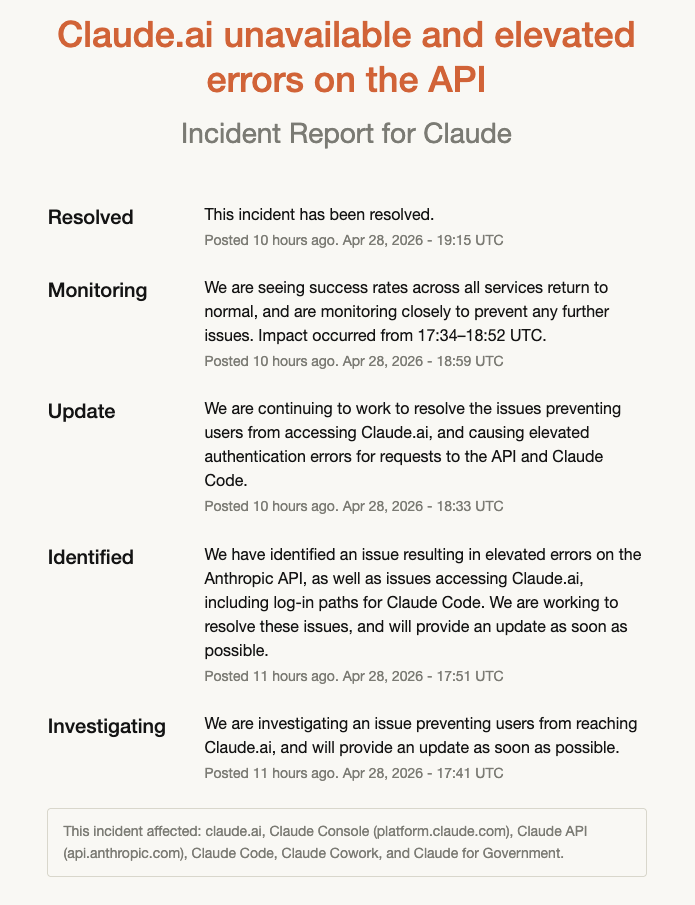
The first event was that Anthropic suffered from another incident today, which lasted about an hour and a half.
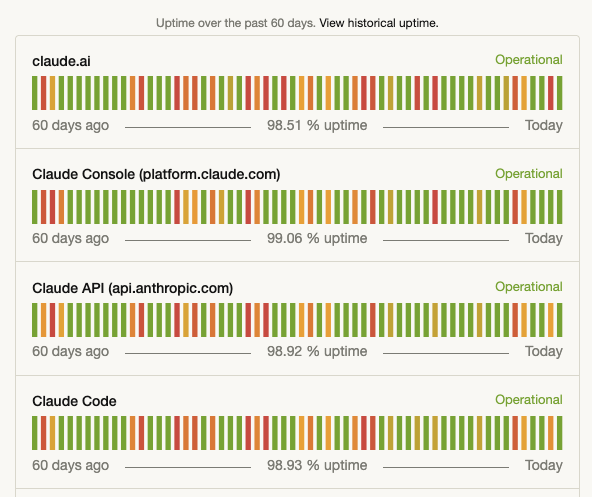
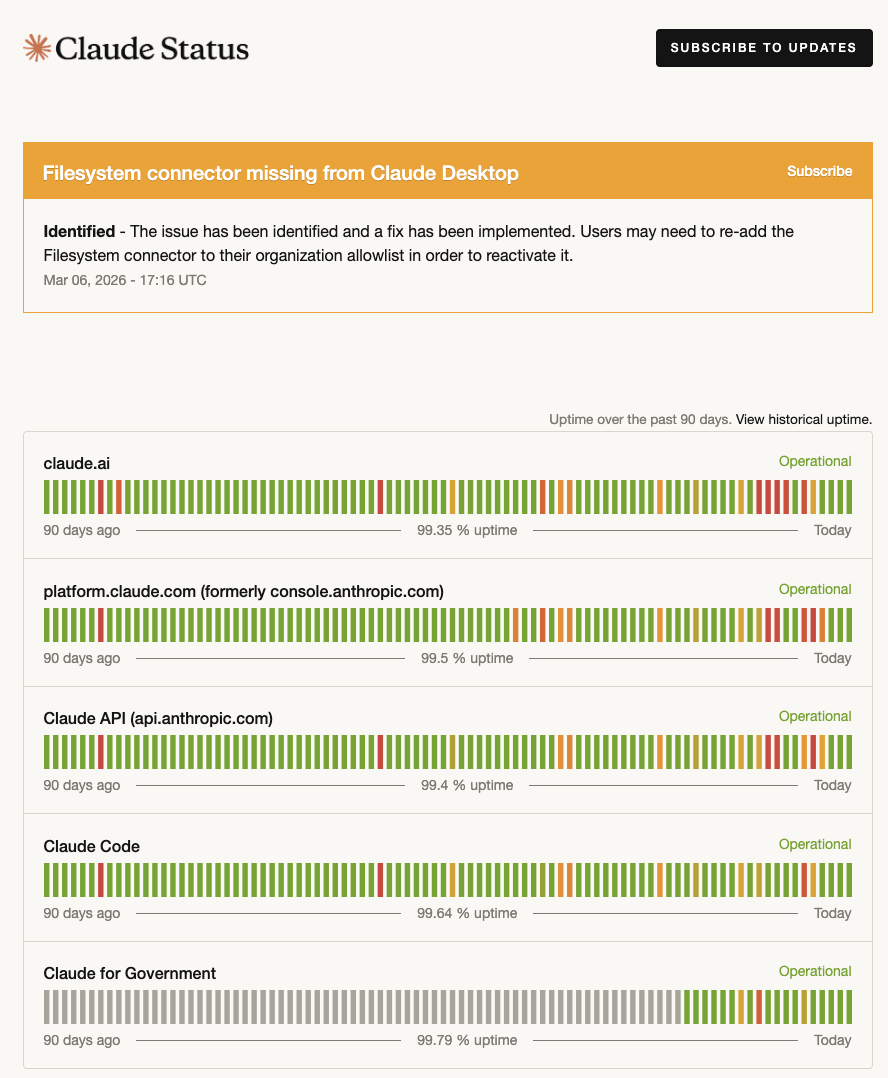
This brought Claude Code down to one nine over the past 60 days, although they’re at two nines if you look over 90 days. I know, I know, I shouldn’t even talk about the nines, but they do make for a great screenshot.
The second event, the one I really want to focus in here, was GitHub’s CTO Vlad Fedorov writing the blog post: An update on GitHub availability. It was only six weeks ago that he wrote Addressing GitHub’s recent availability issues, which is clearly a sign that GitHub is concerned about the impact of recent incidents on their brand.
I want talk about GitHub’s post in the context of David Woods’s Messy 9 collection of patterns about complex systems. I’ve mentioned them before, but to re-iterate, they are: congestion, cascades, conflicts, saturation, lag, friction, tempos, surprises, tangles.
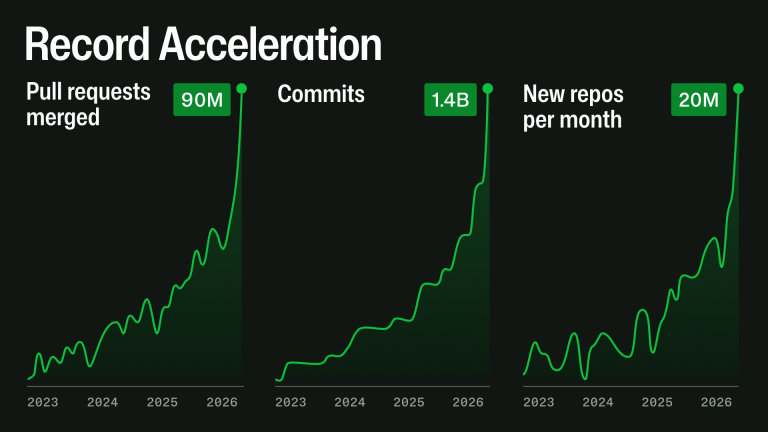
Fedorov notes that AI is driving a lot more activity on the site: the counts of pull requests, commits, repos are growing like never before.
This is a great example of an increase in tempo: the environment that GitHub exists within is changing faster than it has previously. Heck, it’s right there in the title of that graphic: “Record Acceleration”. In particular, the load on GitHub as a system has increased significantly, and GitHub is struggling to keep up with this load. It puts GitHub at risk of saturation.
This exponential growth does not stress one system at a time. A pull request can touch Git storage, mergeability checks, branch protection, GitHub Actions, search, notifications, permissions, webhooks, APIs, background jobs, caches, and databases. At high scale, small inefficiencies compound: queues deepen, cache misses become database load, indexes fall behind, retries amplify traffic, and one slow dependency can affect several product experiences.
GitHub has to make changes to its internal systems in order to handle this load. I don’t work at GitHub, so I don’t know the details, but I have high confidence that they can’t simply horizontally scale their way out of the problem. They will likely have to rearchitect parts of their system in order to handle the increased load. And that will take time, even in the age of AI. And this is where the lags come in. It takes time to actually implement long-term solutions that can handle the load, which increases the probability of short-term outages since the system is running too close to the margin, and those outages delay the long-term solution work because the short-term firefighting steals engineering cycles, and so on. It’s a dangerous place to be, and I don’t envy them.
(As an aside, one other aspect of Fedorov’s post that I found interesting was how the increasing popularity of monorepos is also putting additional stress on GitHub as a system. People are using them in ways that designers had not envisioned!)
I don’t know whether Anthropic will reveal any details about the nature of their most recent outage, but as I’ve written about previously, the author of Claude Code mentioned on Twitter that Anthropic’s availability issues are related to unexpectedly rapid increases in demand. They are victims of their own success.
One of the reasons I don’t expect AI to improve reliability is that I don’t think LLMs are well-suited to mitigate the risk of saturation. As GitHub demonstrates, LLMs are more likely to be on the supply side when it comes to risk of saturation.
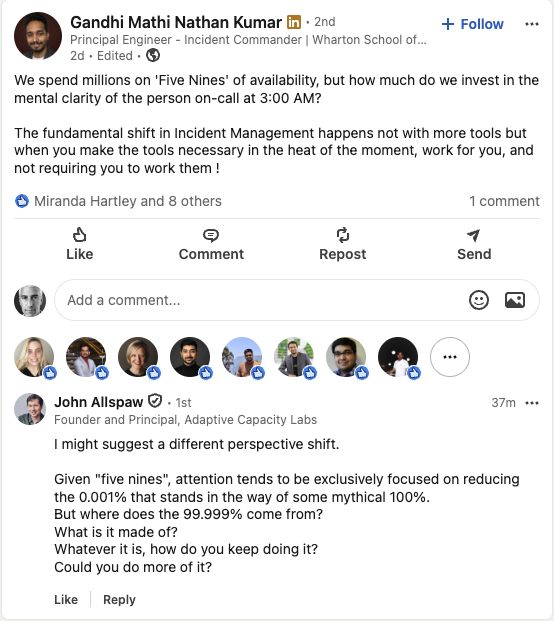
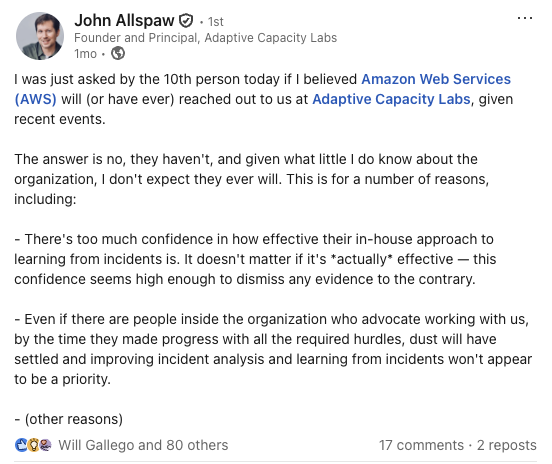
Here’s a recent comment on LinkedIn from John Allspaw, on a post by Gandhi Mathi Nathan Kumar about availability.
Allspaw’s comment is a succinct description of a safety model proposed by the Danish resilience engineering researcher Erik Hollnagel: Safety-II. Hollnagel has described Safety-II in his book Safety-I and Safety-II: The Past and Future of Safety Management, as well as in white papers aimed at aviation and medical audiences. The book and white papers are all quite approachable, and I recommend checking them out.
Hollnagel’s observation is simultaneously trite and surprising: most of the time our systems are succeeding; incidents are the exception, not the norm. After all, this is why we measure availability in nines. The traditional approach to safety, what Hollnagel calls Safety-I, is to try to reduce the bad stuff, the work that leads to incidents. Hollnagel asks us to think about things differently: what if, instead, we focused on cultivating the good stuff: the everyday work that is consistently preventing accidents? There’s a lot more good stuff happening than bad stuff! Or, as my former colleague Ryan Kitchens put it, instead of asking why do things go wrong, it’s more productive to ask how do things go right?
In Hollnagel’s Safety-II model, the normal work that people in your organization do everyday is actively creating safety. Or, as the American organizational psychologist Karl Weick put it in his 1987 paper Organizational culture as a source of high reliability, reliability is a dynamic non-event. That is, the work is explicitly positive, and by the nature of this work, people are constantly doing work that is preventing incidents from happening. However, this work isn’t able to prevent all incidents, which is why they still happen. But taking Safety-II seriously means trying to understand how it is that normal work prevented previous incidents, rather than just trying to understand how it failed to prevent the last one. In Hollnagel’s words, the purpose of an investigation is to understand how things usually go right as a basis for explaining how things occasionally go wrong.
Focusing on the scenarios where things go right is a radical reframing of the problem, so much so that it is a genuinely strange idea, something that violates our intuitions about how systems break. We operate under a baseline, unspoken assumption that reliability is a passive thing, that the default behavior of a system is to stay up, and that somebody needs to actively do something wrong in order to cause the system to break. In other words, we view the day-to-day work people in the system do as a potential threat to reliability. And then, when an incident happens, we try to identify the bad work that broke the system.
If we were to take Safety-II seriously, we’d have to focus on how people adapt their work. It means seeing that people change how they do their work based on the pressures that they are currently facing and the constraints that they are under. More importantly, it means that we have to acknowledge that these adaptations are usually successful. If you only look at these adaptation within the context of an incident, and try to improve reliability by preventing these adaptations, it’s like believing you can figure out how to win the lottery by examining the behaviors of lottery winners. Sure, you can identify patterns among the behavior of lottery winners. But there are even more folks who lose the lottery who exhibit those behaviors, you’re just not looking at those. Note, though, how much this goes against the way people think about how incidents happen.
Safety-II is also challenging to adopt because organizations are simply not used to studying the normal work that goes on in an organization in order to answer the question, “what work is going particularly well, and how can we do more of it?” The closest we probably get is shadowing that happens when new employees join. We do have developer experience surveys, but those focus specifically on problems with existing tooling. I don’t know of any reliability organization at any tech company out there that takes a Safety-II approach and spends time understanding what’s happening when it looks like there’s nothing happening. Perhaps they’re out there, but if they are, they aren’t writing about this work. The one exception to this is the resilience in software folks, but even with us, we’re generally focused on shifting the emphasis of post-incident examination of work, rather than examining work outside of the context of incidents.
Now, attention is a limited resource in an organization, and incidents win the attention of an organization because they are troubling by their nature. Because attention is limited, if all the indicators are currently green, that’s taken as a sign that we can safely spend our attention budget elsewhere. In the tech industry, we also don’t have great models for how to study normal work within an organization, because nobody seems to be doing it. Or, if they are, they aren’t writing about it. In his Safety-II book, Hollnagel recommends doing interviews and field observations. In tech, field observations are trickier because the majority of our work is effectively invisible; we do our work alone at a computer. We can observe interactions over channels like Slack and Zoom, but that’s only part of the story. I suspect that interviews are our best potential source of information here. And then we need to take what we’ve learned from the interviews and use those insights to improve reliability by amplifying what’s already working well. That’s not something we have experience with.
It’s no surprise, then, that Safety-II hasn’t caught on our field. It cuts against our intuitions about the nature of complex systems failure, and we don’t have good public examples to work from about this. We resilience in software folks are trying to push the industry in this direction with trying to get people to think differently about what we can get out of incident analysis, and that’s probably our best bet right now. But we have a long way to go.
Back on April 4, the social media site Bluesky suffered a pretty big outage. I was delighted to discover that one of their engineers, Jim Calabro, published a public writeup about it: April 2026 Outage Post-Mortem.
Calabro’s post goes into a lot of technical details about the failure mode. I’m using this post as a learning exercise for myself. I find that if I have to explain something, then I’ll understand it better. After reading his post and writing this one, I learned things about ephemeral ports, goroutine groups, the TCP state machine, the interaction between blocking system calls and the creation of threads in the Go runtime, and the range of loopback addresses on Linux.
Interpreting the error message
The first thing that struck me is Calabro’s write-up was his discussion of a particular error message he saw in the logs:
dial tcp 127.32.0.1:0->127.0.0.1:11211: bind: address already in use
Now, if I was the one who saw the error message “bind: address already in use”, I would have assumed that a process was trying to listen on a port that another process was already listening on. This sort of thing is server-side behavior, where a server listens on a port (e.g., web servers listen on port 80 and port 443). In the connect attempt associated with the log, the server is listening on port 11211 (the standard port used by memcached). As it says on the Linux bind man page:
 EADDRINUSE
              The given address is already in use.
But that wasn’t the problem in this case! It wasn’t an issue with a server trying and failing to listen on port 11211. Instead, the problem is that the client, which is trying to make a connection to the memcached service, is failing to associate a socket with a port. The system call that’s failing is not listen but (as indicated in the error message) bind. That bind man page actually has two different entries for the address already in use error. Here’s the second one:
EADDRINUSE
              (Internet domain sockets) The port number was specified as
              zero in the socket address structure, but, upon attempting
              to bind to an ephemeral port, it was determined that all
              port numbers in the ephemeral port range are currently in
              use. See the discussion of
              /proc/sys/net/ipv4/ ip_local_port_range ip(7).
I assume that go’s net.Dial function ultimately calls this private dial function, which will call bind if the caller explicitly specifies the local address. In the log message above, the local address was 127.32.0.1:0.
This code was failing because there were no available ephemeral ports left!
I bring this up because Calabro simply mentions as an aside how he (correctly!) interpreted the error message. He just shows the error, and then writes (emphasis mine):
The timing of these log spikes lined up with drops in user-facing traffic, which makes sense. Our data plane heavily uses memcached to keep load off our main Scylla database, and if we’re exhausting ports, that’s a huge problem.
That’s expertise in action!
Saturation, part 1: ephemeral ports
The failure mode that Bluesky encountered is a classic example of saturation, where the system runs out of a critical resource. Calabro’s write-up covers two different time periods, a paging alert on Saturday April 4, and then the Bluesky outage that happened two days later, on Monday April 6. There were different flavors of saturation on the different days, here we’ll talk about the first one.
On Saturday, the limited resource in question was the number of available ephemeral ports. From a programming perspective, when we make calls to servers, we don’t think about the fact that our side of a TCP connection gets assigned a port, because this TCP detail is effectively abstracted away from the developer.
I’m running on macOS, but if I launch an Ubuntu Docker container, I can see that the ephemeral port range goes from 32768 to 60999, for a count of 28,232 available ephemeral ports:
$ sysctl net.ipv4.ip_local_port_range
net.ipv4.ip_local_port_range = 32768 60999
The irony here is that the connections that exhausted the ephemeral ports were to a process that’s running on the same host: memcached listening on 127.0.0.1:11211.
Calabro goes into considerable detail about how the service they refer to as the data plane ran out of ephemeral ports. I’ll describe my understanding based on his write-up. But, as always, I recommend you read the original.
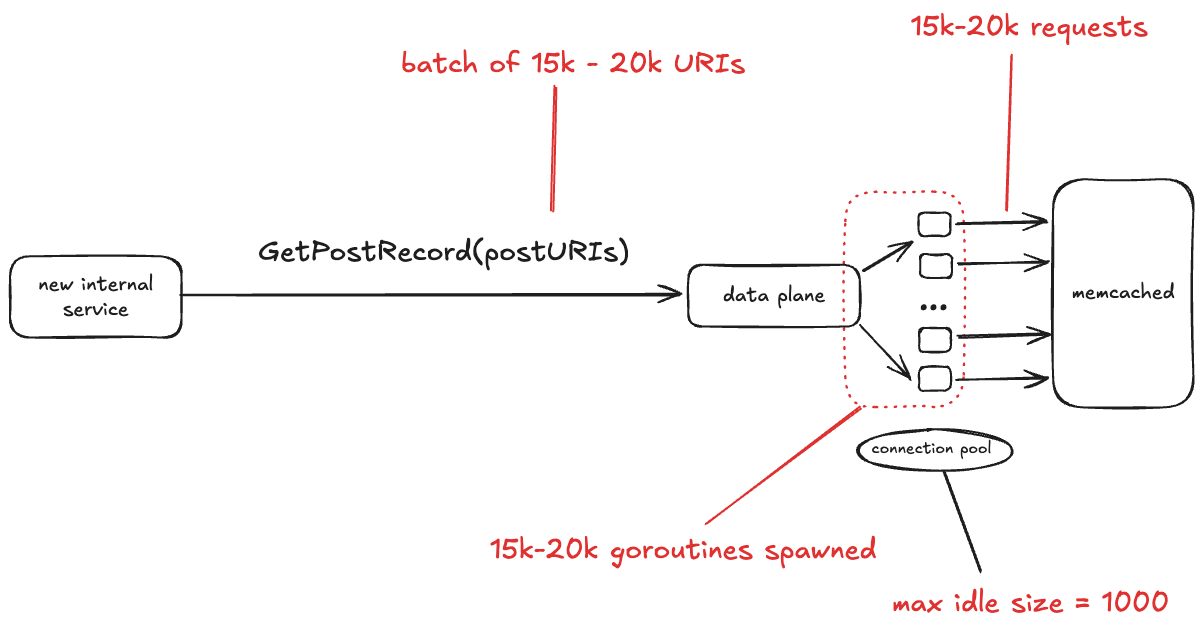
The data plane service talks to a database that is fronted by memcached. This incident only involved interactions between data plane and memcached, so I don’t show the database in the diagram below.
How the data plane service ran out of ephemeral ports
Bluesky recently brought up a new internal service. One of the things this service does is make the GetPostRecord RPC call against the data plane service. The problem isn’t with the rate of traffic. In fact, the volume of traffic that this internal service sends to data plane is low, less than 3 RPS.
No, the problem here is the size of the GetPostRecord payload. It sends a batch of URIs in each call, and sometimes those batches are very large, on the order of 15-20 thousand URIs.
The data plane looks up each URI in memcache first before hitting the database. The data plane is written in Go, and for each request, it starts a new goroutine, and each of those goroutines creates a new TCP connection to memcache. All of those goroutines concurrently making those TCP connections depleted the set of available ephemeral ports.
One thing I learned from this write-up is that Go has a notion of goroutine groups, you can explicitly set a limit of the number of goroutines that are active within a given group. Tragically, this was the one data plane endpoint that was missing an explicit limit.
The connection pool
In the write-up, Calabro notes that the memcached client uses a connection pool, with a maximum idle size of 1000 connections. I was initially confused by this, because I’m used to connection pools where the pool defines the maximum number of simultaneous active connections, and if no unused connections are available, then the client blocks waiting for a connection to be available.
I looked into this, and assuming that this app is using the gomemcache library, that’s not how its connection pool works. Instead, the gomemcache code first looks to see if there’s an available connection. If not, it creates a new connection. So, the connection pool here doesn’t bound connections, but rather is an optimization to reuse an existing connection if one is available.
Instead, what you specify with gomemcache is the maximum number of idle connections, which is the maximum number of connections that the pool will hold onto after use. As mentioned above, Bluesky had this configured as 1,000. This means that if there are 15,000 new connections requested concurrently, at best 1,000 connections will be reused from the pool, requiring 14,000 new connections to be established.
Bitten by time lags – TIME_WAIT
Time lags are underrated factor in incidents, and time lag plays a role here. In this case, the time lag is due to a state in the lifetime of a TCP socket called TIME_WAIT. This state renders a port unusable for a fixed period of time after a connection associated with the port has been closed.
Personally, I first encountered TIME_WAIT back when I was working on a web app on my laptop. Sometimes I’d kill the process and restart it, and the restart would fail with the error that the port it was trying to listen on was already in use. It turns out that the operating system does not immediately release the ports associated with a socket after it’s closed. Instead, the connection transitions to the TIME_WAIT state.
The dropped ACK problem: sending an error when nothing is wrong
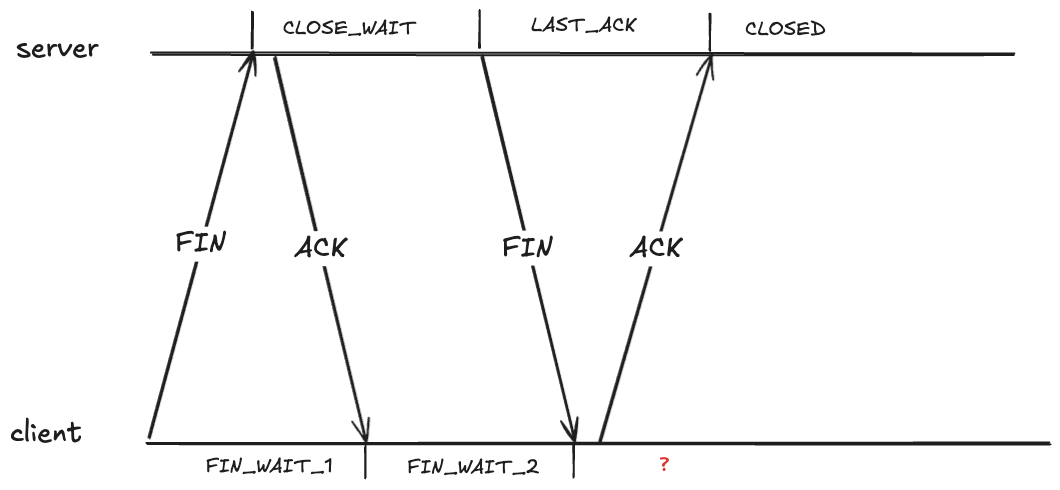
Closing a TCP requires each send side to send a FIN, and each side to ACK the received FIN. As each side sends or receives one of these packets, it transitions through the TCP state machine. Here’s what the exchange looks like. I’ve annotated the TCP states on the server side and the client side.
What state should the client be in after receiving the FIN?
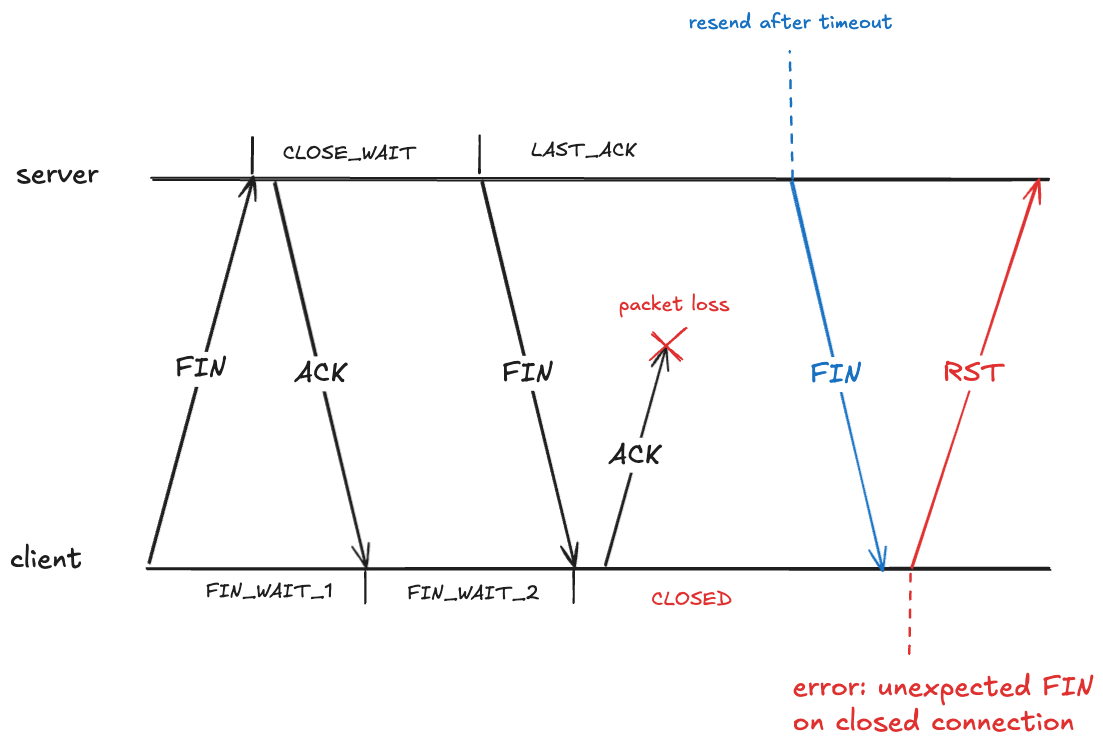
It looks like the client should also be in the CLOSED state after it receives the FIN. However, that creates a problem if the ACK it sends never makes it, because the server will eventually retry sending the FIN.
Here the client has received a packet associated with a TCP connection that has transitioned to the CLOSED state. The client will treat this as an error, and will send an RST packet (if you’ve ever seen the message: connection reset by peer, you’ve been on the receiving end of an RST packet).
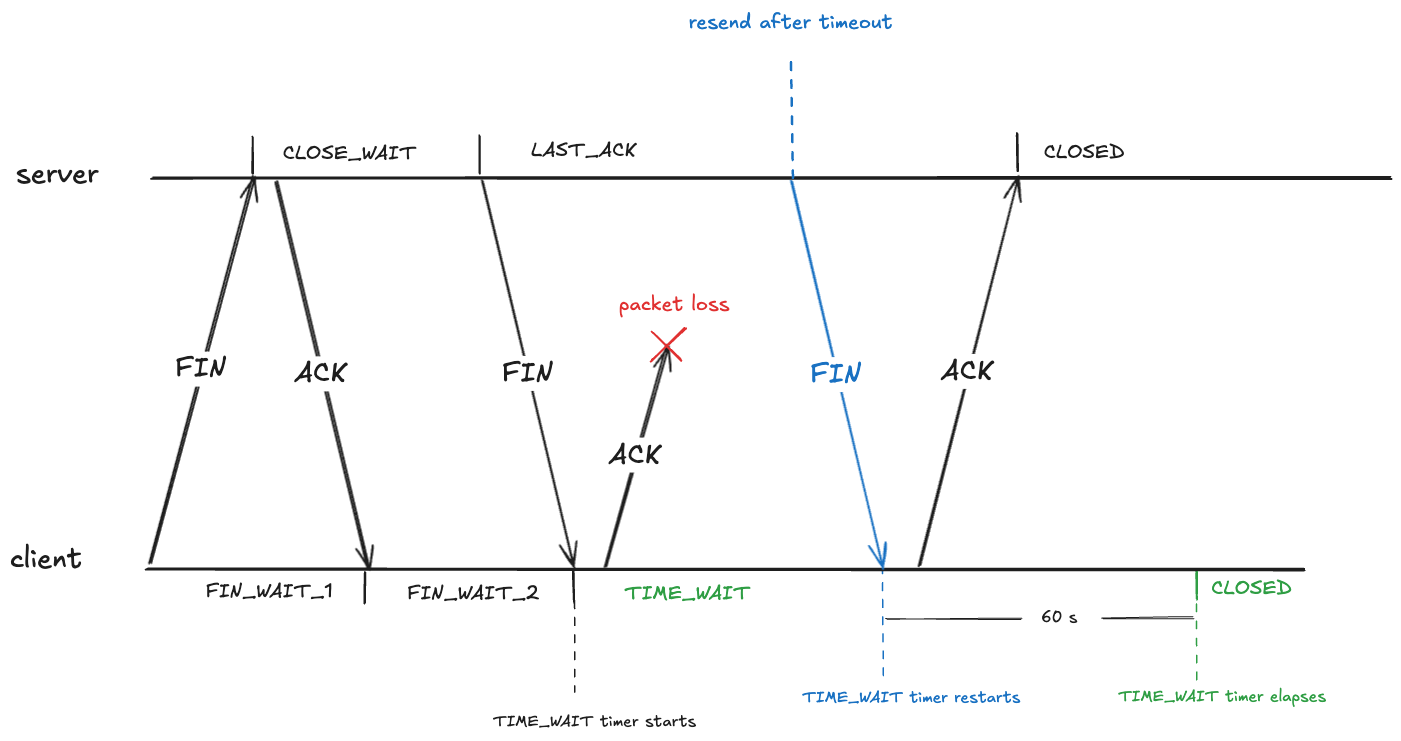
To prevent this, after sending an ACK in the FIN_WAIT_2, the client transitions into the TIME_WAIT state. From RFC-9293:
When a connection is closed actively, it MUST linger in the TIME-WAIT state for a time 2xMSL (Maximum Segment Lifetime)
The RFC doesn’t define what the maximum segment lifetime is. On Linux, the kernel waits in the TIME_WAIT state for about 60 seconds.
#define TCP_TIMEWAIT_LEN (60*HZ) /* how long to wait to destroy TIME-WAIT
* state, about 60 seconds */
This means that the state of the TCP connection will be in the TIME_WAIT state for about a minute before transitioning to CLOSED:
The out of order problem: packet associated with wrong connection
TIME_WAIT also deals with a problem related to packets being received out of order.
Note that a TCP connection’s identity is determined by the four-tuple: (source IP, source port, destination IP, destination port). Here’s an example of such a four-tuple: (127.32.0.1, 32768, 127.0.0.1, 11211).
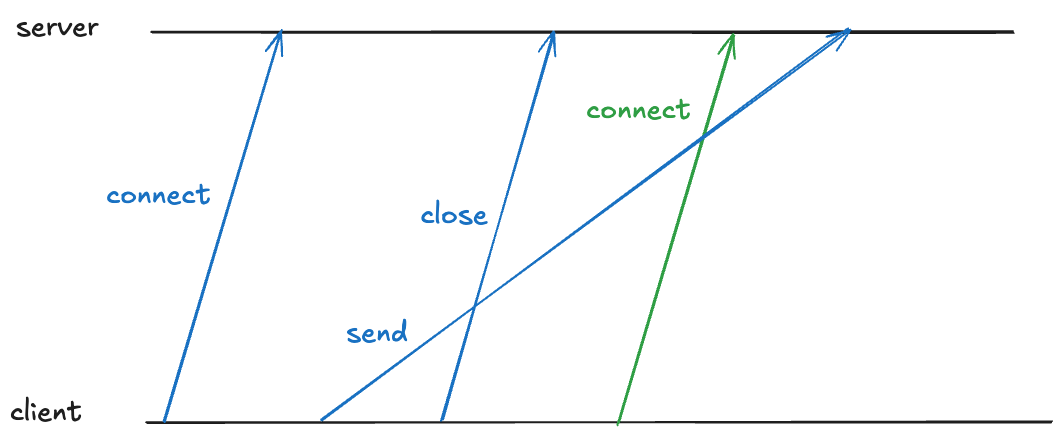
Because TCP packets can arrive out of order, there might still be packets in-flight associated with that connection. If a new TCP connection with the same four-tuple is opened, the receiver will incorrectly associate the packet with the new connection, even though it was part of the old one, as depicted below (here I’m simplifying the connect and close to a single packet rather than using three packets).
The blue “send” packet is incorrectly associated with the green TCP connection.
TIME_WAIT also prevents this by having the client enter TIME_WAIT that is long enough to guarantee that the sent packet is received before the new connection can be opened on the same port.
Eating up the ephemeral port space
Because you have to wait about a minute before you can reuse an ephemeral port, TIME_WAIT reduces the amount of available ephemeral ports.
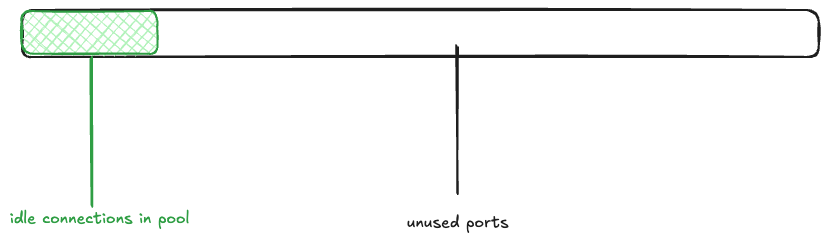
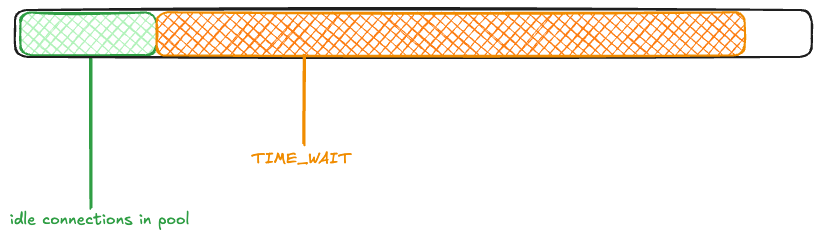
Returning to the Bluesky scenario, imagine that the memcached connection pool is fully populated (there are 1000 idle connections ready to be used), and the rest of the ephemeral ports are free. I’ll depict the space of 28,232 ephemeral ports as a rectangle, with the green rectangle indicating the connection pool.
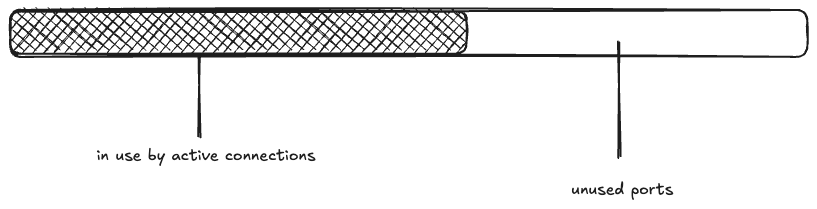
Next, a wave of 15K connections are created. This takes all 1000 of the idle connections, and has to make 14K new connections.
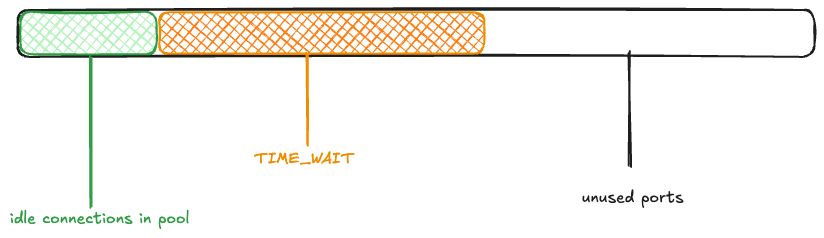
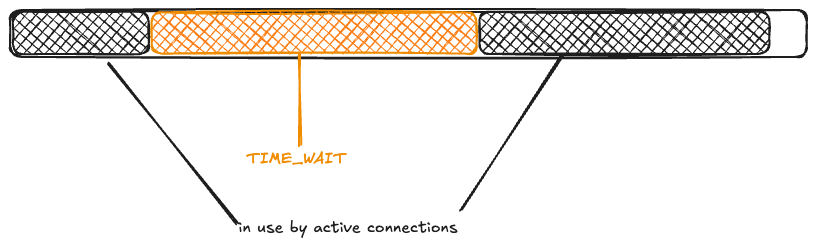
The maximum idle connections is set to 1000, so 1000 of the active connections get returned to the pool. The rest of the connections are closed, and eventually enter the TIME_WAIT state:
Now, another wave of connection requests comes in. Because the ephemeral ports are in use by TCP connections in the TIME_WAIT state, they’re unavailable:
Once again, 1000 connections get returned to the pool, and the rest enter TIME_WAIT.
You can see how the ephemeral ports could be consumed if large numbers of connection requests came in one after another before the TIME_WAIT timer elapsed.
Saturation, part 2: memory
While Bluesky observed the problem with ephemeral port exhaustion on Saturday, it wasn’t until the Monday that they suffered from an outage.
From the write-up, it’s not clear to me what exactly changed on Monday. Perhaps it was just an organic increase in traffic that exacerbated the problem? Whatever it was, the ephemeral port exhaustion contributed to a cascading failure.
According to the write-up, the failure cascade went something like this:
The ephemeral port exhaustion led to error messages when attempting to call memcached.
Every memcached error resulted in a log line being written synchronously to disk.
A large number of goroutines blocked in synchronous system calls led to the Go runtime spawning many OS-level threads (I learned that OS-level threads are called M in Go parlance).
This large number of OS-level threads put memory pressure on the app.
As a result, the data plane experienced stop-the-world GC pauses as well as OOM kills.
Note that because TIME_WAIT is an OS-level state, a data plane process that was OOM killed and restarted would still face limits on the ephemeral port space!
The workaround: leveraging multiple loopbacks
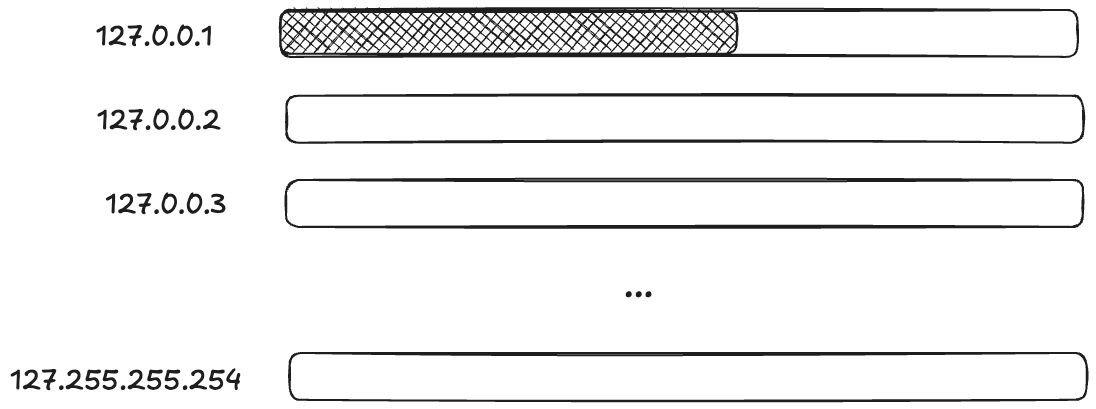
I was impressed by their improvised solution to deal with the problem. I’ve been talking about how an ephemeral port can be consumed, but it’s not actually the port itself. When calling the bind function, you provide not just a port, but the local IP address you want to bind to. It’s the (IP, port) pair that is limited, not the port.
So, if you want to create a TCP connection to a local process (like, say, memcache), and the pair (127.0.0.1,32768) is already in use, if there are other IP addresses that are loopback addresses, you can use those too!
On Linux, by default, all 127.*.*.* IP addresses are loopback address!
# ip route show table local
local 127.0.0.0/8 dev lo proto kernel scope host src 127.0.0.1
...
(Note that this is different from macOS, which only routes 127.0.0.1 via loopback by default).
This means that you potentially have access to a much larger space of ephemeral ports!
Applying terminology from resilience engineering, ephemeral ports are a resource, and you have to do work to mobilize these additional resources.
For Bluesky, the work of marshaling resources came in the form of modifying the code that made the TCP connections. They modified it to randomly select a loopback IP address. Here’s the code from the blog post:
// Use a custom dialer that picks a random loopback IP for each connection.
// This avoids ephemeral port exhaustion on a single IP when a container
// restarts (TIME_WAIT sockets from the old process block the fixed IP).
I wouldn’t describe this is insane, though. This is exactly the kind of improvisational work that you frequently have to do in order to get a system back to healthy during the incident.
Diagnostic challenges
Calabro briefly discusses how difficult it was to diagnose the issue, emphasis mine:
It was all buried in there, but it was hard to know where to look when so much was falling over all at once. You need to have the mental discipline and high granularity in your metrics to be able to cut through the noise to find the real root cause. It’s hard work!
I wish there had been more in this writeup about the process the engineers went through to actually figure out what was going on during the incident, because descriptions of diagnostic work is one of my favorite parts of incident write-ups. We all can stand to do better at improving our diagnostic skills, and one way I try to improve is to read about how someone diagnosed an issue during an incident.
As Calabro mentions, during an incident, there are frequently many things that are failing, and it can be extremely hard to tease out the signals that will help you understand how the system first got into this state.
One particular challenge is noticing an error signal that happens to be unrelated to the ongoing incident, as happened during this incident (emphasis mine):
EDIT: Also, the status page said this was an issue with a 3rd party provider. It was clearly not, apologies for that miscommunication! At the time I posted that status page update, I was looking at some traceroutes that indicated some pretty substantial packet loss from a cloud provider to our data center, but those were not the root cause of the issue.
The messy 9
I want to end this post by bringing up the Messy 9, a set of patterns proposed by the resilience engineering researcher David Woods. These are:
congestion
cascades
conflicts
saturation
lag
friction
tempos
surprises
tangles
I’ve explicitly discussed cascades, saturation, and lag in this post. I suspect that, if we had more detail about this incident, we’d identify even more of these patterns here. Keep on the look-out for these the next time you read an incident write-up or attend an incident review meeting!
GitHub’s been taking it on the chin on the availability front lately. Yesterday, their CTO, Vlad Fedorov, wrote a post on their blog about their recent incidents: Addressing GitHub’s recent availability issues. This post shares some additional details about three recent incidents. I’ll list them in order that they are mentioned in the post:
Feb. 9, 2026 – involved an overloaded database cluster
Feb. 2, 2026 – involved security policies unintentionally blocking access to VM metadata
Mar. 5, 2026 – involved writes failing on a Redis cluster
First observation: I really appreciate it when a company addresses availability concerns by providing more public details about recent incidents. I always think more of companies that are willing to provide these sorts of details, and I hope GitHub provides even more details about their outages in the future.
Saturation, again and again and again
The first incident is a classic example of saturation. In this case, it was an important database cluster that got overloaded. Because databases are much harder to scale up than stateless services, your best bet when dealing with overload is to figure out how to reduce the load so the database can go healthy again. On the other hand, reducing load means denying requests: a “healthy” database that is taking zero traffic has 0% availability! So it’s a balancing act, and the responders are constrained by the infrastructure that currently exists for selectively limiting traffic. Once the overload happens, you can only twist the knobs that you already have available.
Fedorov notes they’re now prioritizing implementing mechanisms to protect against these sorts of scenarios where load increases unexpectedly.
Protecting downstream components during spikes to prevent cascading failures while prioritizing critical traffic loads.
Taking it to the limit, and then over it
Fedorov also provided details on how they ended up seeing so much more traffic than usual. They released a new model (I think it’s an AI model) on a Saturday, when traffic is lower. And then, on Monday, multiple different factors contributed to an increase in traffic that pushed them over the limit. The blog post mentions these four contributors:
new model release
they had reduced a user settings cache TTL from 12 hours to 2 hours, increasing write load
they hit their regular peak load on Monday
many of their users updated to the new version of their client apps, and this update activity increased read load
They had reduced the TTL so that people would get the new model more quickly, but reducing the TTL means that more cache evictions, which meant more database load.
This compounding effect of multiple factors is pernicious, because it can be hard to reason about why your system hit a tipping point. From the write-up:
While the TTL change was quickly identified as a culprit, it took much longer to understand why the read load kept increasing, which prolonged the incident.
Understanding the role of multiple, independent contributing factors is hard enough in a post-incident analysis, identifying this in the heat of an incident can be damn near impossible.
The thing about tipping points is that you don’t notice until you tip
This failure mode was a case where the danger was growing over time, but there were no visible symptoms until they hit the limit.
The architecture was originally selected for simplicity at a time when there were very few models and very few governance controls and policies related to those models. But over time, something that was a few bytes per user grew into kilobytes. We didn’t catch how dangerous that was because the load was visible only during new model or policy rollouts and was masked by the TTL.
The resilience engineering folks would call this an example of a brittle collapse, where a system falls over when it hits the limit. We do our best to monitor for trouble and anticipate trouble ahead, but we’re always going to hit scenarios like this where signals of a problem are being masked, until the perfect storm hits. At that point, we just have to be good at responding. And, hopefully, good at learning as well.
Failovers are a different mode of operation
Their February 2nd incident involved a failover where they had some sort of infrastructure issue in one(?) region. GitHub has mechanisms for automatically shifting traffic to healthy regions, and that mechanism worked here, but there was another issue that they hit:
However, in this case, there was a cascading set of events triggered by a telemetry gap that caused existing security policies to be applied to key internal storage accounts affecting all regions. This blocked access to VM metadata on VM creates and halted hosted runner lifecycle operations.
It was the combination of the traffic failover and a telemetry gap that ultimately led to the outage. (Did the automatic traffic shift end up making things worse? I can’t tell from the write-up). The traffic redirection didn’t create the incident, but it enabled it to happen. Whenever our system runs in an alternate mode, there’s an increased risk that we’ll hit some weird edge case that we haven’t seen before because it doesn’t regularly run in that mode. Automated reliability mechanisms often put our systems in these alternate modes. This means that they can enable novel failure modes.
In fact, the March 5th incident followed a similar pattern, this time it was a Redis cluster primary failover enabled the incident.
The failover performed as expected, but a latent configuration issue meant the failover left the cluster in a state with no writable primary.
Reliability vs security, the eternal struggle
The Feb 2nd incident also illustrates the fundamental tradeoff between reliability and security. Reliability’s job is to ensure service access to the users who are supposed to have it. Security’s job is to deny service access to the users that aren’t supposed to have it. These two forces are are in tension, as we see in this incident where a security mechanism denied access.
It’s not just about automation, it’s about more options for responders
In the Feb 9th incident, Fedorov notes how the responders lacked certain functionality that would have helped them mitigate (emphasis mine)
Further, due to the interaction between different services after the database cluster became overwhelmed, we needed to block the extra load further up the stack, and we didn’t have sufficiently granular switches to identify which traffic we needed to block at that level.
He also notes how they had to manually recover from the March 5th incident:
With writes failing and failover not available as a mitigation, we had to correct the state manually to mitigate.
I hope they don’t pull all of their eggs in the “automation” basket in their remediations. For the first incident in particular, automated load shedding is tricky to get right, it’s hard to reason about, and you won’t have experience with the behavior of this new automation until either you have the incident, or until the automation actually creates an incident (e.g., opens a circuit breaker when it shouldn’t). Making it easier for the responders to manually control load shedding during an incident is important as well.
More generally, reliability work isn’t just about putting in automated mechanisms to handle known failure modes. It’s also about setting up the incident responders for success by providing them with as many resources as possible before the next incident happens. In this context, resources means the ability to manually control different aspects of the infrastructure, whether that’s selective traffic blocking, manually updating database state, or many of the other potential remediations that a responder might have to do. The more flexibility they have, the more room to maneuver (to use David Woods’s phrase), the easier it will be for them to improvise a solution, and the faster the next surprising incident will be mitigated.
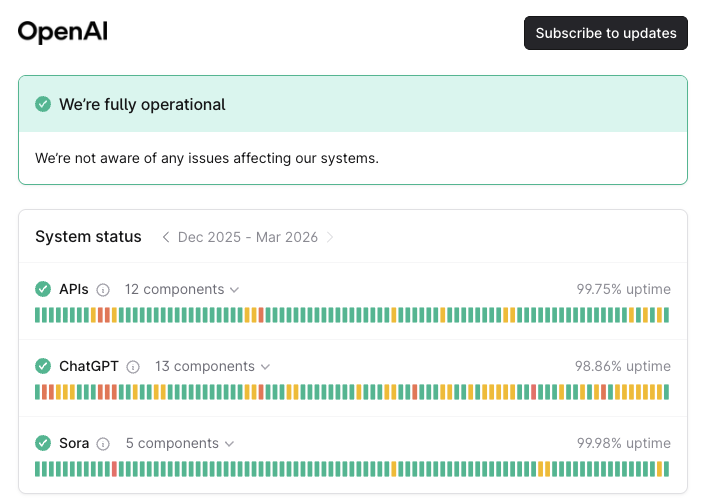
The general vibes I see online is that the AI companies have not been doing particularly well in the reliability department. Both OpenAI and Anthropic publish reliability statistics on their status pages. Now, I’m not a fan of using the nines as a meaningful indicator of reliability, but since I don’t have access to any other signals about reliability for these two companies, they’ll have to do for the purposes of this blog post.
And these numbers… well, they’re not great. With the exception of Sora, none of the services at either company makes it to 99.9% of reliability (three nines). Surprisingly, ChatGPT at 98.86% of uptime does not even make it to two nines.
I’ve seen speculation that the reason that reliability isn’t great is that this is a high development velocity phenomenon. Here’s Boris Cherny (the guy at Anthropic who wrote Claude Code) pushing back on that hypothesis.
Hey Gergely 👋 to be clear this is less about shipping velocity, and more about rapid user growth straining our services. We’re working through these issues the same way we’ve always done. This is what hypergrowth looks like (I’m sure you saw it at Uber too)! 10x y/y growth ain’t…
This isn’t move fast and break things, but rather grow fast and overload things. These companies are in the business of providing LLMs, which are a new capability. Users are leveraging LLMs in new and innovative ways. The resilience engineering researcher David Woods refers to this phenomenon as a florescence to describe this kind of rapid and widespread uptake.
As a consequence of this florescence, the load on the providers increases unexpectedly and dramatically: they weren’t able to predict the load and have struggled to keep up with it when it happens. These LLM providers are running directly into the problem of saturation (plug: check out my recent post on saturation for the Resilience in Software Foundation).
Now, I expect that these companies will get better at recovering from these unexpected increases in load as they gain experience with the problem. Because of capacity constraints with those pricey GPUs, they can’t always scale their way out of these problem, but they can redistribute resources, and they can get better at load shedding and other sorts of graceful degradation to limit the damage of overload. And I bet that’s where they’re both investing in reliability today. At least, I hope so. Because this problem isn’t going to go away. If anything, I suspect their loads will become even more unpredictable as people continue to innovate with LLMs. Because AIs don’t seem to do any better at predicting the future than humans.
With the value of AI coding tools now firmly established in the software industry, the next frontier is AI SRE tools. There are a number of AI SRE vendors. In some cases, vendors are adding AI SRE functionality to extend their existing product lineup, a quick online search reveals one such as PagerDuty’s SRE Agents, Datadog’s Bits AI SRE, incident.io’s AI SRE, Microsoft’s Azure SRE Agent, and Rootly’s AI SRE. There are also a number of pure play AI SRE startups: the ones I’ve heard of are Cleric, Resolve.ai, Anyshift.io, and RunWhen. My sense of the industry is that AI SRE is currently in the evaluation phase, compared to the coding tools which are in the adoption phase.
What I want to write about today is not so much what these AI tools do contribute to resolving incidents, but rather what they don’t contribute. These tools are focused on diagnostic and mitigation work. The idea is to try to automate as much as possible the work of figuring out what the current problem is, and then resolving it. I think most of the focus is, rightly, on the diagnostic side at this stage, although I’m sure automated resolution is also something being pursued. But what none of these tools try to do, as far as I can tell, is incident management.
The work of incident response always involves a group of engineers: some of them are officially on-call, and others are just jumping in to help. Incident management is the coordination work that helps this ad-hoc team of responders work together effectively to get the diagnostic and remediation work done. Because of this, we often say that incident response is a team sport. Incidents involve some sort of problem with the system as a whole, and because everybody in the organization only has partial knowledge of the whole system, we typically need to pool that knowledge together to make sense of what’s actually happening right now in the system. For example, if a database is currently being overloaded, the folks who own the database could tell you that there’s been a change in query pattern, but they wouldn’t be able to tell you why that change happened. For that, you’d need to talk to the team that owns the system that makes those queries.
Another reason why we need multiple people responding to incidents is that humans are prone to a problem known as fixation. You might know it by the more colloquial term tunnel vision. A person will look at a problem from a particular perspective, and that can be problematic if the person addressing the problem has a perspective that is not well-matched to solving that problem. You can even see fixation behavior in the current crop of LLM coding tools: they will sometimes keep going down an unproductive path in order to implement a feature or try to resolve an error. While I expect that future coding agents will suffer less from fixation, given that genuinely intelligent humans frequently suffer from this problem, I don’t think that we’ll ever see an individual coding agent get to the point where it completely avoids fixation traps.
One solution to the problem of fixation is to intentionally inject a diversity of perspectives by having multiple individuals attack the problem. In the case of AI coding tools, we deal with the problem of fixation by having a human supervise the work of the coding agent. The human spots when the agent falls down a fixation rabbit hole, and prompts the agent to pursue a different strategy in order to get it back on track. Another way to leverage multiple individuals to is to strategically have them pursue different strategies. For example, in the early oughts, there was a lot of empirical software engineering research into an approach called perspective-based reading for reviewing software artifacts like requirements or design documents. The idea is that you would have multiple reviewers, and you would explicitly assign a reviewer a particular perspective. For example, let’s say you wanted to get a requirements document reviewed. You could have one reviewer read it from the perspective of a user, another from the perspective of a designer, and a third from the perspective of a tester. The idea here is that reading from a different perspective would help identify different kinds of defects in the artifact.
Getting back to incidents, the problem of fixation arises when a responder latches on to one particular hypothesis about what’s wrong with the system, and continues following on that particular line of investigation, even though it doesn’t bear fruit. As discussed above, having responders with a diverse set of perspectives provides a defense against fixation. This may take the form of multiple lines of doing multiple lines of investigation, or even just somebody in the response asking a question like, “How do we know the problem isn’t Y rather than X?”
I’m convinced that an individual AI SRE agent will never be able to escape the problem of fixation, and so that incident response will necessarily involve multiple agents. Yes, there will be some incidents where a single AI agent is sufficient. But incident response is a 100% game: you need to recover from all of them. That means that eventually you’ll need to deploy a team of agents, whether they’re humans, AI, or a mix. And that means incident response will require coordination: in particular, maintaining common ground.
Maintaining common ground is active work
During an incident, many different things are happening at once. There are multiple signals that you need to keep track of, like “what’s the current customer impact?”, “is the problem getting better, worse, or staying the same?”, “what are the current hypotheses?”, “which graphs support or contradict those hypotheses?” The responders will be doing diagnostic work, and they’ll be performing interventions to the system, sometimes to try to mitigate (e.g., “roll back that feature flag that aligns in time”), and other times to support the diagnostic work (e.g., “we need to make a change to figure out if hypothesis X is actually correct.”)
The incident manager helps to maintain common ground: they make sure that everybody is on the same page, by doing things like helping bring people up to speed on what’s currently going on, and ensuring people know which lines of investigation are currently being pursued and who (if anyone) is currently pursuing them.
If a responder is just joining an incident, an AI SRE agent is extremely useful as a summary machine. You can ask it the question, “what’s going on?”, and it can give you a concise summary of the state of play. But this is a passive use case: you prompt it, and it gives a response. But because the state of the world is changing rapidly during the incident, the accuracy of that answer will decay rapidly with time. Keeping the current state of things up to date in the minds of the responders is an active struggle against entropy.
An effective AI incident manager would have to be able to identify what type of coordination help people need, and then provide that assistance. For example, the agent would have to be able to identify when the responders (be they human or agent) were struggling and then proactively take action to assist. It would need a model of the mental models of the responders to know when to act and what to action to take in order to re-establish common ground.
Perhaps there is work in the AI SRE space to automate this sort of coordination work. But if there is, I haven’t heard of it yet. The focus today is on creating individual responder agents. I think these agents will be an effective addition to an incident response team. I’d love it if somebody built an effective incident management AI bot. But it’s a big leap from AI SRE agent to AI incident management agent. And it’s not clear to me how well the coordination problem is understood by vendors today.
I was listening to Todd Conklin’s Pre-Accident Investigation Podcast the other day, to the episode titled When Normal Variability Breaks: The ReDonda Story. The name ReDonda in the title refers to ReDonda Vaught, an American registered nurse. In 2017, she was working at the Vanderbilt University Medical Center in Nashville when she unintentionally administered the wrong drug to a patient under her care, a patient who later died. Vaught was fired, then convicted by the state of Tennessee for criminally negligent homicide and abuse of an impaired adult. It’s a terrifying story, really a modern tale of witch-burning, but it’s not what this post is about. Instead, I want to home in a term from the podcast title: normal variability.
In the context of the field of safety, the term variability refers to how human performance is, well, variable. We don’t always do the work the exact same way. This variation happens between humans, where different people will do work in different ways. And the variation also happens within humans, the same person will perform a task differently over time. The sources of variation in human performance are themselves varied: level of experience, external pressures being faced by the person, number of hours of sleep the night before, and so on.
In the old view of safety, there is an explicitly safe way to perform the work, as specified in documented procedures. Follow the procedures, and incidents won’t happen. In the software world, these procedures might be: write unit tests for new code, have the change reviewed by a peer, run end-to-end tests in staging, and so on. Under this view of the world, variability is necessarily a bad thing. Since variability means people do work differently, and since safety requires doing work the proscribed way, human variability is a source of incidents. Traditional automation doesn’t have this variability problem: it always does the work the same way. Hence you get the old joke:
The factory of the future will have only two employees: a man and a dog. The man will be there to feed the dog.The dog will be there to keep the man from touching the equipment.
In the new view of safety, normal variability is viewed as an asset rather than a liability. In this view, the documented procedures for doing the work are always inadequate, they can never capture all of the messy details of real work. It is the human ability to adapt, to change the way that they do the work based on circumstances, that creates safety. That’s why you’ll hear resilience engineering folks use the (positive) term adaptive capacity rather than the (more neutral) human variability, to emphasize that human variability is, quite literally, adaptive. This is why tech companies still staff on-call rotations even though they have complex automation that is supposed to keep things up and running. It’s because the automation can never handle all of the cases that the universe will throw at it. Even sophisticated automation always eventually proves too rigid to be able to handle some particular circumstance that was never foreseen by the designers. This is the perfect-storm, weird-edge-case stuff that post-incident write-ups are made of.
This, again, brings us back to AI.
My own field of software development is being roiled by the adoption of AI-based coding tools like Anthropic’s Claude Code, OpenAI’s Codex, and Google’s Gemini Code Assist. These AI tools are rapidly changing the way that software is being developed, and you can read many blog posts of early adopters who are describing their experiences using these new tools. Just this week, there was a big drop in the market value of multiple software companies; I’ve already seen references to the beginning of the SaaS-Pocalypse, the idea being that companies will write bespoke tools using AI rather than purchasing software from vendors. The field of software development has seen a lot of change in terms of tooling in my own career, but one thing that is genuinely different about these AI-based tools is that they are inherently non-deterministic. You interact with these tools by prompting them, but the same prompt yields different results.
Non-determinism in software development tools is seen as a bad thing. The classic example of non-determinism-as-bad is flaky tests. A flaky test is non-deterministic: the same input may lead to a pass or a fail. Nobody wants non-determinism like this in our test suite. On the build side of things, we hope that our compiler emits the same instructions given the same source file and arguments. There’s even a whole movement around reproducible builds, the goal of which is to stamp out all of the non-determinism in the process of producing binaries from the original source code, where the ideal is achieving bit-for-bit identical binaries. Unsurprisingly, then, the non-determinism of the current breed of AI coding tools is seen as a problem. Here’s a quote from a recent article in the Wall Street Journal by Chip Cutter and Sebastian Herrera: Here’s Where AI Is Tearing Through Corporate America:
Satheesh Ravala is chief technology officer of Candescent, which makes digital technology used by banks and credit unions. He has fielded questions from employees about what innovations like Anthropic’s new features mean for the company, and responded by telling them banks rely on the company for software that does exactly what it’s supposed to every time—something AI struggles with.
“If I want to transfer $10,” he said, “it better be $10 not $9.99.”
I believe the AI coding tools are only going to improve with time, though I don’t feel confident in predicting whether future improvements will be orders-of-magnitude or merely incremental. What I do feel confident in predicting is that the non-determinism in these tools isn’t going away.
At their heart, these tools are sophisticated statistical models: they are prediction machines. When you’re chatting with one, it is predicting the next word to say, and then it feeds back the entire conversation so far, predicts the next word to say again, and so on. Because they are statistical models, there is some probability distribution of next word to predict. You could build the system to always choose the most likely word to say next. Statistical models aren’t just an AI thing, and many statistical models do use such a maximum likelihood approach. But that’s not what LLMs do in general. Instead, there’s some randomness that is intentionally injected into the system so that it doesn’t always just pick the most likely next word, but instead does a biased random selection of the next word, based on the statistical model of what’s most likely to come next, and based on a parameter called temperature, drawing an analogy to physics. If the temperature is zero, then the system always outputs the most likely next word. The higher the temperature, the more random the selection is.
What’s fascinating to me about this is the deliberate injection of randomness improved the output of the models, as judged qualitatively by humans. In other words, increasing the variability of the system improved outcomes.
Now, these LLMs haven’t achieved the level of adaptability that humans possess, though they can certainly perform some impressive cognitive tasks. I wouldn’t say they have adaptive capacity, and I firmly believe that humans will still need to be on-call for software system for the remainder of my career, despite the proliferation of AI SRE solutions. But what I am saying instead is that the ability of LLMs to perform cognitive tasks well depends upon them being able to leverage variability. And my prediction is that this dependence on variability isn’t going to go away. LLMs will get better, and they might even get much better, but I don’t think they’ll ever be deterministic. I think variability is an essential ingredient for a system to be able to perform these sorts of complex cognitive tasks.
Over at Aeon, there’s a thoughtful essay written by the American anesthesiologist Ronald Dworkin about how he unexpectedly began suffering from anxiety after returning to work from a long vacation. During surgeries he became plagued with doubt, where he experienced difficulty making decisions during scenarios that had never been a problem for him before.
Dworkin doesn’t characterizes his anxiety as the addition of something new to his state of being. Instead, he interprets becoming anxious as having something taken away from him, as summed up by the title of his essay: When I lost my intuition. To Dworkin, anxiety is the absence of intuition, its opposite.
To compensate for his newfound challenges in decision-making, Dworkin adopts an evidence-based strategy, but the strategy doesn’t work. He struggles with a case that involves a woman who had chewed gum before her scheduled procedure. Gum chewing increases gastric juice in the stomach, which raises the risk of choking while under anesthetic. Should he delay the procedure? He looks to medical journals for guidance, but the anesthesiology studies he finds on the effect of chewing gum were conducted in different contexts from his situation, and their results conflict with each other. This decision cannot be outsourced to previous scientific research: studies can provide context, but he must make the judgment call.
Dworkin looks to psychology for insight into the nature of intuition, so he can make sense of what he has lost. He name checks the big ideas from both academic psychology and pop psychology about intuition, including Herb Simon’s bounded rationality, Daniel Kahneman’s System 1and System 2, Roger Sperry’s concept of analytic left-brain, intuitive right-brain, and the Myers-Briggs personality test notion of intuitive vs analytical. My personal favorite, the psychologist Gary Klein, receives only a single sentence in the essay:
In The Power of Intuition (2003), the research psychologist Gary Klein says the intuitive method can be rationally communicated to others, and enhanced through conscious effort.
In addition, Klein’s naturalistic decision-making model is not even mentioned explicitly. Instead, it’s the neuroscientist Joel Pearson’sSMILE framework that Dworkin connects with the most. SMILE stands for self-awareness, mastery, impulse control, low probability, and environment. It’s through the lens of SMILE that Dworkin makes sense of how his anxiety has robbed him of his intuition: he lost awareness of his own emotional state (self-awareness), he overestimated the likelihood of complications during surgery (low probability), and his long vacation made the hospital feel like an unfamiliar place (environment). I hadn’t heard of Pearson before this essay, but I have to admit that his website gives off the sort of celebrity-academic vibe that arouses my skepticism.
While the essay focuses on the intuition-anxiety dichotomy, Dworkin touches briefly on another dichotomy, between intuition and science. Intuition is a threat to science, because science is about logic, observation, and measurement to find truth, and intuition is not. Dworkin mentions the incompatibility of science and intuition only in passing before turning back to the theme of the role of intuition is in the work of the professional. The implication here is that professionals face different sorts of problems than scientists do. But I suspect the practice of real science involves a lot more intuition than this stereotyped view of it. I could not help thinking of the “Feynman Problem Solving Algorithm”, so named because it is attributed to the American physicist Richard Feynman.
Write down the problem
Think real hard
Write down the solution
Intuition certainly plays a role in step 2!
Eventually, Dworkin became comfortable again making the sort of high-consequence decisions under uncertainty that are required of a practicing anesthesiologist. As he saw it, his intuition returned. And, though he still experienced some level of doubt about his decisions, he came to realize that there was never a time when his medical decisions had been completely free of doubt: that was an illusion.
In the software operations world, we are often faced with these sorts of potentially high-consequence decisions under uncertainty, especially during incident response. Fortunately for us, the stakes are lower: lives are rarely on the line in the way that they are for doctors, especially when it comes to surgical procedures. But it’s no coincidence that How Complex Systems Fail was also written by an anesthesiologist. As Dr. Richard Cook reminds us in that short paper: all practitioner actions are gambles.
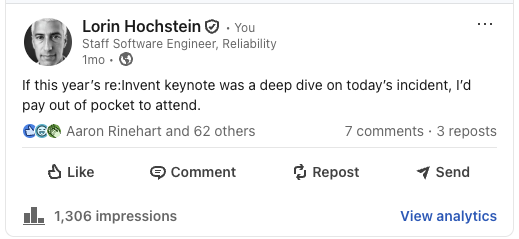
Last month, I made the following remark on LinkedIn about the incident that AWS experienced back in October.
To Amazon’s credit, there was a deep dive talk on the incident at re:Invent! OK, it wasn’t the keynote, but I’m still thrilled that somebody from AWS gave that talk. Kudos to Amazon leadership for green-lighting a detailed talk on the failure mode, and to Craig Howard in particular for giving this talk.
In my opinion, this talk is the most insightful post-incident public artifact that AWS has ever produced, and I really hope they continue to have these sorts of talks after significant outages in the future. It’s a long talk, but it’s worth it. In particular, it goes into more detail about the failure mode than the original write-up.
Tech that improves reliability bit them in this case
Multiple enactor instances – to protect against individual enactor instances failing
Locking mechanism – to make it easier for engineers to reason about the system behavior
Cleanup mechanism – to protect against saturating Route 53 by using up all of the records
Transactional mechanism – to protect against the system getting into a bad state after a partial failure (this is “all succeeds or none succeeds”)
Rollback mechanism – to be able to recover quickly if a bad plan is deployed
These all sound like good design decisions to me! But in this case, they contributed to an incident, because of an unanticipated interaction with a race condition. Note that many of these are anticipating specific types of failures, but we can never imagine all types of failures, and the ones that we couldn’t imagine are the ones that bite us.
Things that made the incident hard
This talk not only discusses the failure itself, but also the incident response, and what made the incident response more difficult. This was my favorite part of the talk, and it’s the first time I can remember anybody from Amazon talking about the details of incident response like this.
Some of the issues that issues that Howard brought up:
They used UUIDs as identifiers for plans, which was difficult for the human operators to work with as compared to more human-readable identifiers
There were so many alerts firing that it took them fifteen minutes to look through all of them and find the one that told them what the underlying issue is
the logs that were outputted did not make it easy to identify the sequence of events that led to the incidents.
He noted that this illustrates how the “let’s add an alert” approach to dealing with previous incidents can actually hurt you, and that you should think about what will happen in a large future incident, rather than simply reacting to the last one.
Formal modeling and drift
This incident was triggered by a race condition, and race conditions are generally very difficult to identify in development without formal modeling. They had not initialized modeling this aspect of DynamoDB beforehand. When they did build a formal model (using TLA+) after the incident, they discovered that the original design didn’t have this race condition, but later incremental changes to the system did introduce it. This means that, at design time, if they had formally modeled the system, they wouldn’t have caught it then either, because it wasn’t there at design time.
Interestingly, they were able to use AI (Amazon Q, of course) to check correspondence between the model and the code. This gives me some hope that AI might make it a lot easier to keep models and implementation in sync over time, which would increase the value of maintaining these models.
Listening to this talk, there were elements of it that gestured in the direction of resilience engineering, which is why I enjoyed it so much. I already wrote about how Howard called out elements that made the incident harder. He also talked about how post-incident analysis can take significant time, and it’s a very different type of work than the heat-of-the-moment diagnostic work. In addition, there were some good discussion in the talk about tradeoffs. For example, he talked about caching tradeoffs in the context of negative DNS caching and how that behavior exacerbated this particular incident. He also spoke about how there are broader lessons that others can learn from this incident, even though you will never experience the specific race condition that they did. These are the kinds of topics that the resilience in software community has been going on about for years now. Hopefully, Amazon will get there.
And while I was happy that this talk spent time on the work of incident response, I wish it had gone farther. Despite the recognition earlier in the talk about how incident response was made more difficult by technical decisions, in the lessons learned section at the end, there was no discussion about “how do we design our system to make it easier for responders to diagnose and mitigate when the next big incident happens?”.
Finally, I still grit my teeth whenever I hear the Amazonian term for their post-incident review process: Correction of Error.
I was at QCon SF during the recent Cloudflare outage (I was hosting the Stories Behind the Incidents track), so I hadn’t had a real chance to sit down and do a proper read-through of their public writeup and capture my thoughts until now. As always, I recommend you read through the writeup first before you read my take.
All quotes are from the writeup unless indicated otherwise.
Hello saturation my old friend
The software had a limit on the size of the feature file that was below its doubled size. That caused the software to fail.
One thing I hope readers take away from this blog post is the complex systems failure mode pattern that resilience engineering researchers call saturation. Every complex system out there has limits, no matter how robust that system is. And the systems we deal with have many, many different kinds of limits, some of which you might only learn about once you’ve breached that limit. How well a system is able to perform as it approaches one of its limits is what resilience engineering is all about.
Each module running on our proxy service has a number of limits in place to avoid unbounded memory consumption and to preallocate memory as a performance optimization. In this specific instance, the Bot Management system has a limit on the number of machine learning features that can be used at runtime. Currently that limit is set to 200, well above our current use of ~60 features.
In this particular case, the limit was set explicitly.
thread fl2_worker_thread panicked: called Result::unwrap() on an Err value
As sparse as the panic message is, it does explicitly tell you that the problematic call site was an unwrap call. And this is one of the reasons I’m a fan of explicit limits over implicit limits: you tend to get better error messages than when breaching an implicit limit (e.g., of your language runtime, the operating system, the hardware).
A subsystem designed to protect surprisingly inflicts harm
Identify and mitigate automated traffic to protect your domain from bad bots. – Cloudflare Docs
The problematic behavior was in the Cloudflare Bot Management system. Specifically, it was in the bot scoring functionality, which estimates the likelihood that a request came from a bot rather than a human.
This is a system that is designed to help protect their customer from malicious bots, and yet it ended up hurting their customers in this case rather than helping them.
As I’ve mentioned previously, once your system achieves a certain level of reliability, it’s the protective subsystems that end up being things that bite you! These subsystems are a net positive, they help much more than they hurt. But they also add complexity, and complexity introduces new, confusing failure modes into the system.
The Cloudflare case is a more interesting one than the typical instances of this behavior I’ve seen, because Cloudflare’s whole business model is to offer different kinds of protection, as products for their customers. It’s protection-as-a-service, not an internal system for self-protection. But even though their customers are purchasing this from a vendor rather than building it in-house, it’s still an auxiliary system intended to improve reliability and security.
Confusion in the moment
What impressed me the most about this writeup is that they documented some aspects of what it was like responding to this incident: what they were seeing, and how they tried to made sense of it.
In the internal incident chat room, we were concerned that this might be the continuation of the recent spate of high volume AisuruDDoS attacks:
Man, if I had a nickel every time I saw someone Slack “Is it DDOS?” in response to a surprising surge of errors returned by the system, I could probably retire at this point.
The spike, and subsequent fluctuations, show our system failing due to loading the incorrect feature file. What’s notable is that our system would then recover for a period. This was very unusual behavior for an internal error.
We humans are excellent at recognizing patterns based on our experience, and that generally serves us well during incidents. Someone who is really good at operations can frequently diagnose the problem very quickly just by, say, the shape of a particular graph on a dashboard, or by seeing a specific symptom and recalling similar failures that happened recently.
However, sometimes we encounter a failure mode that we haven’t seen before, which means that we don’t recognize the signals. Or we might have seen a cluster of problems recently that followed a certain pattern, and assume that the latest one looks like the last one. And these are the hard ones.
This fluctuation made it unclear what was happening as the entire system would recover and then fail again as sometimes good, sometimes bad configuration files were distributed to our network. Initially, this led us to believe this might be caused by an attack.
This incident was one of those hard ones: the symptoms were confusing. The “problem went away, then came back, then went away again, then came back again” type of unstable incident behavior is generally much harder to diagnose than one where the symptoms are stable.
Throwing us off and making us believe this might have been an attack was another apparent symptom we observed: Cloudflare’s status page went down. The status page is hosted completely off Cloudflare’s infrastructure with no dependencies on Cloudflare. While it turned out to be a coincidence, it led some of the team diagnosing the issue to believe that an attacker may be targeting both our systems as well as our status page.
Here they got bit by a co-incident, an unrelated failure of their status page that led them to believe (reasonably!) that the problem must have been external.
I’m still curious as to what happened with their status page. The error message they were getting mentions CloudFront, so I assume they were hosting their status page on AWS. But their writeup doesn’t go into any additional detail on what the status page failure mode was.
But the general takeaway here is that even the most experienced operators are going to take longer to deal with a complex, novel failure mode, precisely because it is complex and novel! As the resilience engineering folks say, prepare to be surprised! (Because I promise, it’s going to happen).
A plea: assume local rationality
The writeup included a screenshot of the code that had an unhandled error. Unfortunately, there’s nothing in the writeup that tells us what the programmer was thinking when they wrote that code.
In the absence of any additional information, a natural human reaction is to just assume that the programmer was sloppy. But if you want to actually understand how these sorts of incidents actually happen, you have to fight this reaction.
People always make decisions that make sense to them in the moment, based on what they know and what constraints they are operating under. After all, if that wasn’t true, then they wouldn’t have made that decision. The only we can actually understand the conditions that enable incidents, we need to try as hard as we can to put ourselves into the shoes of the person who made that call, to understand what their frame of mind was at the moment.
If we don’t do that, we risk the problem of distancing through differencing. We say, “oh, those devs were bozos, I would never have made that kind of mistake”. This is a great way to limit how much you can learn from an incident.
Detailed public writeups as evidence of good engineering
The writeup produced by Cloudflare (signed by the CEO, no less!) was impressively detailed. It even includes a screenshot of a snippet of code that contributed to the incident! I can’t recall ever reading another public writeup with that level of detail.
Companies generally err on the side of saying less rather than more. After all, if you provide more detail, you open yourself up to criticism that the failure was due to poor engineering. The fewer details you provide, the fewer things people can call you out on. It’s not hard to find people online criticizing Cloudflare online using the details they provided as the basis for their criticism.
Now, I think it would advance our industry if people held the opposite view: the more details that are provided an incident writeup, the higher esteem we should hold that organization. I respect Cloudflare is an engineering organization a lot more precisely because they are willing to provide these sorts of details. I don’t want to hear what Cloudflare should have done from people who weren’t there, I want to hear us hold other companies up to Cloudflare’s standard for describing the details of a failure mode and the inherently confusing nature of incident response.