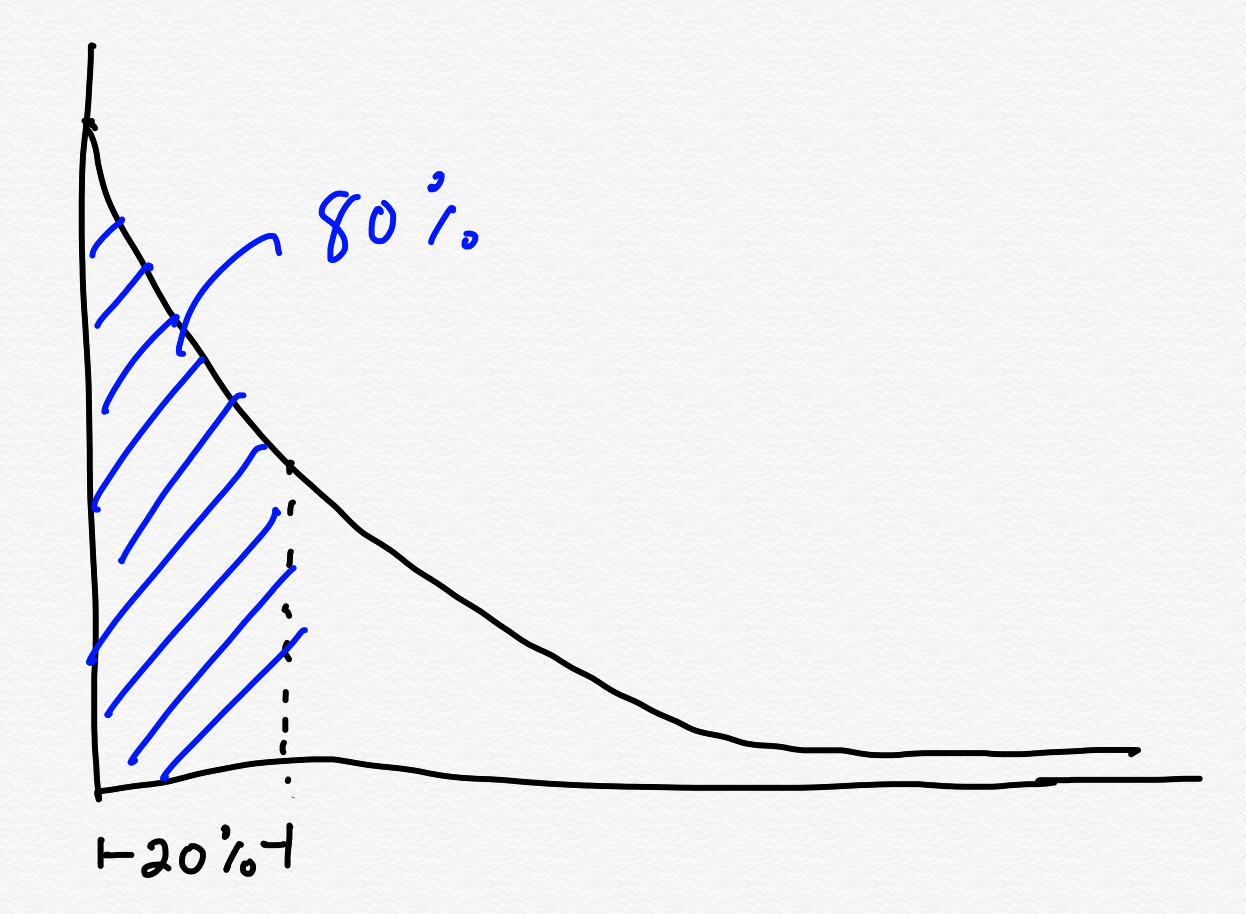
You’re probably familiar with the 80-20 rule: when 80% of the X stems from only 20% of the Y. For example, 80% of your revenue comes from only 20% of your customer, or 80% of the logs that you’re storing are generated from only 20% of the services. Talk to anybody who is looking to reduce cloud costs in their organization, and chances are they’re attacking the problem by looking for the 20% of services that are generating 80% of the costs, rather than trying to reduce cloud usage uniformly across all services.
Not all phenomena follow the 80-20 rule, but it’s common enough in the systems we encounter that it’s a good rule of thumb. The technical term for it is the Pareto principle, and distributions that exhibit this 80-20 phenomena are an example of Pareto distributions, also known as power law distributions.
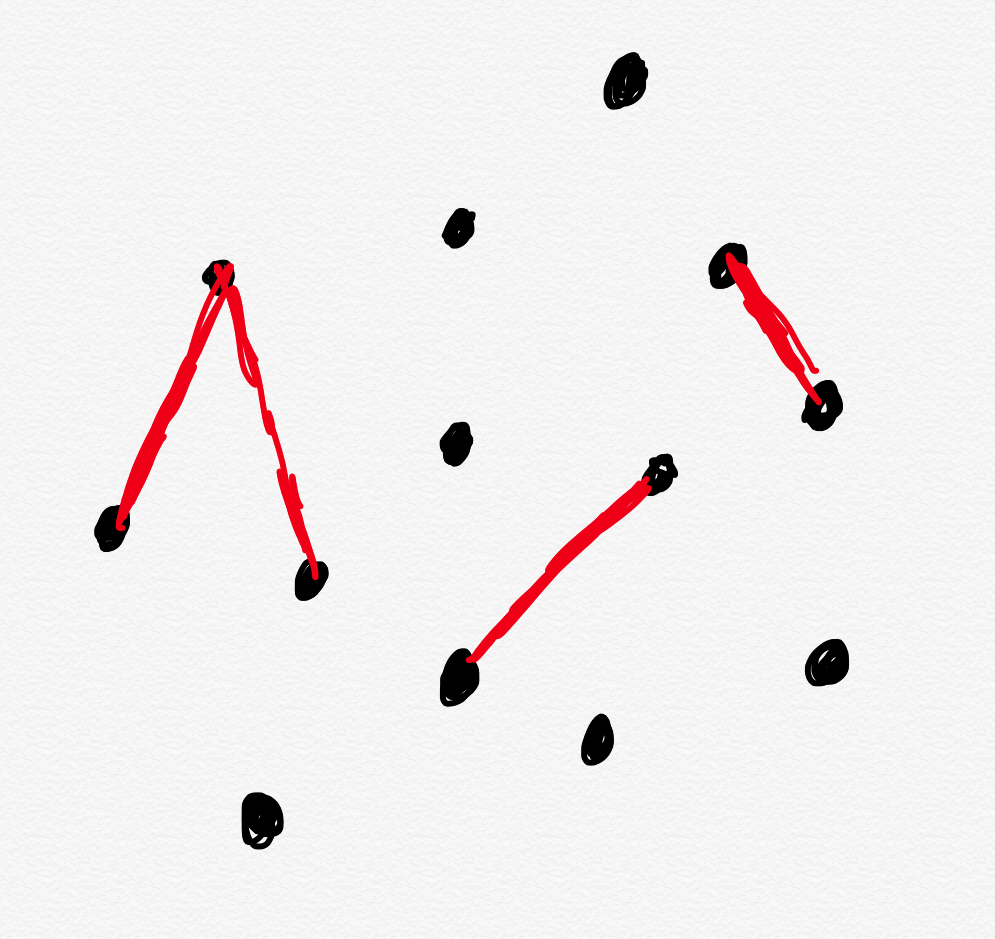
A common implicit assumption is that availability problems are Pareto-distributed. If you look at incidents and keep track of their causes, you should be able to identify a small number of causes that lead to the majority of the incidents. Because of this, we should attribute a cause to an incident, and then look to see which causes most often contribute to incident in order to identify interventions that will have the largest impact: those 20% of improvements that should yield 80% improvements. If you believe in the RCA (root cause analysis) model of incidents, that’s a reasonable assumption to make: identify the root cause of each incident, track these across incidents, and then invest in projects that attack the most expensive root causes.
If we can identify the problematic red dots, we can achieve significant improvements
But if you’re a frequent reader of this blog, you know there’s an alternative model of how incidents come to be. I’m fond of referring to the alternative as the LFI (learning from incidents) model. However, in the safety science research community this alternative model is more commonly associated with terms such as the New View, the New Look, or Safety-II.
The contrast of the LFI model with the RCA model is captured well in Richard Cook’s famous monograph, How Complex Systems Fail:
Post-accident attribution accident to a ‘root cause’ is fundamentally wrong.
Because overt failure requires multiple faults, there is no isolated ‘cause’ of an accident. There are multiple contributors to accidents. Each of these is necessary insufficient in itself to create an accident. Only jointly are these causes sufficient to create an accident. Indeed, it is the linking of these causes together that creates the circumstances required for the accident.
In this model, incidents don’t happen because of a single cause: rather, it’s through the interaction of multiple contributors.
If incidents stem from problematic interactions rather than problematic components, then focusing on components will lead us astray
Under an incident model where incidents are a result of interactions, we wouldn’t expect there to be a Pareto distribution of causes. This means that if we look at a distribution of incidents by contributor (or cause, or component), we’re unlikely to see any one of these stand out as being the source of a large number of incidents. Instead, by looking at the components instead of the interactions, we’re unlikely to see much of any pattern at all.
Turning back to How Complex Systems Fail again:
Complex systems are heavily and successfully defended against failure.
The high consequences of failure lead over time to the construction of multiple layers of defense against failure. These defenses include obvious technical components (e.g. backup systems, ‘safety’ features of equipment) and human components (e.g. training, knowledge) but also a variety of organizational, institutional, and regulatory defenses (e.g. policies and procedures, certification, work rules, team training). The effect of these measures is to provide a series of shields that normally divert operations away from accidents.
All of these explicit and implicit components of the system work together to keep things up and running. You can think of this as a process that most of the time generates safety (or availability), but sometimes doesn’t. You can think of these failure cases as a sort of error or residual term, they’re the leftover, the weird cases at the edges of our system. I think treating incidents as an error term is a useful metaphor because we don’t fall into the trap of thinking about error terms as looking like Pareto distributions.
This doesn’t mean that there aren’t patterns of failure in our incidents: there absolutely are. But it means that the patterns we need to look for aren’t going to visible if we don’t ask the right questions. It’s the difference between asking “which services were involved?” and “what were the goal conflicts that the engineers were facing?“
Here are a few anecdotes about safety from the past few years.
In 2020, the world was struck by the COVID-19 pandemic. The U.S. response was… not great. Earlier in 2019, before the pandemic struck, the Johns Hopkins Center for Health Security released a pandemic preparedness assessment that ranked 195 countries on how well prepared they were to deal with a pandemic. The U.S. was ranked number one: it was identified as the most well-prepared country on earth.
With its pandemic playbook, “The U.S. was very well prepared,” said Eric Toner, senior scholar at the Johns Hopkins Center for Health Security. “What happened is that we didn’t do what we said we’d do. That’s where everything fell apart. We ended up being the best prepared and having one of the worst outcomes.”
On October 29, 2018, Lion Air Flight 610 crashed 13 minutes after takeoff, killing everyone on board. This plane was a Boeing 737 MAX, and a second 737 MAX had a fatal crash a few months later. Seven days prior to the Lion Air crash, the National Safety Council presented the Boeing Company with the Robert W. Campbell Award for leadership in safety:
“The Boeing Company is a leader in one of those most safety-centric industries in the world,” said Deborah A.P. Hersman, president and CEO of the National Safety Council. “Its innovative approaches to EHS excellence make it an ideal recipient of our most prestigious safety award. We are proud to honor them, and we appreciate their commitment to making our world safer.”
On April 20th, 2010, an explosion on the Deepwater Horizon offshore drilling rig killed eleven workers and led to the largest marine oil spill in the history of the industry. The year before, the U.S. Minerals Management Service issued its SAFE award to Deepwater Horizon:
MMS issued its SAFE award to Transocean for its performance in 2008, crediting the company’s “outstanding drilling operations” and a “perfect performance period.” Transocean spokesman Guy Cantwell told ABC News the awards recognized a spotless record during repeated MMS inspections, and should be taken as evidence of the company’s longstanding commitment to safety.
When things are going badly, everybody in the org knows it. If you go into an organization where high-severity incidents are happening on a regular basis, where everyone is constantly in firefighting mode, then you don’t need metrics to tell you how bad things are: it’s obvious to everyone, up and down the chain. The problems are all-too-visible. Everybody can feel them viscerally.
It’s when things aren’t always on fire that it can be very difficult to assess whether we need to allocate additional resources to reduce risk. As the examples above show, absence of incidents do not indicate an absence of risk. In fact, these quiet times can lull is into a sense of complacency, leading us to think that we’re in a good spot, when the truth is that there’s a significant risk that’s hidden beneath the surface.
Personally, I don’t believe it’s even possible to say with confidence that “everything is ok with right now”. As the cases above demonstrate, when things are quiet, there’s a limit to how well we can actually assess the risk based on the kinds of data we traditionally collect.
So, should you be worried about your system? If you find yourself constantly in firefighting mode, then, yes, you should be worried. And if things are running smoothly, and the availability metrics are all green? Then, also yes, you should be worried. You should always be worried. The next major incident is always just around the corner, no matter how high your ranking is, or how many awards you get.
Imagine you wanted to understand how to get better at playing the lottery. You strike upon a research approach: study previous lottery winners! You collect a list of winners, look them up, interview them about how they go about choosing their numbers, collate this data, identify patterns, and use these to define strategies for picking numbers.
The problem with this approach is that it doesn’t tell you anything about how effective these strategies actually are. To really know how well these strategies work, you’d have to look at the entire population of people who employed them. For example, say that you find that most lottery winners use their birthdays to generate winning numbers. It may turn out, that for every winning ticket that has the ticket holder’s birthday, there are 20 million losing tickets that also have the ticket holder’s birthday. To understand a strategy’s effectiveness, you can’t just look at the winning outcomes: you have to look at the losing outcomes as well.The technical term for this type of analytic error is selecting on the dependent variable.
Here’s another example of this error in reasoning: according to the NHTSA, 32% of all traffic crash fatalities in the United States involve drunk drivers. That means that 68% of all traffic crash fatalities involve sober drivers. If you only look at scenarios that involve crash fatalities, it looks like being sober is twice as dangerous as being drunk! It’s a case of only looking at the dependent variable: crash fatalities. If we were to look at all driving scenarios, we’d see that there are a lot more sober drivers than drunk drivers, and that any given sober driver is less likely to get into a crash fatality than a given drunk driver. Being sober is safer, even though sober drivers appear more often in fatal accidents than drunk drivers.
Now, imagine an organization that holds a weekly lottery. But it’s a bizarro-world type of lottery: if someone wins, then they receive a bad outcome instead of a good one. And the bad outcome doesn’t just impact the “winner” (although they are impacted the most), it has negative consequences for the entire organization. Nobody would willingly participate in such a lottery, but everyone in the organization is required to: you can’t opt out. Every week, you have to buy a ticket, and hope the numbers you picked don’t come up.
The organization wants to avoid these negative outcomes, and so they try to identify patterns in how previous lottery “winners” picked their numbers, so that they can reduce the likelihood of future lottery wins by warning people against using these dangerous number-picking strategies.
At this point, the comparison to how we treat incidents should be obvious. If we only examine people’s actions in the wake of an incident, and not when things go well, then we fall into the trap of selecting on the dependent variable.
The real-world case is even worse than the lottery case: lotteries really are random, but that way that people do their work isn’t; rather, it’s adaptive. People do work in specific ways because they have found that it’s an effective way to get stuff done given that the constraints that they are under. The only way to really understand why people work the way they do is to understand how those adaptations usually succeed. Unless you’re really looking for it, you aren’t going to be able to learn how people develop successful adaptations if you only ever examine the adaptations when they fail. Otherwise, you’re just doing the moral equivalent of asking what lottery winners have in common.
Cliff L. Biffle blogged a great write-up of a debugging odyssey at Oxide with the title Who killed the network switch? Here’s the bit that jumped out at me:
At the time that code was written, it was correct, but it embodied the assumption that any loaned memory would fit into one region.
That assumption became obsolete the moment that Matt implemented task packing, but we didn’t notice. This code, which was still simple and easy to read, was now also wrong.
This type of assumption is an example of an invariant, a property of the system that is supposed to be guaranteed to not change over time. Invariants play an important role in formal methods (for example, see the section Writing an invariant in Hillel Wayne’s Learn TLA+ site).
Now, consider the following:
Our systems change over time. In particular, we will always make modifications to support new functionality that we could not have foreseen earlier in the lifecycle of the system.
Our code often rests on a number of invariants, properties that are currently true of our system and that we assume will always be true.
These invariants are implicit: the assumptions themselves are not explicitly represented in the source code. That means there’s no easy way to, say, mechanically extract them via static analysis.
A change can happen that violates an assumed invariant can be arbitrary far away from code that depends on the invariant to function properly.
What this means is that these kinds of failure modes are inevitable. If you’ve been in this business long enough, you’ve almost certainly run into an incident where one of the contributors was an implicit invariant that was violated by a new change. If you’re system lives long enough, it’s going to change. And one of those changes is eventually going to invalidate an assumption that somebody made long ago, which was a reasonable assumption to make at the time.
Implicit invariants are, by definition, impossible to enforce explicitly. They are time bombs. And they are everywhere.
The Toyota-themed book I’m currently reading is Mike Rother’s Toyota Kata: Managing People for Improvement, Adaptiveness and Superior Results. Rother often uses the phrase “go and see”, as in “go to the shop floor and observe how the work is actually being done”. I’ve often heard lean advocates use a similar phrase: go the gemba, although Rother himself doesn’t use it in his book. There’s a good overview at the Lean Enterprise Institute’s web page for gemba:
Gemba (現場) is the Japanese term for “actual place,” often used for the shop floor or any place where value-creating work actually occurs. It is also spelled genba. Lean Thinkers use it to mean the place where value is created. Japanese companies often supplement gemba with the related term “genchi gembutsu” — essentially “go and see” — to stress the importance of empiricism.
The idea of focusing on understanding work-as-done is a good one. Unfortunately, in software development in particular, and knowledge work in general, the place that the work gets done is distributed: it happens wherever the employees are sitting in front of their computers. There’s no single place, no shop floor, no gemba that you can go to in order to go and see the work being done.
Now, you can observe the effects of the work, whether it’s artifacts generated (pull requests, docs), or communication (slack messages, emails). And you can talk to people about the work that they do. But, it’s not like going to the shop floor. There is no shop floor.
And it’s precisely because we can’t go to the gemba that incident analysis can bring so much value, because it allows you to essentially conduct a miniature research project to try to achieve the same goal. You get granted some time (a scarce resource!) to reconstruct what happened, by talking to people and looking at those work products generated over time. If we’re good at this, and we’re lucky, we can get a window into how the real work happens.
In the wake of an incident, we want to answer the questions “What happened?” and, afterwards, “What should we do differently going forward?” Invariably, this leads to people trying to answer the question “what went wrong?”, or, even more specifically, the two questions:
What did we do wrong here?
What didn’t we do that we should have?
There’s an implicit assumption behind these questions that because there was a bad outcome, that there must have been a bad action (or an absence of a good action) that led to that outcome. It’s such a natural conclusion to reach that I’ve only ever seen it questioned by people who have been exposed to concepts from resilience engineering.
In some sense, this belief in bad outcomes from bad actions is like Aristole’s claim that heavier objects fall faster than lighter ones. Intuitively, it seems obvious, but our intuitions lead us astray. But in another sense, it’s quite different, because it’s not something we can test by running an experiment. Instead, the idea that systems fail because somebody did something wrong (or didn’t do something right) is more like a lens or a frame, it’s a perspective, a way of making sense of the incident. It’s like how the fields of economics, psychology, and sociology act as different lenses for making sense of the world: a sociological explanation of a phenomenon (say, the First World War) will be different from an economic explanation, and we will get different insights from the different lenses.
An alternative lens for making sense of an incident is to ask the question “how did this incident happen, assuming that everybody did everything right?” In other words, assume that everybody whose actions contributed to the incident made the best possible decision based on the information they had, and the constraints and incentives that were imposed upon them.
Looking at the incident from this perspective will yield will very different kinds of insights, because it will generate different types of questions, such as:
What information did people know in the moment?
What were the constraints that people were operating under?
Now, I personally believe that the second perspective is strictly superior to the first, but I acknowledge that this is a judgment based on personal experience. However, even if you think the first perspective also has merit, if you truly want to maximize the amount of insight you get from a post-incident analysis, then I encourage you to try to the second perspective as well. Make the claim “Let’s assume everybody did everything right. How could this incident still have happened?” I guarantee, you’ll learn something new about your system that you didn’t know before.
There are two general approaches to decision-making. One way is to make a judgment call. Informally, you could call this “trusting your gut”. Formally, you could describe this as a subjective, implicit process. The other way is to use an explicit approach that relies on objective, quantitative data, for example, doing a return-on-investment (ROI) calculation on a proposed project to decide whether to undertake the project. We use the term rigorous to describe these type of approaches, and we generally regard them as superior.
Here, Porter argues that quantitative, rigorous decision-making in a field is not a sign of its maturity, but rather its political weakness. In fields where technical professionals enjoy a significant amount of trust, these professionals do decision-making using personal judgment. While professionals will use quantitative data as input, their decisions are ultimately based on their own subjective impressions. (For example, see Julie Gainsburg’s notion of skeptical reverence in The Mathematical Disposition of Structural Engineers). In Porter’s account, we witnessed an increase of rigorous decision-making approaches in the twentieth century because of a lack of trust in certain professional fields, not because the quantitative approaches yielded better results.
It’s only in fields where the public does not grant deference to professionals that they are compelled to use explicit, objective processes to make the decisions. They are forced to show their work in a public way because they aren’t trusted. In some cases, a weak field adopts rigor to strengthen itself in the eyes of the public, such as experimental psychology’s adoption of experimental rigor (in particular, ESP research). Most of the case studies in the book come from areas where a field was compelled to adopt objective approaches because there was explicit political pressure and the field did not have sufficient power to resist.
In some cases, professionals did have the political clout to push back. An early chapter of the book discusses a problem that the British parliament wrestled with in the late nineteenth century: unreliable insurance companies that would happily collect premiums but then would eventually fail and would hence be unable to pay out when their customers submitted claims. A parliamentary committee formed and heard testimony from actuaries about how the government could determine whether an insurance company was sound. The experienced actuaries from reputable companies argued that it was not possible to define an objective procedure for assessing a company. They insisted that “precision is not attainable through actuarial methods. A sound company depends on judgment and discretion.” They were concerned that a mechanical, rule-based approach wouldn’t work:
Uniform rules of calculation, imposed by the state, might yield “uniform errors.” Charles Ansell, testifying before another select committee a decade earlier, argued similarly, then expressed his fear that the office of government actuary would fall to “some gentlemen of high mathematical talents, recently removed from one of our Universities, but without any experience whatever, though of great mathematical reputation.” This “would not qualify him in any way whatever for expressing a sound opinion on a practical point like that of the premiums in a life assurance.”
Trust in Numbers, pp108-109
Porter tells a similar story about American accountants. To stave off having standardized rules imposed on them, the American Institute of Accountants defined standards for its members, but these were controversial. One accountant, Walter Wilcox, argued in 1941 that “Cost is not a simple fact, but is a very elusive concept… Like other aspects of accounting, costs give a false impression of accuracy.” Similarly, when it came to government-funded projects, the political pressure was simply too strong to defer to government civil engineers, such as the French civil engineers who had to help decide which rail projects should be funded, or the U.S. Army Corps of Engineers who had to help make similar decisions about waterway projects such as dams and reservoirs. In the U.S., they settled on a cost-benefit analysis process, where the return on investment had to exceed 1.0 in order to justify a project. But, unsurprisingly, there were conflicts over how benefits were quantified, as well as over how to classify costs. While the output may have been a number, and the process was ostensibly objective, because it needed to be, ultimately these numbers were negotiable and assessments changed as a function of political factors.
In education, teachers were opposed to standardized testing, but did not have the power to overcome it. On the other hands, doctors were able to retain the use of their personal judgment for diagnosing patients. However, the regulators had sufficient power that they were able to enforce the use of objective measures for evaluating drugs, and hence were able to oversee some aspect of medical practice.
This tug of war between rigorous, mechanical objectivity and élite professional autonomy continues to this day. Professionals say “This requires private knowledge; trust us”. Sometimes, the public says “We don’t trust you anymore. Make the knowledge public!”, and the professionals have no choice but to relent. On the subject of whether we are actually better off when we trade away judgment for rigor, Porter is skeptical. I agree.
I’ve just started reading Trust in Numbers: The Pursuit of Objectivity in Science and Public Life by the historian of science Theodore Porter, and so far it’s fantastic. The first chapter discusses how, in the days before the metric system, even units of measure were negotiable. Porter gives two examples. One example comes from Poland, where the size of a unit of land would sometimes vary based on the quality of the soil, to make adjustments to equalize the amount of productive land, rather than simply the area of the land.
The other example Porter gives is about the reference vessel that towns would use to as their local definition of a bushel. You might think that defining a specific vessel as the bushel would give a fixed definition, but there was still flexibility. The amount of say, grain, or oat, that could be poured into the vessel could vary, depending on how it was poured (e.g., whether the material was “flattened” or “heaped”, the height it was poured from). This allowed people to make adjustments on the actual volume that constituted a bushel based on factors such as quality.
We humans have to build systems in order to scale up certain kinds of work: we couldn’t have large-scale organizations like governments and corporations without the technologies of bureaucracies and other forms of standardization. This is the sort of thing that James Scott calls legibility. But these formal systems demand fixed rules, which can never fully accommodate the messiness that comes with operating in the real world. And so, the people at the sharp end, the folks on the ground who are doing the actual work of making the system go, have to deal with this messiness that the system’s designers did not account for.
For these people to be able to do their work, there needs to be some give in the system. The people need to be able to exercise judgment, some ability to negotiate the boundaries of the rules of the system. Every human system is like this: the actors must have some amount of flexibility, otherwise the rules of the system will prevent people from being able to achieve the goals of the system. In other words, negotiability in a system is non-negotiable.
Reporting an outcome’s occurrence consistently increases its perceived likelihood and alters the judged relevance of data describing the situation preceding the event.
In my last blog post, I wrote about how computer scientists use execution histories to reason about consistency properties of distributed data structures. One class of consistency properties is known as causal consistency. In my post, I used an example that shows a violation of causal consistency, a property called writes follows reads.
Here’s the example I used, with timestamps added (note: this is a single-process example, there’s no multi-process concurrency here).
Now, imagine this conversation between two engineers who are discussing this queue execution history.
A: “There’s something wrong with the queue behavior.”
B: “What do you mean?”
A: “Well, the queue was clearly empty at t=0, and then it had a value at t=1, even though there was no write.”
B: “Yes, there was, at t=2. That write is the reason why the queue read [“A: Hello”] at t=1.”
We would not accept that answer given by B, that the read seen at t=1 was due to the write that happened at t=2. The reason we would reject it is that this violates are notion of causality: the current output of a system cannot depend on its future inputs!
It’s not that we are opposed to the idea of causal systems in principle. We’d love to be able to build systems that can see into the future! It’s that such systems are not physically realizable, even though we can build mathematical models of their behavior. If you build a system whose execution histories violate causal consistency, you will be admonished by distributed systems engineers: something has gone wrong somewhere, because that behavior should not be possible. (In practice, what’s happened is that events have gotten reordered, rather than an engineer having accidentally built a system that can see into the future).
In the wake of an incident, we often experience the exact opposite problem: being admonished for failing to be part of a non-causal system. What happens is that someone will make an observation that the failure mode was actually foreseeable, and that engineers erred by not being able to anticipate it. Invariably, the phrase “should have known” will be used to describe this lack of foresight.
The problem is, this type of observation is only possible with knowledge of how things actually turned out. They believe that the outcome was foreseeable because they know that it happened. When you hear someone say “they should have known that…”, what that person is in fact saying is “the system’s behavior in the past failed to take into account future events”.
This sort of observation, while absurd, is seductive. And it happens often enough that researchers have a name for it: hindsight bias, or alternately, creeping determinism. The paper by the engineering researcher Baruch Fischhoff quoted at the top of this post documents a controlled experiment that demonstrates the phenomenon. However, you don’t need to look at the research literature to see this effect. Sadly, it’s all around us.
So, whenever you hear “X should have”, that should raise a red flag, because it’s an implicit claim that it’s possible to build non-causal systems. The distributed systems folks are right to insist on causal consistency. To berate someone for not building an impossible system is pure folly.
“Thanks! I’m excited to be here. This is my first tech job, even if it is just an internship.”
“We’re going to start you off with some automated testing. You’re familiar with queues, right?”
“The data structure? Sure thing. First in, first out.”
“Great! We need some help validating that our queueing module is always working properly. We have a bunch of test scenarios written, and we want need to someone to check that the observed behavior of the queue is correct.”
“So, for input, do I get something like a history of interactions with the queue? Like this?”
q.add("A") -> OK
q.add("B") -> OK
q.pop() -> "A"
q.add("C") -> OK
q.pop() -> "B"
q.pop() -> "C"
“Exactly! That’s a nice example of a correct history for a queue. Can you write a program that takes a history like that as input and returns true if it’s a valid history?”
“Sure thing.”
“Excellent. We’ll also need your help generating new test scenarios.”
A few days later
“I think I found a scenario where the queue is behaving incorrectly when it’s called by a multithreaded application. I got a behavior that looks like this:”
q.add("A") -> OK
q.add("B") -> OK
q.add("C") -> OK
q.pop() -> "A"
q.pop() -> "C"
q.pop() -> "B"
“Hmmm. That’s definitely incorrect behavior. Can you show me the code you used to generate the behavior?”
“Sure thing. I add the elements to the queue in one thread, and then I spawn a bunch of new threads and dequeue in the new threads. I’m using the Python bindings to call the queue. My program looks like this.”
from bigco import Queue from threading import Thread
“Well, that’s certainly not the order I expect the output to be printed in, but how do you know the problem is that the queue is actually behaving correctly? It might be that the values were dequeued in the correct order, but because of the way the threads are scheduled, the print statements were simply executed in a different order than you expect.”
“Hmmm. I guess you’re right: just looking at the order of the printed output doesn’t give me enough information to tell if the queue is behaving correctly or not. Let me try printing out the thread ids and the timestamps.”
[id0] [t=1] before pop
[id0] [t=2] after pop
[id0] [t=3] output: A
[id1] [t=4] before pop
[id2] [t=5] before pop
[id2] [t=6] after pop
[id2] [t=7] output: C
[id1] [t=8] after pop
[id1] [t=9] output: B
“Oh, I see what happened! The operations of thread 1 and thread 2 were interleaved! I didn’t think about what might happen in that case. It must have been something like this:”
“Well, it looks like the behavior is still correct, the items got dequeued in the expected order, it’s just that they got printed out in a different order.”
The next day
“After thinking through some more multithreaded scenarios, I ran into a weird situation that I didn’t expect. It’s possible that the “pop” operations overlap in time across the two different threads. For example, “pop” might start on thread 1, and then in the middle of the pop operation, the operating system schedules thread 2, and it starts in the middle.”
[id0]             [id1]                  [id2]
q.pop(): start
q.pop(): end
print("A")
                  q.pop(): start
                  |                      q.pop(): start
                  q.pop(): end           |
                                         q.pop(): end
                                         print("C")
                  print("B")
“Let’s think about this. If id1 and id2 overlap in time like this, what do you think the correct output should be? ‘ABC’ or ‘ACB’?”
“I have no idea. I guess we can’t say anything!”
“So, if the output was ‘ABB’, you’d consider that valid?”
“Wait, no… It can’t be anything. It seems like either ‘ABC’ or ‘ACB’ should be valid, but not “ABB”.
“How about ‘BCA’? Would that be valid here?”
“No, I don’t think so. There’s no overlap between the first pop operation and the others, so it feels like the pop in id0 should return “A”.
“Right, that makes sense. So, in a concurrent world, we have potentially overlapping operations, and that program you wrote that checks queue behaviors doesn’t have any notion of overlap in it. So we need to be able to translate these potentially overlapping histories into the kind of sequential history your program can handle. Based on this conversation, we can use two rules:
1. If two operations don’t overlap (like the pop in id0 and the pop in id1) in time, then we use the time ordering (id0 happened before id1).
2. If two operations do overlap in time, then either ordering is valid.
“So, that means that when I check whether a multithreaded behavior is valid, I need to actually know the time overlap of the operations, and then generate multiple possible sequential behaviors, and check to see if the behavior that I witnesses corresponds to one of those?”
“Yes, exactly. This is a consistency model called linearizability. If our queue has linearizable consistency, that means that for any behavior you witness, you can define a linearization, an equivalent sequential behavior. Here’s an example.”
“The question is: can we generate a linearization based on the two rules above? We can! Because the “id1” and “id2” overlap, we can generate a linearization where the “id1″ operation happens first. One way to think about it is to identify a point in time between the start and end of the operation and pretend that’s when the operation really happens. I’ll mark these points in time with an ‘x’ in the diagram.
“We’re expanding our market. We’re building on our queue technology to build a distributed queue. We’re also providing a new operation: “get”. When you call “get” on a distributed queue, you get the entire contents of the queue, in queue order.”
“Oh, so a valid history would be something like this?”
“Exactly! One use case we’re targeting is using our queue for implementing online chat, so the contents of a queue might look like this:”
["Alice: How are you doing?",
 "Bob: I'm fine, Alice. How are you?",
 "Alice: I'm doing well, thank you."]
CAPd
“OK, I did some testing with the distributed queue. ran into a problem with the distributed queue. Look at this history, it’s definitely wrong. Note that the ids here are process ids, not thread ids, because we’re running on different machines.
“When process 1 called ‘get’, it didn’t see the “Alice: Hello” entry, and that operation completed before the ‘get’ started! This history isn’t linearizable!”
“You’re right, our distributed queue isn’t linearizable. Note that we could modify this history to make it linearizable if process 0’s add operation did not complete until after the get:
[id0]                         [id1]
q.add("Alice: Hello"): start

                              q.add("Bob: "Hi"): start
                              q.add(...) -> OK
                              q.get(): start
                              q.get()-> ["Bob: Hi"]
q.add(...) -> OK
“Now we can produce a valid linearization from the history”
“But look what we had to do: we had to delay the completion of that add operation. This is the lesson of the CAP theorem: if you want your distributed object to have linearizable consistency, then some operations might take an arbitrarily long time to complete. With our queue, we decided to prefer availability, so that all operations are guaranteed to complete within a certain period of time. Unfortunately, once we give up on linearizability, things can get pretty weird. Let’s see how many different types of weird things you can find.”
Monotonic reads
“Here’s a weird one. The ‘Hi’ message disappeared in the second read!”
“Yep, this violates a property called monotonic reads. Once process 0 has seen the effect of the add(“B: Hi”) operation, we expect that it will always see it in the future. This is an example of a session property. If the two gets happened on two different processes, this would not violate the monotonic reads property. For example, the following history doesn’t violate monotonic reads, even though the operations and ordering are the same. That’s because one of the gets is in process 0, and the other is in process 1, and the monotonic reads property only applies to reads within the same process.
“All right, let’s say we can guarantee monotonic reads. What other kinds of weirdness happen?”
Read your writes
[id0]
q.add("A: Hello")
q.get() -> []
“Read your writes is one of the more intuitive consistency properties. If a process writes data, and then does a read, it should be able to see the effective of the write. Here we did a write, but we didn’t see it.”
“Here’s a case where read-your-writes isn’t violated (in fact, we don’t do any reads after the write), but something very strange has happened. We saw the effect of our write before we actually did the write! This violates the writes follow reads property. This also called session causality, and you can see why: when it was violated, we saw the effect before the cause!”
Monotonic writes
[id0]                      [id1]
q.add("A: Hi there!")
q.add("A: How are you?")
                           q.get() -> ["A: How are you?"]
“Hey, process 1 saw the ‘How are you?’ but not the ‘Hi there!’, even though they both came from process 0.”
“Yep. It’s weird that process 1 saw the second write from process 0, but it didn’t see the first write. This violates the monotonic writes property. Note that if the two writes were from different processes, this would not violate the property. For example, this would be fine:
[id0]                      [id1]
q.add("A: Hi there!")
                           q.add("A: How are you?")
                           q.get() -> ["A: How are you?"]
“From process 1’s perspective, it looks like the history of the chat log changed! Somehow, ‘A: Hello’ snuck in before ‘B: Hi’, even though process 1 had already seen ‘B: Hi’.”
“Yes, this violates a property called consistent prefix. Note that this is different from monotonic reads, which is not violated in this case. (Sadly, the Jepsen consistency page doesn’t have an entry for consistent prefix).
Reasoning about correctness in a distributed world
One way to think about what it means for a data structure implementation to be correct is to:
Define what it means for a particular execution history to be correct
Check that every possible execution history for the implementation satisfies this correctness criteria.
Step 2 requires doing a proof, because in general there are too many possible execution histories for us to check exhaustively. But, even if we don’t actually go ahead and do the formal proof, it’s still useful to think through step 1: what it means for a particular execution history to be correct.
As we move from sequential data structures to concurrent (multithreaded) ones and then distributed ones, things get a bit more complicated.
Recall that for the concurrent case, in order to check that a particular execution history was correct, we had to see if we could come up with a linearization. We had to try and identify specific points in time when operations took effect to come up with a sequential version of the history that met our sequential correctness criteria.
In Principles of Eventual Consistency, Sebastian Burckhardt proposed a similar type of approach for validating the execution history of a distributed data structure. (This is the approach that Viotti & Vukolic extended. Kyle Kingsbury references Viotti and Vukolic on the Jepsen consistency models page that I’ve linked to several times here).
Execution histories as a set of events
To understand Burckhardt’s approach, we first have to understand how he models a distributed data structure execution history. He models an execution history as a set of events, where each event has associated with it:
The operation (including arguments), e.g.:
get()
add(“Hi”)
A return value, e.g.
[“Hi”, “Hello”]
OK
He also defines two relations on these events, returns-before and same-session.
Returns-before
The returns-before (rb) relation models time. If there are two events, e1, e2, and (e1,e2) is in rb, that means that the operation associated with e1 returned before the operation associated with e2 started.
Let’s take this example, where the two add operations overlap in time:
Note that neither (e1,e2) nor (e2,e1) is in rb, because the two operations overlap in time. Neither one happens before the other.
Same-session
The same-session (ss) relation models the grouping of operations into processes. In the example above, there are three sessions (id0, id1, id2), and the same-session relation looks like this: ss={(e1,e1),(e1,e4),(e4,e1),(e4,e4),(e2,e2),(e3,e3)}. (Note: in this case, there are only two operations that are in the same session, e1 and e4
This is what the graph looks like with the returns-before (rb) and same-session (ss) relationship shown.
Explaining executions with visibility and arbitration
Here’s the idea behind Burckhardt’s approach. He defines consistency properties in terms of the returns-before (rb) relation, the same-session (ss) relation, and two other binary relations called visibility (vis) and arbitration (ar).
For example, an execution history satisfies read my writes if: (rb ∩ ss) ⊆ vis
In this scheme, an execution history is correct if we can come up with visibility and arbitration relations for the execution such that:
All of the consistency properties we care about are satisfied by our visibility and arbitration relations.
Our visibility and arbitration relations don’t violate any of our intuitions about causality.
You can think of coming up with visibility and arbitration relations for a history as coming up with an explanation for how the history makes sense. It’s a generalization of the process we used for linearizability where we picked a specific point in time where the operation took effect.
(1) tells us that we have to pick the right vis and ar (i.e., we have to pick a good explanation). (2) tells us that we don’t have complete freedom in picking vis and ar (i.e., our explanations have to make intuitive sense to human beings).
You can think of the visibility relation as capturing which write operations were visible to a read, and the arbitration relation as capturing how the data structure should reconcile conflicting writes.
Specifying behavior based on visibility and arbitration
Unfortunately, in a distributed world, we can no longer use the sequential specification for determining correct behavior. In the sequential world, writes are always totally ordered, but in the distributed world, we might have to deal with two different writes that aren’t ordered in a meaningful way.
What’s a valid value for ???. Let’s assume we’ve been told that: vis={(e1,e3),(e2,e3)}. This means that both writes are visible to process 3.
Based on our idea of how this data structure should work, e3 should either be: [“A”,”B”] or [“B”,”A”]. But the visibility relationship doesn’t provide enough information to tell us which one of these it was. We need some additional information to determine what the behavior should be.
This is where the arbitration relation comes in. This relation is always a total ordering. (For example, if ar specifies an ordering of e1->e2->e3, then the relation would be {(e1,e2),(e1,e3),(e2,e3)}. ).
If we define the behavior of our distributed queue such that the writes should happen in arbitration order, and we set ar=e1->e2->e3, then e3 would have to be get()->[“A”,”B”].
The above history is valid, because we can do: vis={(e1,e3),(e2,e4),(e3,e4))}, ar=e1->e2->e3->e4. Note that even though (e2,e3) is in ar, e2 is not visible to e3, and an operation only has to reflect the visible writes.
Note that we can come up with valid vis and ar relations for this history:
vis = {(e3,e2)}
ar = e1->e3->e2
But, despite the fact that we can come up with an explanation for this history, it doesn’t make sense to us, because e3 happened after e2. You can see why this is also referred to as session causality, because it violates our sense of causality: we read a write that happened in the future!
This is a great example of one of the differences between programming and formal modeling. It’s impossible to write a non-causal program (i.e., a program whose current output depends on future inputs). On the other hand, in formal modeling, we have no such restrictions, so we can always propose “impossible to actually happen in practice” behaviors to look at. So we often have to place additional constraints on the behaviors we generate with formal models to ensure that they’re actually realizable.
Sometimes we do encounter systems that record history in the wrong order, which makes the history look non-causal.
History is sometimes re-ordered in such a way that it looks like causality has been violated
Consistency as constraints on relations
The elegant thing about this relation-based model of execution histories is that the consistency models can be expressed in terms of them. Burckhardt conveniently defines two more relationships.
Session-order (so) is the ordering of events within each session, expressed as: so = rb ∩ ss
Happens-before (hb) is a causal ordering, in the sense of Lamport’s Time, Clocks, and the Ordering of Events in a Distributed System paper. (e1,e2) is in hb if (e1,e2) is in so (i.e., e1 comes before e2 in the same session), or if (e1,e2) is in vis (i.e., e1 is visible to e2), or if there’s some transitive relationship (e.g., there’s some e3 such that (e1,e3) and (e3,e2) are in so or vis.
Therefore, happens-before is the transitive closure of so ∪ vis, which we write as: hb = (so ∪ vis)⁺ . We can define no circular causality as no cycles in the hb relation or, as Burckhardt writes it: NoCircularCausality = acyclic(hb)
If you made it all of the way here, I’d encourage you to check out Burckhardt’s Principles of Eventual Consistency book. You can get the PDF for free by clicking the “Publication” button the web page.




 Surfing Complexity