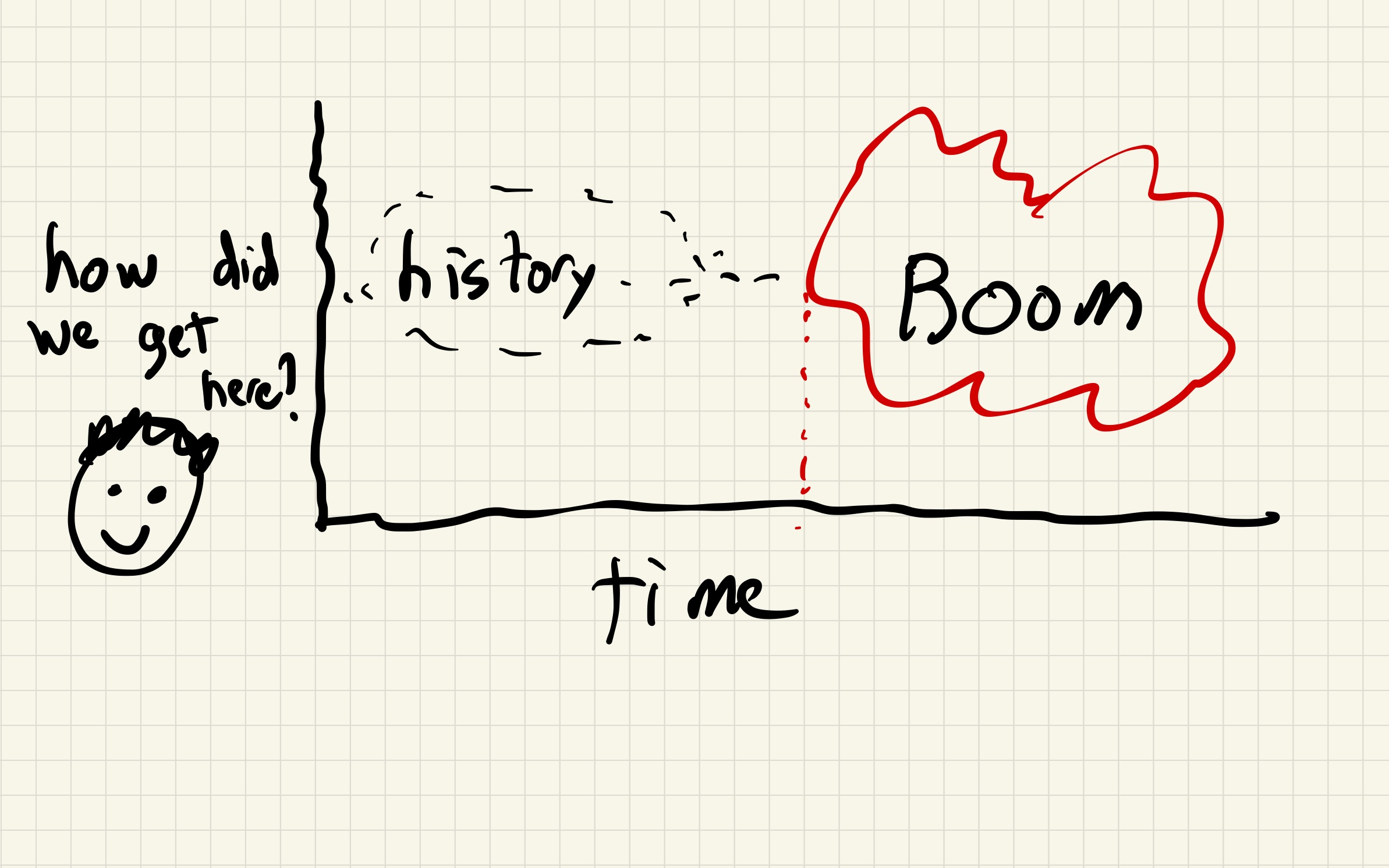
Aristotle’s revenge

Imagine you’re walking around a university campus. It’s a couple of weeks after the spring semester has ended, and so there aren’t many people about. You enter a building and walk into one of the rooms. It appears to be some kind of undergraduate lab, most likely either physics or engineering.

In the lab, you come across a table. On the table, someone has balanced a rectangular block on its smallest end.
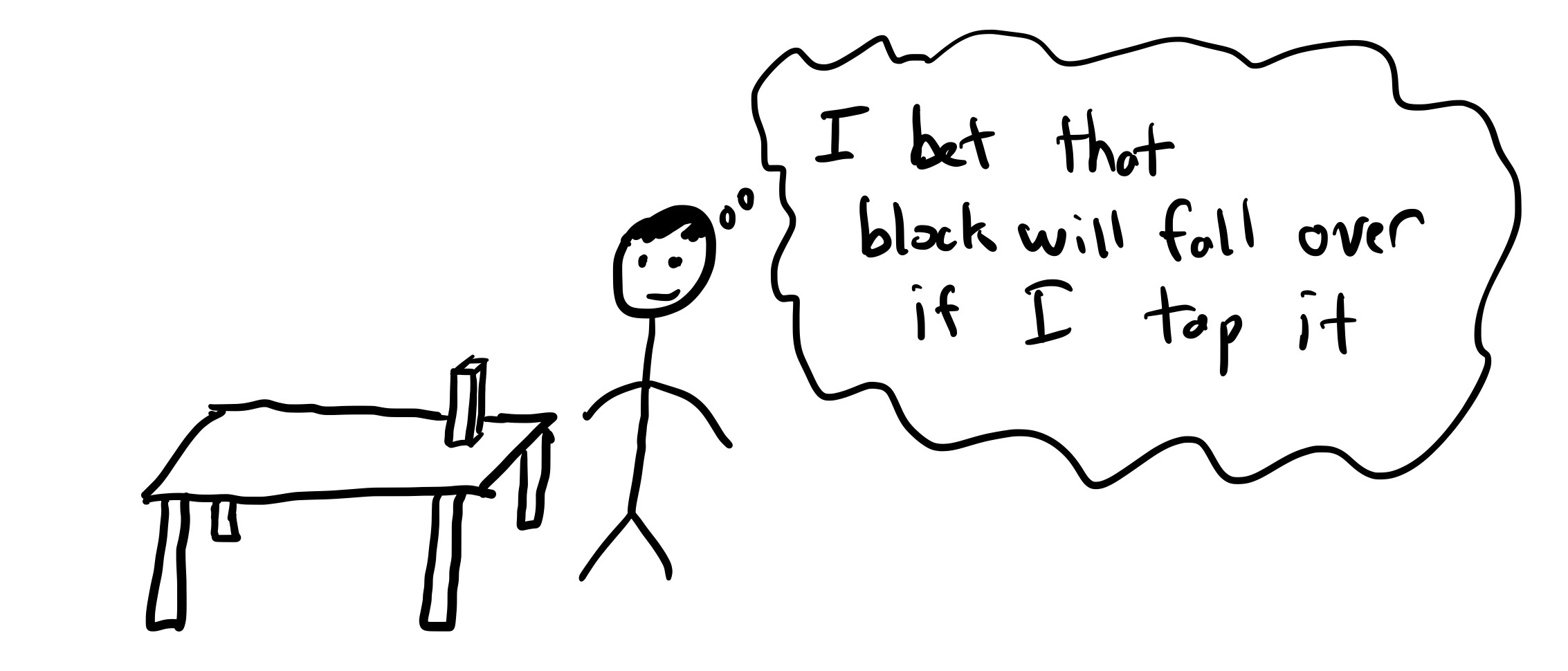
You nudge the top of the block. As expected, it falls over with a muted plonk. You look around to see if you might have gotten in trouble, but nobody’s around.

You come across another table. This table has some sort of track on it. The table also has a block on it that’s almost identical to the one on the other table, except that the block has a pin in it that connects it to some sort of box that is mounted on the track.

Not being able to resist, you nudge the top of this block, and it starts to fall. Then, the little box on the track whirs to life, moving along the track in the same direction that you nudged the block in. Because of the motion of the box, the block stays upright.


The ancient philosopher Aristotle believed that there were four distinct types of causes that explained why things happened. One of these is what Aristotle called the efficient cause: “Y behaved the way it did because X acted on Y“. For example, the red billiard ball moved because it was struck by the white ball. This is the most common way we think about causality today, and it’s sometimes referred to as linear causality.

Efficient cause does a good job of explaining the behavior of the first rectangular block in the anecdote: it fell over because we nudged it with our finger. But it doesn’t do a good job of explaining the observed behavior of the second rectangular block: we nudged it, and it started to fall, but it righted itself, and ended up balanced again.

Another type of cause Aristotle talked about was what he called the final cause. This is a teleological view of cause, which explains the behavior of objects in terms of their purpose or goal.

Final cause sounds like an archaic, unscientific view of the world. And, yet, reasoning with final cause enables us to explain the behavior of the second block more effectively than efficient cause does. That’s because the second block is being controlled by a negative-feedback system that was designed to keep the block balanced. The system will act to compensate for disturbances that could lead to the block falling over (like somebody walking over and nudging it). Because the output, a sensor that reads the angle of the block, is fed back into the input of the control system, the relationship between external disturbance and system behavior isn’t linear. This is sometimes referred to as circular causality, because of the circular nature of feedback loops.

The systems that we deal with contain goals and feedback loops, just like the inverted pendulum control system that keeps the block balanced. If you try to use linear causality to understand a closed-loop system, you will be baffled by the resulting behavior. Only when you understand the goals that the system is trying to achieve, and the feedback loops that it uses to adjust its behavior to reach those goals, will the resulting behavior make sense.

Henry Yin on what the cyberneticists got wrong

I’ve been on a bit of a control systems kick lately, and, serendipitously, I happened to see this tweet, which referenced a paper by Henry Yin at Duke University titled The crisis in neuroscience.

In the paper, Yin argues that neuroscience has failed to make progress in modeling human behavior because it tries to model the brain as a linear system, where you can study it by generating inputs and observing outputs.

Input/output model of brain

Yin proposes an alternative model, that you need to view the brain as composed of a collection of hierarchical, closed-loop control systems in order to understand behavior from a neurological perspective.

Now, the cybernetics folks have long argued that you should model human brains as control systems. But Yin argues that the cyberneticists got an important thing wrong in their control models: their models were too close to engineering applications to be directly applicable to organisms.

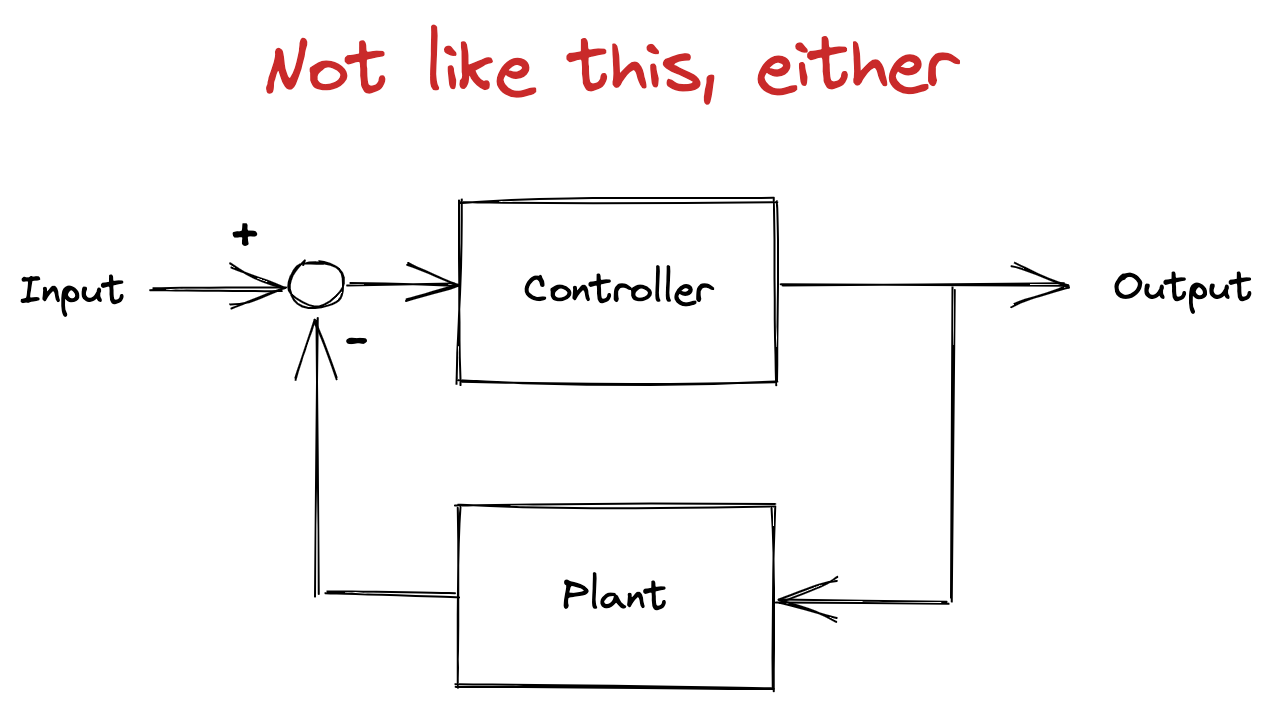
Classical engineering model of a feedback control system

In an engineered control system, a human operator specifies the set point. For example, for a cruise control system, you’d set desired speed. In the block diagram above, this set point is provided as the input to the system.

The output of the “Plant” block diagram is the current state of the variable you’re trying to control (e.g., current speed). The controller takes as input the difference between the set point and current state, and uses that to determine how to drive the plant (e.g., input to the motor).

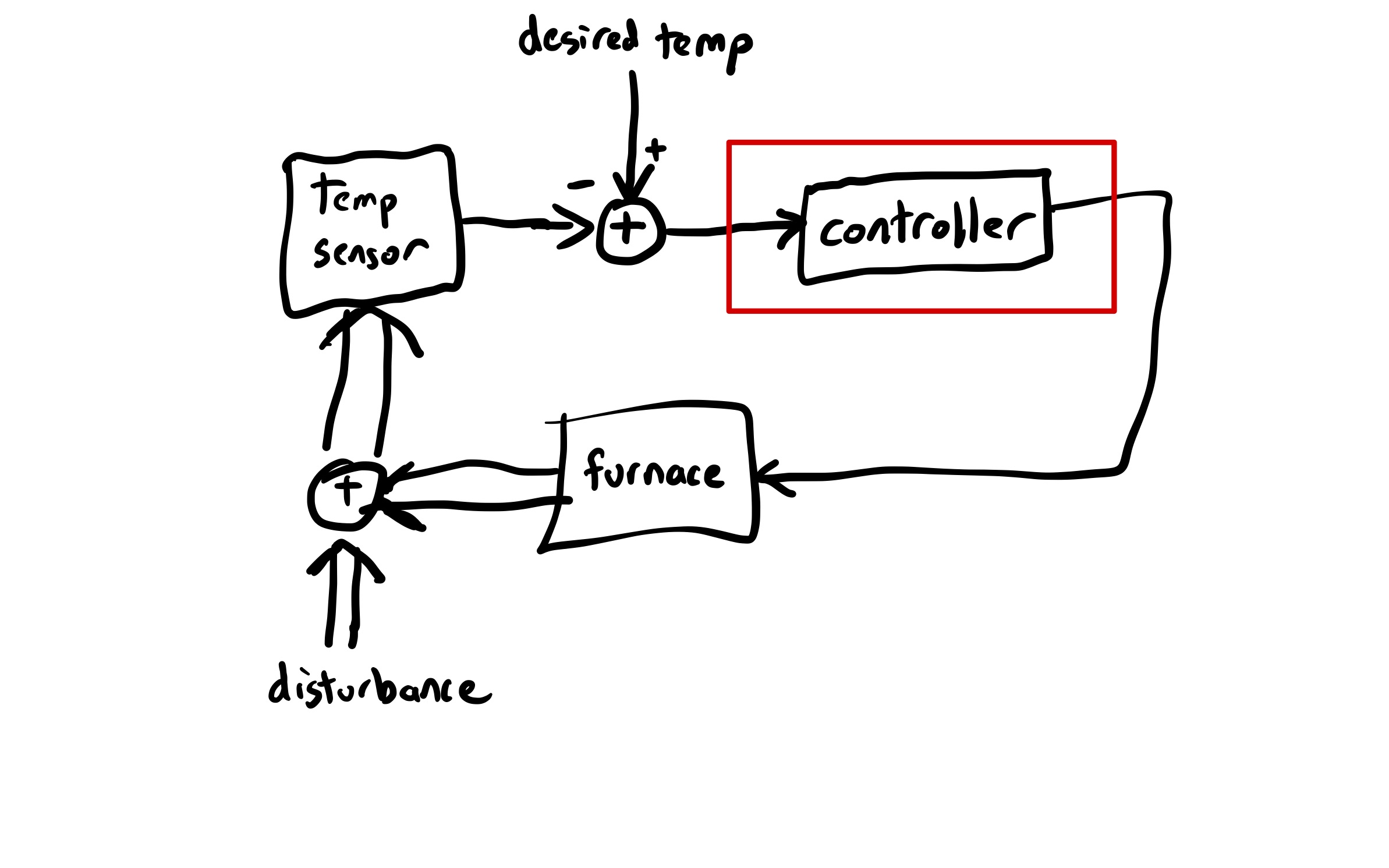
Here’s a block diagram of everyone’s favorite control systems example, the thermostat:

A thermostat that controls temperature

I’ve used a double-arrow to indicate signals that propagate through the environment, and single-arrows to indicate signals that propagate through wires. I’ve put a red box around where Yin claims the cyberneticists hold as their model for control in animals.

The variable under control is the temperature. A human sets the desired temperature, and a temperature sensor reads the current temperature. The controller takes as input the difference between the desired temperature and the current temperature, and uses that to determine whether or not to turn on the furnace.

The actual temperature in the house is determined both by the output of the furnace, and by other factors (e.g., temperature outside, how good the insulation is, whether someone has opened a door), which I’ve labeled disturbance.

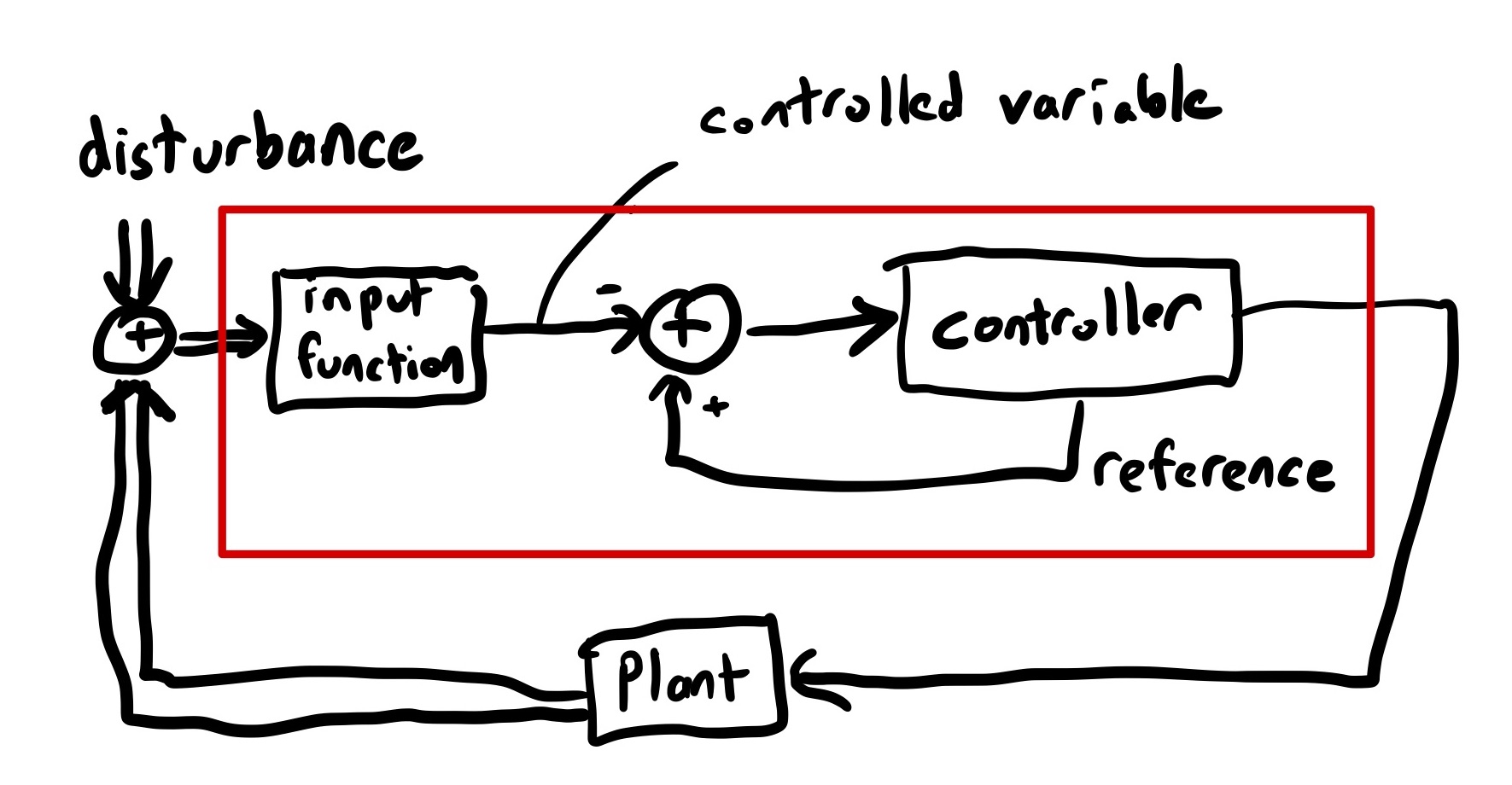
The problem with this, Yin argues, is that the red box is not a good model for the control that happens in the brain. As an alternative, he proposes the following model:

You can think of the red box as being the stuff inside some aspect of the brain, the “plant” as being the things that this aspect controls (e.g., other parts of the brain, muscles).

The difference in Yin’s model is that the controller determines the set point. There’s no external agent specifying the desired value as an input. Instead, the controller generates its own set point, which Yin calls the reference value.

Also note that Yin’s model includes the input function inside the red box. This takes sensory input at calculates the variable that’s under control. The difference between this model and the thermostat is that, in the thermostat model, you know from the outside that temperature is the variable being controlled. In Yin’s model, you can’t see from the outside what the variable is that’s being controlled for: the variable is internal to the control system.

Despite knowing nothing about neuroscience, and only knowing a bit about control systems, I still found this paper surprisingly accessible. I recommend it. There’s a lot more here than what I’ve touched on in this post.

The ambiguity of real work

All ambiguity is resolved by actions of practitioners at the sharp end of the system.

Dr. Richard I. Cook, How Complex Systems Fail

There’s a wonderful book by the late urban planning professor Donald Schön called The Reflective Practitioner: How Professionals Think in Action. In the first chapter, he discusses the “rigor or relevance” dilemma that faces educators in professional degree programs. In the case of a university program aimed at preparing students for a career in software development, this is the “should we teach topological sort or React?” question.

Schön argues that the dilemma itself is a fundamental misunderstanding of the nature of professional work. What it misses is the ambiguity and uncertainty inherent in the work of professional life. The “rigor vs relevance” debate is an argument over the best way to get from the problem to the solution: do you teach the students first principles, or do you teach them how to use the current set of tools? Schön observes that a more significant challenge for professionals is defining the problems to solve in the first place, since an ill-defined problem admits no technical solution at all.

In the varied topography of professional practice, there is a high, hard ground where practitioners can make effective use of research-based theory and technique, and there is a swampy lowland where situations are confusing “messes” incapable of technical solution. The difficulty is that the problems of the high ground, however great their technical interest, are often relatively unimportant to clients or to the larger society, while in the swamp are the problems of greatest human concern.

His use of the term “messes” evokes Russell Ackoff’s use of the term in his paper The Future of Operational Research is Past:

Managers are not confronted with problems that are independent of each other, but with dynamic situations that consist of complex systems of changing problems that interact with each other. I call such situations messes. Problems are abstractions extracted from messes by analysis; they are to messes as atoms are to tables and chairs. We experience messes, tables, and chairs; not problems and atoms

To take another example from the software domain. Imagine that you’re doing quarterly planning, and there’s a collection of reliability work that you’d like to do, and you’re trying to figure out how to prioritize it. You could apply a rigorous approach, where you quantify some values in order to do the prioritization work, and so you try to estimate information like:

  • the probability of hitting a problem if the work isn’t done
  • the cost to the organization if the problem is encountered
  • the amount of effort involved in doing the reliability work

But you’re soon going to discover the enormous uncertainty involved in trying to put a number on any of those things. And, in fact, doing any reliability work can actually introduce new failure modes.

Over and over, I’ve seen the theme of ambiguity and uncertainty appear in ethnographic research that looks at professional work in action. In Designing Engineers, the aerospace engineering professor Louis Bucciarelli did an ethnographic study of engineers in a design firm, and discovered that the engineers all had partial understanding of the problem and solution space, and that their understandings also overlapped only partially. As a consequence, a lot of the engineering work that was done actually involved engineers resolving their incomplete understanding through various forms of communication, often informal. Remarkably, the engineers were not themselves aware of this process of negotiating understandings of the problems and solutions.

The famous Common Ground and Coordination in Joint Activity paper by Gary Klein, Paul Feltovich, and David Woods, makes explicit the role that ambiguity plays in human coordination and communication.

You’ll sometimes hear researchers who study work talk about the process of sensemaking. For example, there’s a paper by Sana Albolino, Richard Cook, and Micahel O’Connor called Sensemaking, safety, and cooperative work in the intensive care unit that describes this type of work in an intensive care unit. I think of sensemaking as an activity that professionals perform to try to resolve ambiguity and uncertainty.

(Ambiguity isn’t always bad. In the book On Line and On Paper, the sociologist Kathryn Henderson describes how engineers use engineering drawings as boundary objects. These are artifacts are that are understood differently by the different stakeholders: two engineers looking at the same drawing will have different mental models of the artifact based on their own domain expertise(!). However, there is also overlap in their mental models, and it is this combination of overlap and the fact that individuals can use the same artifact for different purposes that makes it useful. Here the ambiguity has actual value! In fact, her research shows that computer models, which eliminate the ambiguity, were less useful for this sort of work).

As practitioners, we have no choice: we always have to deal with ambiguity. As noted by Richard Cook in the quote that opens this blog post, we are the ones, at the sharp end, that are forced to resolve it.

The Howie Guide: How to get started with incident investigations

Until now, if you wanted to improve your organization’s ability to learn from incidents, there wasn’t a lot of how-to style material you could draw from. Sure, there were research papers you could read (oh, so many research papers!). But academic papers aren’t a great source of advice for someone who is starting on an effort to improve how they do incident analysis.

There simply weren’t any publications about how to get started with doing incident investigations which were targeted at the infotech industry. Your best bet was the Etsy Debrief Facilitation Guide. It was practical, but it focused on only a single aspect of the incident investigation process: the group incident retrospective meeting. And there’s so much more to incident investigation than that meeting.

The folks at Jeli have stepped up to the challenge. They just released Howie: The Post-Incident Guide.

Readers of this blog will know that this is a topic near and dear to my heart. The name “Howie” is short for “How we got here“, which is what we call our incident writeups at Netflix. (This isn’t a coincidence: we came up with this name at Netflix when Nora Jones of Jeli and I were on the CORE team).

Writing a guide like this is challenging, because so much of incident investigation is contextual: what you look at it, what questions you ask, will depend on what you’ve learned so far. But there are also commonalities across all investigations; the central activities (constructing timelines, doing one-on-one interviews, building narratives) happen each time. The Howie guide gently walks the newcomer through these. It’s accessible.

When somebody says, “OK, I believe there’s value in learning more from incidents, and we want to go beyond doing a traditional root-cause-analysis. But what should I actually do?”, we now have a canonical answer: go read Howie.

How much did that outage cost?

People like to put dollar values on outages. There’s no true answer to the question of how much an outage costs an organization. If your company is transaction-based, you can estimate how many transactions were missed, but there are all sorts of other factors that you could decide to model. (Are those transactions really lost, or will people come back later? Does it impact the public’s perception of the organization? What if your business isn’t transaction-based?). If you ask John Allspaw, he’ll tell you that incidents can provide benefits to an organization in addition to costs.

Putting all of that aside for now, one question around incident cost that I think is interesting is the perceived cost within the organization. How costly does leadership feel that this incident was?

Here’s a proposed approach to try and capture this. After an incident, go to different people in leadership, and ask them the following question:

Imagine I could wave a magic wand, and it would alter history to undo the incident: it will be as if the incident never happened. However, I’ll only do this if you pay me money out of your org’s budget. How much are you willing to pay me to wave the wand?

I think this would be an interesting way to convey to the organization how leadership perceived the incident.

The danger of hidden functional roles

There’s a collection of friends that I have a standing videochat with every couple of weeks. We had been meeting at 8am, but several people developed conflicts at that time, including me. I have a teenager that starts school at 8am, and I’m responsible for getting them to school in the morning (I like to leave the house around 7:40am), which prevented me from participating.

As a group, we decided to reschedule the chat to 7am. This works well for me, because I get up at 6. Today was the first day meeting at the new scheduled time. I got up as I normally do, and was sure to be quiet so as not to wake my wife, Stacy; she sleeps later than I do, but she gets up early enough to rouse our kids for school. I even closed the bedroom door so that any noise I made from the videochat wouldn’t disturb her.

I was on the videochat, taking part in the conversation in hushed tones, when I looked over at the time. I saw it was 7:25am, which is about fifteen minutes before I start getting ready to leave the house. Usually, the rest of the household is up, showering, eating breakfast. But I hadn’t heard a peep from anyone. I went upstairs to discover that nobody else had gotten up yet.

It turns out that my typical morning routine was acting as a natural alarm clock for Stacy. My alarm goes off at 6am every weekday, and I get up, but Stacy stays in bed. However, the noises from my normal morning routine are the thing that rouse her, which is typically around 7am. Today, I was careful to be very quiet, and so she didn’t wake up. I didn’t know that I was functioning as an alarm clock for her! That’s why I was careful to be quiet, and why I didn’t even think to mention to her about the new videochat time.

I suspect this is failure mode is more common than we realize: there is a process inside a system, and over time the process comes to fulfill some unintended, ancillary functional role, and there are people who participate in this process that aren’t even aware of this function.

As an example, consider Chaos Monkey. Chaos Monkey’s intended function is to ensure that engineers design their services to withstand a virtual machine instance failing unexpectedly, by increasing their exposure to this failure mode. But Chaos Monkey also has the unintended effect of recycling instances. For teams that deploy very infrequently, their service might exhibit problems with long-lived instances that they never notice because Chaos Monkey tends to terminate instances before they hit those problems. Now imagine declaring an extended period of time where, in the interest of reducing risk(!), no new code is deployed, and Chaos Monkey is disabled.

When you turn something off, you never know what might break. In some cases, nobody in the system knows.

Plus c’est la même chose, plus ça change

I’m re-reading a David Woods’s paper titled the theory of graceful extensibility: basic rules that govern adaptive systems. The paper proposes a theory to explain how certain types of systems are able to adapt over and over again to changes in their environment. He calls this phenomenon sustained adaptability, which we contrasts with systems that can initially adapt to an environment but later collapse when some feature of the environment changes and they fail to adapt to the new change.

Woods outlines six requirements that any explanatory theory of sustained adaptability must have. Here’s the fourth one (emphasis in the original):

Fourth, a candidate theory needs to provide a positive means for a unit at any scale to adjust how it adapts in the pursuit of improved fitness (how it is well matched to its environment), as changes and challenges continue apace. And this capability must be centered on the limits and perspective of that unit at that scale.

The phrase adjust how it adapts really struck me. Since adaptation is a type of change, this is referring to a second-order change process: these adaptive units have the ability to change the mechanism by which they change themselves! This notion reminded me of Chris Argyris’s idea of double-loop learning.

Woods’s goal is to determine what properties a system must have, what type of architecture it needs, in order to achieve this second-order change process. He outlines in the paper that any such system must be a layered architecture of units that can adapt themselves and coordinate with each other, which he calls a tangled, layered network.

Woods believes there are properties that are fundamental to systems that exhibit sustained adaptability, which implies that these fundamental properties don’t change! A tangled, layered network may reconfigure itself in all sorts of different ways over time, but it must still be tangled and layered (and maintain other properties as well).

The more such systems stay the same, the more they change.

Adapting to a crunch: the Mask Match story

I just got back from Strange Loop, and my favorite talk was Tech When the Sky is Falling: Tools for Crisis Response by Emma Ferguson and Colin Schimmelfing. I’m going to use this talk to illustrate one of the ideas in David Woods theory of graceful extensibility. The idea is that a system needs to deploy, mobilize, or generate capacity when it is at risk of saturation.

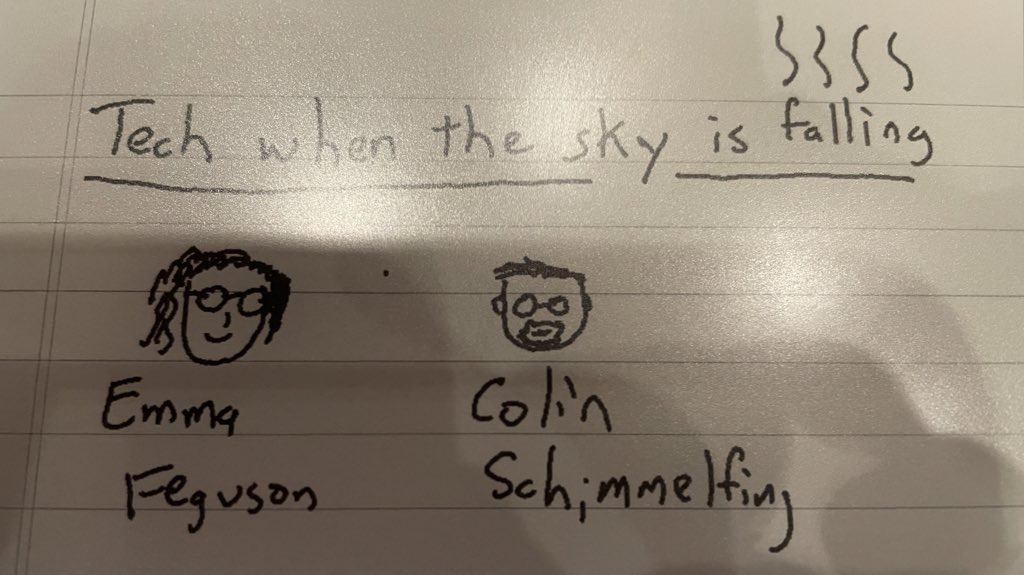
My silly doodle of the speakers

Back in March 2020, frontline hospital workers dealing with COVID-19 patients were running short on N95 face masks. Hospitals simply didn’t have enough masks to supply their workers. This shortage of masks is a great example of what Woods calls a crunch, where a system runs short on some resource that it needs. When a system is crunched like this, it needs to adapt. It has to make some sort of change in order to get more of that resource so that it can function properly.

Woods lists three methods for getting more of a resource. If you’ve prepared in advance by stockpiling resources, you can deploy those stockpiles. If you don’t have those extra resources on hand, but your larger network has resources to spare, you can mobilize your network to access those resources. Finally, if you can’t tap into your network to get those resources, your only option is to generate the resources you need. In order to generate resources, you need access to raw materials, and then you need to do work to transform those raw materials into the right resources.

In the case of the mask shortages, the hospitals did not have sufficient stockpiles of N95 masks on hand, so deploying wasn’t an option. It turns out that there were many American households that happened to have N95 masks sitting in storage, and many of those households were willing to donate these unused masks to healthcare workers. In theory, hospitals could mobilize this network of volunteers in order to get these masks to the frontline workers.

There was a problem, though: hospital administrators refused to accept donated N95 masks because of liability concerns. So, this wasn’t something the hospitals were going to do.

Workers wanted masks, and people wanted to donate, but hospital admins wouldn’t let them

Fortunately, there was a loophole: frontline workers could bring in their own masks. Now, the problem to be solved was: how do you get masks from donors who had masks to the workers who wanted them?

Emma and Colin needed to generate a new capability: a mechanism for matching up the donors with the healthcare workers. The raw materials that they initially used to generate this capability were Google Sheets and Gmail for coordinating among the volunteers.

And it worked! However, they quickly ran into a new risk of saturation. Google Sheets has a limit of 50 concurrent editors, and Gmail limits an email account to a maximum of 500 emails per day. And so, once again, the team had to generate a new capability that would scale beyond what Google Sheets and Gmail were capable of. They ended up building a system called Mask Match, by writing a Flask app that they deployed on Heroku, and using Mailgun for sending the emails.

My favorite part of this talk was when Emma Ferguson mentioned that they originally just wanted to pay Google in order to get the Google Sheets and Gmail limits increased (their GoFundMe campaign was quite successful, so getting access to money wasn’t a problem for them). However, they couldn’t figure out how to actually pay Google for a limit increase! This is a wonderful example of what Woods calls brittleness, where a system is unable to extend itself when it reaches its limits. Google is great at building robust systems, but their ethos of removing humans from the loop means that it’s more difficult for consumers of Google services to adapt them to unexpected, emergency scenarios.

The strange beauty of strange loop failure modes

As I’ve posted about previously, at my day job, I work on a project called Managed Delivery. When I first joined the team, I was a little horrified to learn that the service that powers Managed Delivery deploy itself using Managed Delivery.

“How dangerous!”, I thought. What if we push out a change that breaks Managed Delivery? How will we recover? However, after having been on the team for over a year now, I have a newfound appreciation for this approach.

Yes, sometimes there’s something that breaks, and that makes it harder to roll back, because Managed Delivery provides the main functionality for easy rollback. However, it also means that the team gets quite a bit of practice at bypassing Managed Delivery when something goes wrong. They know how to disable Managed Delivery and use the traditional Spinnaker UI to deploy an older version. They know how to poke and prod at the database if the Managed Delivery UI doesn’t respond properly.

These strange loop failure modes are real: if Managed Delivery breaks, we may lose out on the functionality of Managed Delivery to help us recover. But it also means that we’re more ready for handling the situation if something with Managed Delivery goes awry. Yes, Managed Delivery depends on itself, and that’s odd. But we have experience with how to handle things when this strange loop dependency creates a problem. And that is a valuable thing.

Live-drawing my slides during a talk

The other day, I gave an internal talk, and I tried an experiment. Using my iPad and the GoodNotes app, I drew all of my slides while I was talking (except the first slide, which I drew in advance).

“What font is that?” someone asked. It’s my handwriting

I’ve always been in awe of people who can draw, I’ve never been good at it.

“Where’s the bug”, it says. Not my best handwriting

Over the years, I’ve tried doodling more. I was influenced by Dan Roam’s books, Julia Evans’s zines, sketchnotes, and most recently, Christina Wodtke’s Pencil Me In.

The words have stink lines, so you know they’re bad

If you’ve read my blog before, you’ve seen some of my previous doodles (e.g., Root cause of failure, root cause of success or Taming complexity: from contract to compact).

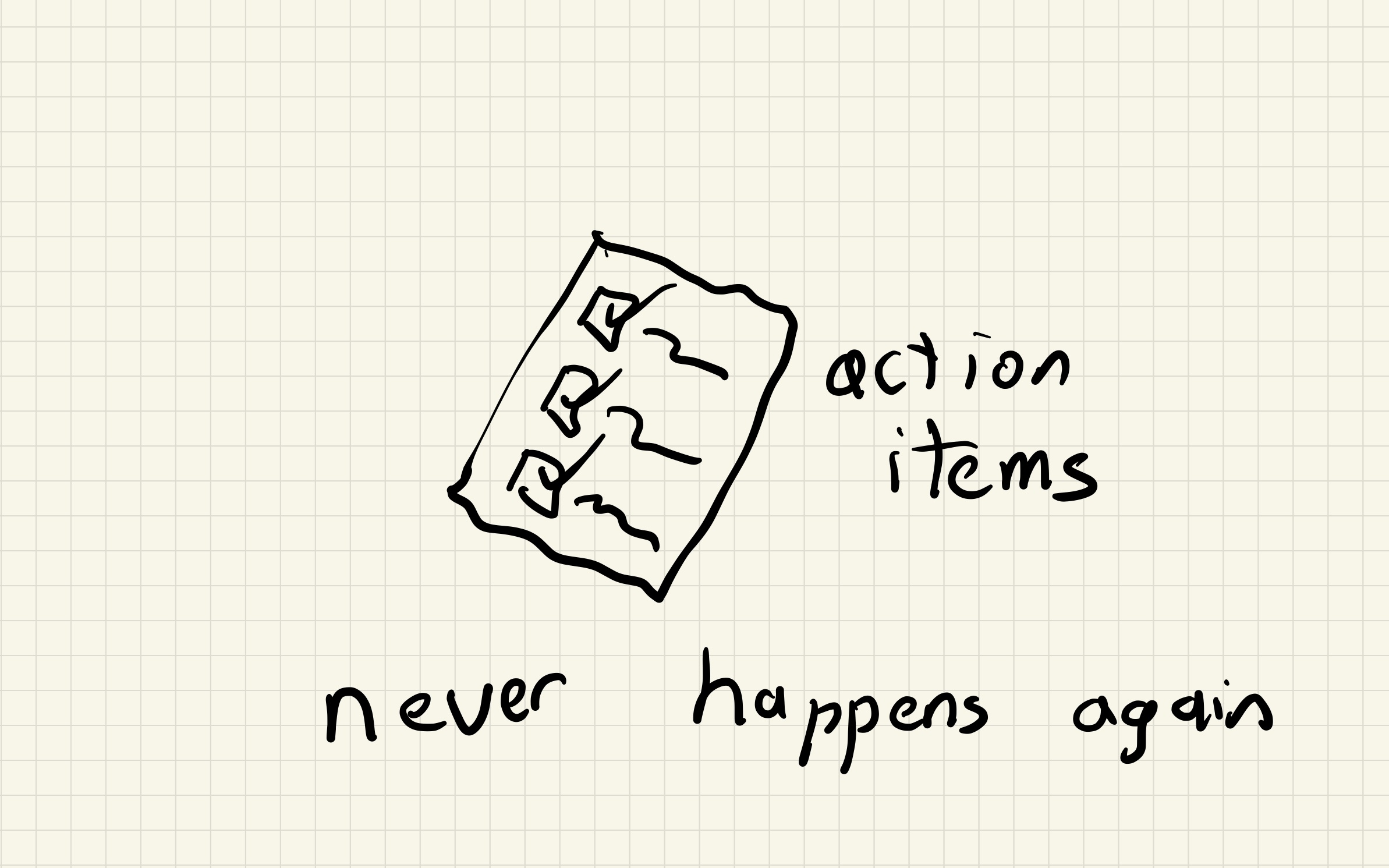
We need to complete the action items so it never happens again

When I was asked to present to a team, I wanted to use my drawings rather than do traditional slides. I actually hate using tools like PowerPoint and Google Slides to do presentations. Typically I use Deckset, but in this case, I wanted to do them all drawn.

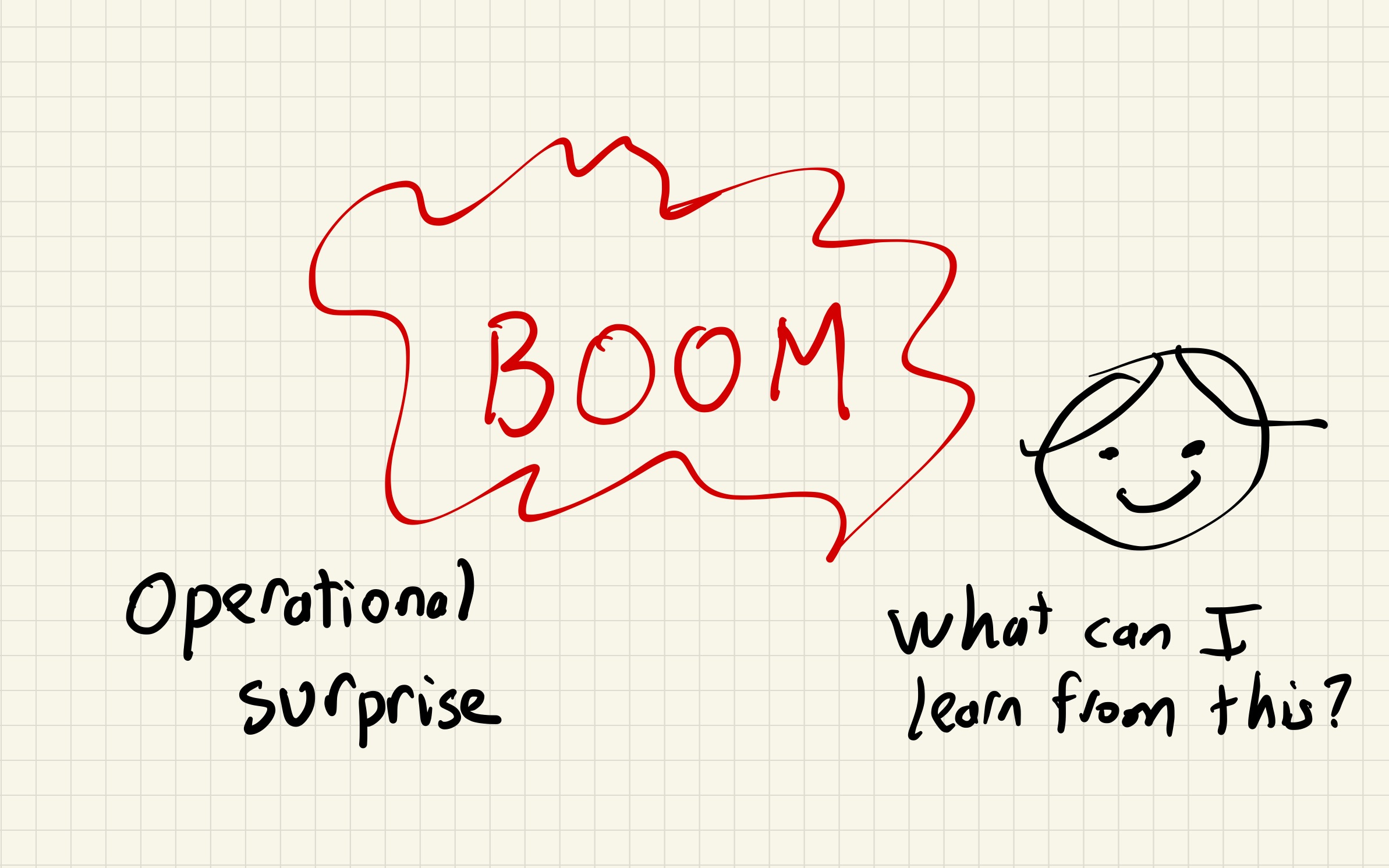
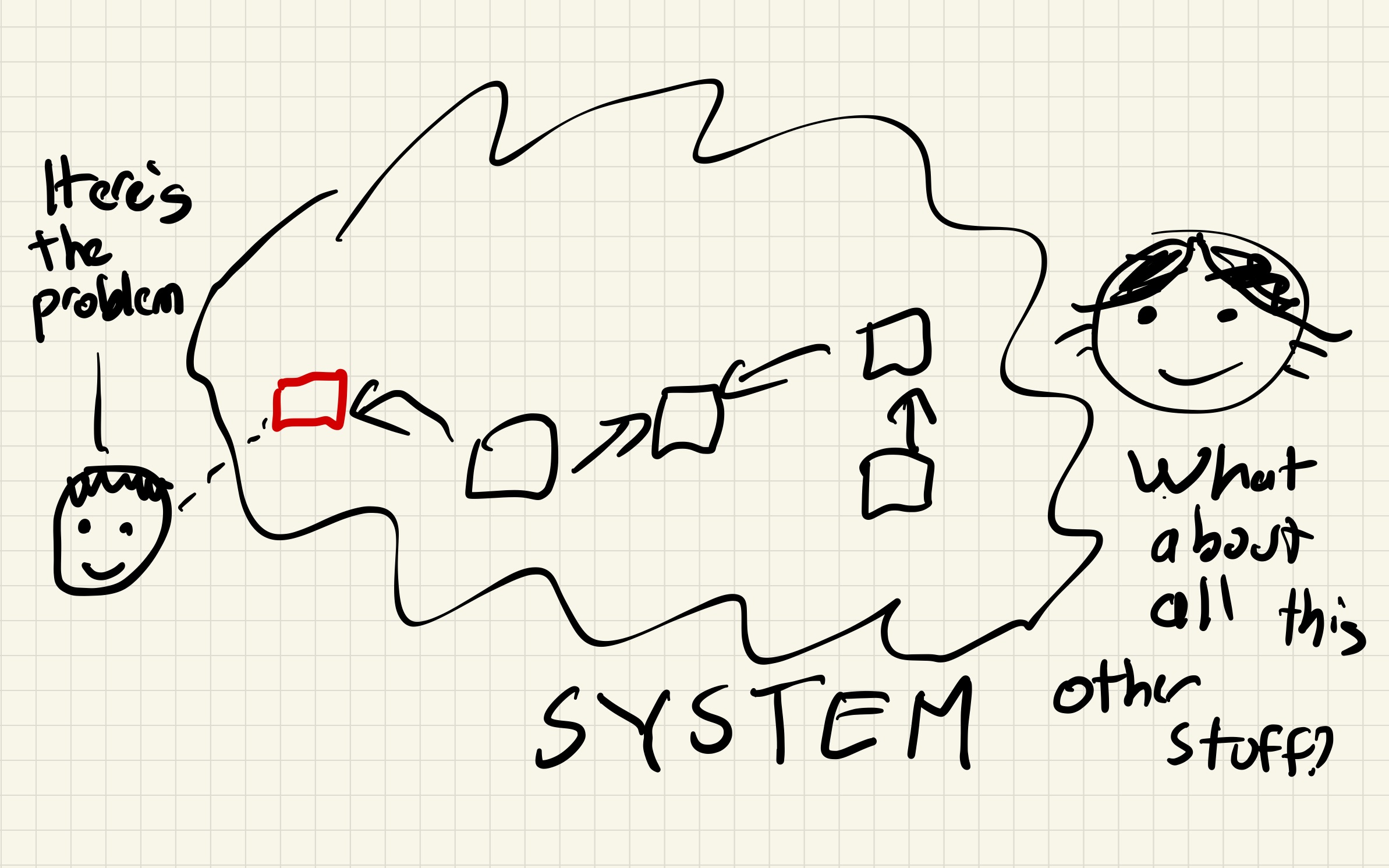
A different perspective on incidents

I started off by drawing out my slides in advance. But then I thought, “instead of showing pre-drawn slides, why don’t I draw the slides as I talk? That way, people will know where to look because they’ll look at where I’m drawing.”

I still had to prepare the presentation in advance. I drew all of the slides beforehand. And then I printed them out and had them in front of me so that I could re-draw them during the talk. Since it was done over Zoom, people couldn’t actually see that I was working from the print-outs (although they might have heard the paper rustling).

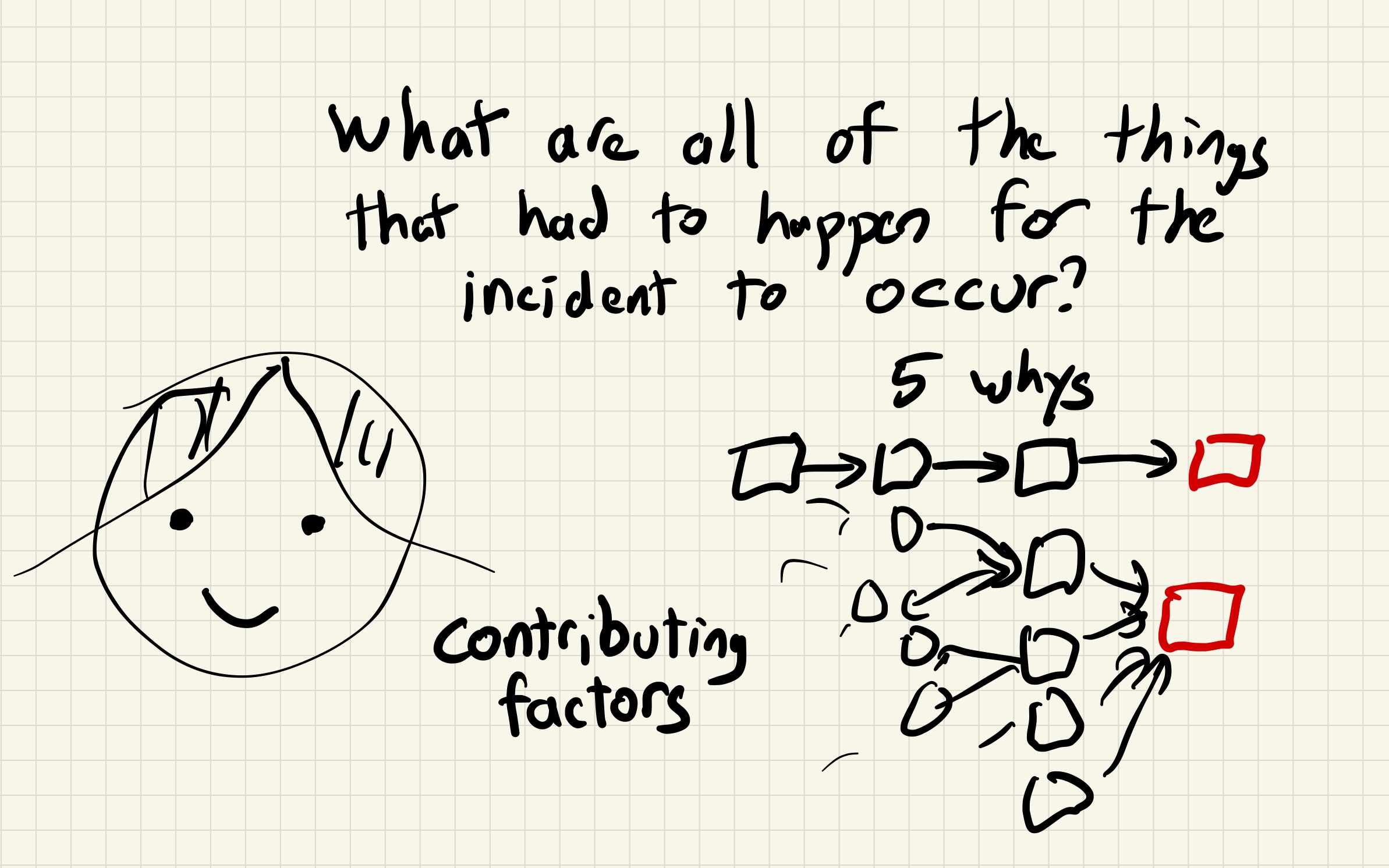
Contributing factors aren’t like root cause

One benefit of this technique was that it made it easier to answer questions, because I could draw out my answer. When I was writing the text at the top, somebody asked, “Is that something like a root cause chain?” I drew the boxes and arrows in response, to explain how this isn’t chain-like, but instead is more like a web.

The selected images above should give you a sense of what my slides looked like. I had fun doing the presentation, and I’d try this approach again. It was certainly more enjoyable than futzing with slide layout.