Rehabilitating “you can’t manage what you can’t measure”

There’s a management aphorism that goes “you can’t manage what you can’t measure”. It is … controversial. W. Edwards Deming, for example, famously derided it. But I think there are two ways to interpret this quote, and they have very different takeaways.

One way to read this is to treat the word measure as a synonym for quantify. When John Allspaw rails against aggregate metrics like mean time to resolve (MTTR), he is siding with Deming in criticizing the idea of relying solely on aggregate, quantitative metrics for gaining insight into your system.

But there’s another way to interpret this aphorism, and it depends on an alternate interpretation of the word measure. I think that observing any kind of signal is a type of measurement. For example, if you’re having a conversation with someone, and you notice something in their tone of voice or their facial expression, then you’re engaged in the process of measurement. It’s not quantitative, but it represents information you’ve collected that you didn’t have before.

By generalizing the concept of measurement, I would recast this aphorism as: what you aren’t aware of, you can’t take into account.

This may sound like a banal observation, but the subtext here is “… and there’s a lot you aren’t taking into account.” A lot of things that are happening in your organization, your system, are largely invisible. And those things, that work, is keeping things up and running.

The concept that there’s invisible work happening that’s creating your availability is at the heart of the learning from incidents in software movement. And it isn’t obvious, even though we all experience it directly.

This invisible work is valuable in the sense that it’s contributing to keeping your system healthy. But the fact that it’s invisible is dangerous because it can’t be taken into account when decisions are made that change the system. For example, I’ve seen technological changes that have made it more difficult for the incident management team to diagnose what’s happening in the system. The teams who introduced those changes were not aware of how the folks on the incident management team were doing diagnostic work.

In particular, one of the dangers of an action-item-oriented approach to incident reviews is that you may end up introducing a change to the system that disrupts this invisible work.

Take the time to learn about the work that’s happening that nobody else sees. Because if you don’t see it, you may end up breaking it.

An old lesson about a fish

Back when I was in college [1], I was required to take several English courses. I still remember an English professor handing out an excerpt from the book ABC of Reading by Ezra Pound [2]:

No man is equipped for modern thinking until he has understood the anecdote of Agassiz and the fish:

A post-graduate student equipped with honours and diplomas went to Agassiz to receive the final and finishing touches. The great man offered him a small fish and told him to describe it.

Post-Graduate Student: ‘That’s only a sunfish.’

Agassiz: ‘I know that. Write a description of it.’

After a few minutes the student returned with the description of the Ichthus Heliodiplodokus, or whatever term is used to conceal the common sunfish from vulgar knowledge, family of Heliichtherinkus, etc., as found in textbooks of the subject.

Agassiz again told the student to describe the fish.

The student produced a four-page essay. Agassiz then told him to look at the fish. At the end of three weeks the fish was in an advanced state of decomposition, but the student knew something about it.

I remember my eighteen-year-old self hating this anecdote. It sounded like Agassiz just wasted the graduate student’s time, leaving him with nothing but a rotting fish for his troubles. As an eventual engineering major, I had no interest in the work of analyzing texts that was required in English courses. I thought such analysis was a waste of time.

It would take about two decades for the lesson of this anecdote to sink into my brain. The lesson I eventually took away from it is that there is real value in devoting significant effort to close study of an object. If you want to really understand something, a casual examination just won’t do.

To me, this is the primary message of the learning from incidents in software movement. Doing an incident investigation, like studying the fish, will take time. Completing an investigation may take weeks, even months. Keep in mind, though, that you aren’t really studying an incident at all: you’re studying your system through the lens of an incident. And, even though the organization will have long since moved on, once you’re done, you’ll know something about your system.

[1] Technically it was CEGEP, but nobody outside of Quebec knows what that is.

[2] Pound is likely retelling an anecdote originally told by either Nathaniel Shaler or Samuel Hubbard Scudder, both of whom were students of Agassiz.

There is no escape from the adaptive universe

If I had to pick just one idea from the field of resilience engineering that has influenced me the most, it would be David Woods’s notion of the adaptive universe. In his 2018 paper titled The theory of graceful extensibility: basic rules that govern adaptive systems, Woods describes the two assumptions [1] of the adaptive universe:

  1. Resources are always finite.
  2. Change is ongoing.

That’s it! Just two simple assertions, but so much flows from them.

At first glance, the assumptions sound banal. Nobody believes in infinite resources! Nobody believes that things will stop changing! Yet, when we design our systems, it’s remarkable how often we don’t take these into account.

The future is always going to involve changes to our system that we could not foresee at design time, and those changes are always going to be made in a context where we are limited in resources (e.g., time, headcount) and hence will have to make tradeoffs. Instead, we tell ourselves a story about how next time, we’re going to build it right. But, we aren’t, because the next time we’ll also be resource constrained, and so we’ll have to make some decisions for reasons of expediency. And the next time, the system will also change in ways we could never have predicted, invalidating our design assumptions.

Because we are forever trapped in the adaptive universe.

[1] If you watch Woods’s online resilience engineering short course, which precedes this paper, he mentions a third property: surprise is fundamental. But I think this property is a consequence of the first two assumptions rather than requiring an additional assumption, and I suspect that’s why he doesn’t mention it as an assumption in his 2018 paper.

There is no escape from Ashby’s Law

[V]ariety can destroy variety

W. Ross Ashby

There are more things in heaven and earth, Horatio,
Than are dreamt of in your philosophy.

Hamlet (1.5.167-8)

In his book An Introduction to Cybernetics, published in 1956, the English psychiatrist W. Ross Ashby proposed the Law of Requisite Variety. His original formulation isn’t easy to extract into a blog post, but the Principia Cybernetica website has a pretty good definition:

The larger the variety of actions available to a control system, the larger the variety of perturbations it is able to compensate.

Like many concepts in systems thinking, the Law of Requisite Variety is quite abstract, which makes it hard to get a handle on. Here’s a concrete example I find useful for thinking about it.

Imagine you’re trying to balance a broomstick on your hand:

This is an inherently unstable system, and so you have to keep moving your hand around to keep the broomstick balanced, but you can do it. You’re acting as a control system to keep the broomstick up.

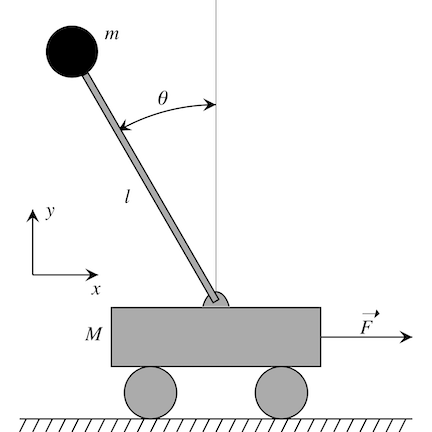
If you constrain the broomstick to have only one degree of freedom, you have what’s called the inverted pendulum problem, which is a classic control systems problem. Here’s a diagram:

From the Wikipedia Inverted pendulum article

The goal is to move the cart in order to keep the pendulum balanced. If you have sensor information that measures the tilt angle, θ, you can use that data to build a control system to push on the cart in order to keep the pendulum from falling over. Information about the tilt angle is part of the model that the control system has about the physical system it’s trying to control.

Now, imagine that the pendulum isn’t constrained to only one degree of freedom, but it now has two degrees of freedom: this is the situation when you’re balancing a broom on your hand. There are now two tilt angles to worry about: it can fall towards/away from your body, or it can fall left/right.

You can’t use the original inverted pendulum control system to solve this problem, because that only models one of the tilt angles. Imagine you can only move your hand forward and back, but not left or right. Because of this, the control system won’t be able to correct for the other angle: the pendulum will fall over.

The problem is that the new system can vary in ways that the control system wasn’t designed to handle: it can get into states that aren’t modeled by the original system.

This is what the Law of Requisite Variety is about: if you want to build a control system, the control system needs to be able to model every possible state that the system being controlled can get into: the state space of the control system has to be at least as large as the state space of the physical system. If it isn’t, then the physical system can get into states that the control system won’t be able to deal with.

Bringing this into the software world: when we build infrastructure software, we’re invariably building control systems. These control systems can only handle situations that it is designed for. We invariably run into trouble when the systems we build get into states that the designer never imagined happening. A fun example of this case is some pathological traffic pattern.

The fundamental problem with building software control systems is that we humans aren’t capable of imagining all possible states that the systems being controlled can get into. In particular, we can’t imagine the changes that people are going to make in the future that will create new states that we simply could not ever imagine needing to handle. And so, our control systems will invariably be inadequate, because they won’t be able to handle these situations. The variety of the world exceeds the variety our control systems are designed to handle.

Fortunately, we humans are capable of conceiving of a much wider variety of system states than the systems we build. That’s why, when our software-based control systems fail and the humans get paged in, the humans are eventually able to make sense of what state the system has gotten itself into and put things right.

Even we humans are not exempt from Ashby’s Law. But we can revise of our (mental) models of the system in ways that our software-based control systems cannot, and that’s why we can deal effectively with incidents. Because of how we can update our models, we can adapt where software cannot.

The downsides of expertise

I’m a strong advocate of the value of expertise to a software organization. I’d even go so far as to say that expertise is a panacea.

Despite the value of expertise, there are two significant obstacles to organizations to leverage expertise as effectively as possible.

Expertise is expensive to acquire

Developing expertise is expensive for an organization to acquire. Becoming an expert requires experience, which takes time and effort. An organization can hire for some forms of expertise, but no organization can hire someone who is already an expert in the org’s socio-technical system. And a lot of the value for an organization is having expertise in the behaviors of the local system.

You can transfer expertise from one person to another, but that also takes time and effort, and you need to put mechanisms in place to support this. Apprenticeship and coaching are two traditional methods of expertise transfer, but also aren’t typically present in software organizations. I’m an advocate of learning from incidents as a medium for skill transfer, but that requires its own expertise for doing incident investigation in a way that supports skill transfer.

Alas, you can’t transfer expertise from a person to a tool, as John Allspaw notes, so we can’t take a shortcut by acquiring sophisticated tooling. AI researchers tried building such expert systems in the 1980s, but these efforts failed.

Concentrated expertise is dangerous

Organizations tend to foster local experts: a small number of individuals who have a lot of expertise with aspects of the local system. These people are enormously valuable to organizations (they’re often very helpful during incidents), but they represent single points of failure. If these individuals happen to be out of the office during a critical incident, or if they leave the company, it can be very costly to the organization. My former colleague Nora Jones calls this the islands of knowledge problem.

What’s worse, high concentration of expertise can become a positive feedback loop. If there’s a local expert, then other individuals may use the expert as a crutch, relying on the expert to solve the harder problems and never putting in the effort to develop their own expertise.

To avoid this problem, we need to develop the expertise in more people within the organization, which, is as mentioned earlier, is expensive.

I continue to believe that it’s worth it.

Conveying confusion without confusing the reader

Confusion is a hallmark of a complex incident. In the moment, we know something is wrong, but we struggle to make sense of the different signals that we’re seeing. We don’t understand the underlying failure mode.

After the incident is over and the engineers have had a chance to dig into what happened, these confusing signals make sense in retrospect. We find out that about the bug or inadvertent config change or unexpected data corruption that led to the symptoms we saw during the incident.

When writing up the narrative, the incident investigator must choose whether to inform the reader in advance about the details of the failure mode, or to withhold this info until the point in time in the narrative when the engineers involved understood what was happening.

I prefer the first approach: giving the reader information about the failure mode details in the narrative before the actors involved in the incident have that information. This enables the reader to make sense of the strange, anomalous signals in a way that the engineers in the moment were not able to.

I do this because, as a reader, I don’t enjoy the feeling of being confused: I’m not looking for a mystery when I read a writeup. If I’m reading about a series of confusing signals that engineers are looking at (e.g., traffic spikes, RPC errors), and I can’t make sense of them either, I tend to get bored. It’s just a mess of confusion.

On the other hand, if I know why these signals are happening, but the characters in the story don’t know, then that is more effective in creating tension in my mind. I want to read on to resolve the tension, to figure out how the engineers ended up diagnosing the problem.

When informing the reader about the failure mode in advance, the challenge is to avoid infecting the reader with hindsight bias. If the reader thinks, “the problem was obviously X. How could they not see it?”, then I’ve failed in the writeup. What I try to do is put the reader into the head of the people involved as much as possible: to try to convey the confusion they were experiencing in the moment, and the source of that confusion.

By enabling the reader to identify with the people involved, you can communicate to the reader how confusing the situation was to the people involved, without directly inflicting that same confusion upon them.

The Gamma Knife model of incidents

Safety researchers love using metaphors as a framework to describe how accidents happen, which they call accident models.

One of the earliest models, dating back to 1931, is Herbert W. Heinrich’s domino model of accident causation:

Image source: https://risk-engineering.org/concept/Heinrich-dominos

About sixty years later, in 1990, James Reason proposed the Swiss cheese model of accident causation:

By Davidmack – Own work, CC BY-SA 3.0, https://commons.wikimedia.org/w/index.php?curid=31679759

About seven years later, in 1997, Jens Rasmussen proposed the dynamic safety model. This model doesn’t have an evocative a name as “domino” or “Swiss cheese”. I like to call it the “boundary” model, because everyone talks about it in terms of drifting towards a safety boundary:

This diagram originally appears in Rasmussen’s paper Risk management in a dynamic society: a modelling problem. I re-created the diagram from that paper.

I haven’t encountered a good metaphor that captures the role of multiple contributing factors in incidents. I’m going to propose one and call it the Gamma knife model of incidents.

Gamma knife is a system that surgeons use for treating brain tumors by focusing multiple beams of gamma radiation on a small volume inside of the brain.

Multiple beams of gamma radiation converge on the target. From the Radiosurgery wikipedia page.

Each individual beam is of low enough intensity that it doesn’t affect brain tissue. It is only when multiple beams intersect at one point that the combined intensity of the radiation has an impact.

Every day inside of your system, there are things that are happening (or not happening(!)) that could potentially enable an incident. You can think of each of these as a low-level beam of gamma radiation going off in a random direction. Somebody pushes a change to production, zap! Somebody makes a configuration change with a typo, zap! Somebody goes on vacation, zap! There’s an on-call shift change, zap! A particular service hasn’t been deployed in weeks, zap!

Most of these zaps are harmless, they have no observable impact on the health of the overall system. Sometimes, though, many of these zaps will happen to go off at the same time and all point to the same location. When that happens, boom, you have an incident on your hands.

Alas, there’s no way to get rid of all of those little beams of radiation that go off. You can eliminate some of them, but in the process, you’ll invariably create new ones. There are some you can’t avoid, and there are many that you don’t even see, unless you know how to look for them. One of the reasons I am interested in otherwise harmless operational surprises is that they can reveal the existence of previously unknown beams.

Tuning to the future

In short, the resilience of a system corresponds to its adaptive capacity tuned to the future. [emphasis added]

Branlat, Matthieu & Woods, David. (2010). How do systems manage their adaptive capacity to successfully handle disruptions? A resilience engineering perspective. AAAI Fall Symposium – Technical Report

In simple terms, an incident is a bad thing that has happened that was unexpected. This is just the sort of thing that makes people feel uneasy. Instinctively, we want to be able to say “We now understand what has happened, and we are taking the appropriate steps to make sure that this never happens again.”

But here’s the thing. Taking steps to prevent the last incident from recurring doesn’t do anything to help you deal with the next incident, because your steps will have ensured that the next one is going to be completely different. There is, however, one thing that your next incident will have in common with the last one: both of them are surprises.

We can’t predict the future, but we can get better at anticipating surprise, and dealing with surprise when it happens. Getting better at dealing with surprise is what resilience engineering is all about.

The first step is accepting that surprise is inevitable. That’s hard to do. We want to believe that we are in control of our systems, that we’ve plugged all of the holes. Sure, we may have had a problem before, but we fixed that. If we can just take the time to build it right, it’ll work properly.

Accepting that future operational surprises are inevitable isn’t natural for engineers. It’s not the way we think. We design systems to solve problems, and one of the problems is staying up. We aren’t fatalists.

However, once we do accept that operational surprise is inevitable, we can shift our thinking of the system from the computer-based system to the broader socio-technical system that includes both the people and the computers. The solution space here looks very different, because we aren’t used to thinking about designing systems where people are part of the system, especially when we engineers are part of the system we’re building!

But if we want the ability to handle things the future is going to throw at us, then we need to get better at dealing with surprise. Computers are lousy at this, they can’t adapt to situations they weren’t designed to handle. But people can.

In this frame, accepting that operational surprises are inevitable isn’t fatalism. Building adaptive capacity to deal with future surprises is how we tune to the future.

Contributors, mitigators & risks: Cloudflare 2019-07-02 outage

John Graham-Cumming, Cloudflare’s CTO, wrote a detailed writeup of a Cloudflare incident that happened on 2019-07-02. Here’s a categorization similar to the one I did for the Stripe outage.

Note that Graham-Cumming has a “What went wrong” section in his writeup where he explicitly enumerates 11 different contributing factors; I’ve sliced things a little differently here: I’ve taken some of those verbatim, reworded some of them, and left out some others.

All quotes from the original writeup are in italics.

Contributing factors

Remember not to think of these as “causes” or “mistakes”. They are merely all of the things that had to be true for the incident to manifest, or for it to be as severe as it was.

Regular expression lead to catastrophic backtracking

A regular expression used in a firewall engine rule resulted in catastrophic backtracking:

(?:(?:\"|'|\]|\}|\\|\d|(?:nan|infinity|true|false|null|undefined|symbol|math)|\`|\-|\+)+[)]*;?((?:\s|-|~|!|{}|\|\||\+)*.*(?:.*=.*)))

Simulated rules run on same nodes as enforced rules

This particular change was to be deployed in “simulate” mode where real customer traffic passes through the rule but nothing is blocked. We use that mode to test the effectiveness of a rule and measure its false positive and false negative rate. But even in the simulate mode the rules actually need to execute and in this case the rule contained a regular expression that consumed excessive CPU.

Failure mode prevented access to internal services

But getting to the global WAF [web application firewall] kill was another story. Things stood in our way. We use our own products and with our Access service down we couldn’t authenticate to our internal control panel … And we couldn’t get to other internal services like Jira or the build system.

Security feature disables credentials for infrequent use for an operator interface

[O]nce we were back we’d discover that some members of the team had lost access because of a security feature that disables their credentials if they don’t use the internal control panel frequently

Bypass mechanisms not frequently used

And we couldn’t get to other internal services like Jira or the build system. To get to them we had to use a bypass mechanism that wasn’t frequently used (another thing to drill on after the event). 

WAF changes are deployed globally

The diversity of Cloudflare’s network and customers allows us to test code thoroughly before a release is pushed to all our customers globally. But, by design, the WAF doesn’t use this process because of the need to respond rapidly to threats … Because WAF rules are required to address emergent threats they are deployed using our Quicksilver distributed key-value (KV) store that can push changes globally in seconds

The SOP allowed a non-emergency rule change to go globally into production without a staged rollout.

The fact that WAF changes can only be done globally exacerbated the incident by increasing the size of the blast radius.

WAF implemented in Lua, which uses PCRE

Cloudflare makes use of Lua extensively in production … The Lua WAF uses PCRE internally and it uses backtracking for matching and has no mechanism to protect against a runaway expression.

The regular expression engine being used didn’t have complexity guarantees.

Based on the writeup, it sounds like they used the PCRE regular expression library because PCRE is the regex library that ships with Lua, and Lua is the language they use to implement the WAF.

Protection accidentally removed by a performance improvement refactor

A protection that would have helped prevent excessive CPU use by a regular expression was removed by mistake during a refactoring of the WAF weeks prior—a refactoring that was part of making the WAF use less CPU.

Cloudflare dashboard and API are fronted by the WAF

Our customers were unable to access the Cloudflare Dashboard or API because they pass through the Cloudflare edge.

Mitigators

Paging alert quickly identified a problem

At 13:42 an engineer working on the firewall team deployed a minor change to the rules for XSS detection via an automatic processThree minutes later the first PagerDuty page went out indicating a fault with the WAF. This was a synthetic test that checks the functionality of the WAF (we have hundreds of such tests) from outside Cloudflare to ensure that it is working correctly. This was rapidly followed by pages indicating many other end-to-end tests of Cloudflare services failing, a global traffic drop alert, widespread 502 errors and then many reports from our points-of-presence (PoPs) in cities worldwide indicating there was CPU exhaustion.

Engineers recognized high severity based on alert pattern

This pattern of pages and alerts, however, indicated that something gravely serious had happened, and SRE immediately declared a P0 incident and escalated to engineering leadership and systems engineering.

Existence of a kill switch

At 14:02 the entire team looked at me when it was proposed that we use a ‘global kill’, a mechanism built into Cloudflare to disable a single component worldwide.

Risks

Declarative program performance is hard to reason about

Regular expressions are examples of declarative programs (SQL is another good example of a declarative programming language). Declarative programs are elegant because you can specify what the computation should do without needing to specify how the computation can be done.

The downside is that it’s impossible to look at a declarative program and understand the performance implications, because there isn’t enough information in a declarative program to let you know how it will be executed! You have to be familiar with how the interpreter/compiler works to understand the performance implications of a declarative program. Most programmers probably don’t know how regex libraries are implemented.

Simulating in production environment

For rule-based systems, it’s enormously valuable for an engineer to be able to simulate what effect the rules will have before they’re put into effect, as it is generally impossible to reason about their impacts without doing simulation.

The more realistic the simulation is, the more confidence we have that the results of the simulation will correspond to the actual results when the rules are enabled in production.

However, there is always a risk of doing the simulation in the production environment, because the simulation is a type of change, and all types of change carry some risk.

Severe outages happen infrequently

[S]ome members of the team had lost access because of a security feature that disables their credentials if they don’t use the internal control panel frequently.

To get to [internal services] we had to use a bypass mechanism that wasn’t frequently used (another thing to drill on after the event). 

The irony is that when we only encounter severe outages infrequently, we don’t have the opportunity to exercise the muscles we need to use when these outages do happen.

Large blast radius

The SOP allowed a non-emergency rule change to go globally into production without a staged rollout.

In the future, it sounds like non-emergency rule changes will be staged at Cloudflare. But the functionality will still exist for global changes, because it needs to be there for emergency rule changes. They can reduce the amount of changes that need to get pushed globally, but they can’t drive it down to zero. This is an inevitable risk tradeoff.

Questions

Why hasn’t this happened before?

You’re not generally supposed to ask “why” questions, but I can’t resist this one. Why did it take so long for this failure mode to manifest? Hadn’t any of the engineers at Cloudflare previously written a rule that used a regex with pathological backtracking behavior? Or was it that refactor that removed their protection from excessive CPU load in the case of regex backtracking?

What was the motivation for the refactor?

A protection that would have helped prevent excessive CPU use by a regular expression was removed by mistake during a refactoring of the WAF weeks prior—a refactoring that was part of making the WAF use less CPU.

What was the reason they were trying to make the WAF use less CPU? Were they trying to reduce the cost by running on fewer nodes? Were they just trying to run cooler to reduce the risk of running out of CPU? Was there some other rationale?

What’s the history of WAF rule deployment implementation?

The SOP allowed a non-emergency rule change to go globally into production without a staged rollout. [emphasis added]

The WAF rule system is designed to support quickly pushing out rules globally to protect against new attacks. However, not all of the rules require quick global deployment. Yet, this was the only mechanism that the WAF system supported, even though code changes support staged rollout.

The writeup simply mentions this as a contributing factor, but I’m curious as to how the system came to be that way. For example, was it originally designed with only quick rule deployment in mind? Were staged code deploys introduced into Cloudflare only after the WAF system was built?

Other interesting notes

The WAF rule update was normal work

At 13:42 an engineer working on the firewall team deployed a minor change to the rules for XSS detection via an automatic process. 

Based on the writeup, it sounds like this was a routine change. It’s important to keep in mind that incidents often occur as a result of normal work.

Multiple sources of evidence to diagnose CPU issue

The Performance Team pulled live CPU data from a machine that clearly showed the WAF was responsible. Another team member used strace to confirm. Another team saw error logs indicating the WAF was in trouble.

It was interesting to read how they triangulated on high CPU usage using multiple data sources.

Normative language in the writeup

Emphasis added in bold.

We know how much this hurt our customers. We’re ashamed it happened.

The rollback plan required running the complete WAF build twice taking too long.

The first alert for the global traffic drop took too long to fire.

We didn’t update our status page quickly enough.

Normative language is one of the three analytical traps in accident investigation. If this was an internal writeup, I would avoid the language criticizing the rollback plan, the alert configuration, and the status page decision, and instead I’d ask questions about how these came to be, such as:

Was this the first time the rollback plan was carried out? (If so, that may explain the reason why it wasn’t known how long it would take).

Is the global traffic drop alert configuration typical of the other alerts, or different? If it’s different (i.e., other alerts fire faster?) what led to it being different? If it’s similar to other alert configurations, that would explain why it was configured to be “too long”.

Work to reduce CPU usage contributed to excessive CPU usage

A protection that would have helped prevent excessive CPU use by a regular expression was removed by mistake during a refactoring of the WAF weeks prior—a refactoring that was part of making the WAF use less CPU.

These sorts of unintended consequences are endemic when making changes within complex systems. It’s an important reminder that the interventions we implement to prevent yesterday’s incidents from recurring may contribute to completely new failure modes tomorrow.

Contributors, mitigators & risks: Stripe 2019-07-10 outage

Stripe’s CTO, David Singleton, did a detailed narrative writeup of the incident they had on 2019-07-10. I love narrative descriptions of incidents, and there’s a ton of great detail here.

As an exercise, using the writeup, I collected some aspects of the incident into the following sections:

Contributing factors: what were all of the conditions that had to be present for the outage to happen, or for it to be as severe as it was? It’s important not to think of these as causes, or mistakes, or even bad things.

Mitigators: What kept the incident from being worse that it was?

Risks: What are the more general risks that this incident reveals?

In an ideal world, I’d talk to the people involved directly to get more details, but we work with what we have. I don’t summarize the incident here, so I recommend reading the Stripe writeup first.

Text in italics is copied verbatim from the writeup.

Contributing factors

Minor database version upgrade

Three months ago, we upgraded our databases to a new minor version.the new version … introduced a subtle fault in the database’s failover system that only manifested in the presence of multiple stalled nodes.

One shard had multiple stalled nodes

Two nodes became stalled for yet-to-be-determined reasons. …  a subtle fault in the database’s failover system … only manifested in the presence of multiple stalled nodesOn the day of the events, one shard was in the specific state that triggered this fault, and the shard was unable to elect a new primary.

Stalled nodes reported as healthy

 These [stalled] nodes stopped emitting metrics reporting their replication lag but continued to respond as healthy to active checks.

The database nodes support health checks, but these health checks did not detect the problem. We aren’t provided with any more details about the health check failure mode.

Database writes time out when shard has no elected primary

Without a primary, the shard was unable to accept writes. Applications that write to the shard began to time out. 

Problem manifested on a critical shard

Stripe splits data by kind into different database clusters and by quantity into different shards. Because of widespread use of this shard across applications, including the API, the unavailability of this shard … cascaded into a severe API degradation.

Based on this description, it sounds like this incident would have been much less severe if the problem had manifested on a shard other than this one.

We don’t know how it was that this particular shard was the one where the nodes stalled. It might just be bad luck. Sometimes, that’s the only difference between an incident and a surprise.

Timeouts lead to compute resource starvation

Applications that write to the shard began to time out. Because of widespread use of this shard across applications, including the API, the unavailability of this shard starved compute resources for the API

Novel, complex failure mode

  • [2019-07-10 16:36 UTC] Our team was alerted and we began incident response.
  • [2019-07-10 16:50 UTC] We determined the cluster was unable to elect a primary.

Because this was a complex failure mode that we had not previously experienced, we needed to diagnose the underlying cause and determine the steps to remediate.

The language in the writeup suggests that the complexity and novelty of the failure mode made it more difficult for them to diagnose the problem. However, the timeline suggests that it took them about 14 minutes to figure out that the database was in a bad state. That sounds pretty good to me(!).

Remediation required restarting database cluster

  • [2019-07-10 16:50 UTC] We determined the cluster was unable to elect a primary.
  • [2019-07-10 17:00 UTC] We restarted all nodes in the database cluster, resulting in a successful election.
  • [2019-07-10 17:02 UTC] The Stripe API fully recovered.

Our team identified forcing the election of a new primary as the fastest remediation available, but this required restarting the database cluster. 

The “but” in the sentence above suggests that restarting the database cluster was not an ideal remediation strategy, but there isn’t a rationale given for why it isn’t. It’s not clear from the timeline how long it took to reboot all of the database nodes: it looks like it could be 2 minutes, which sounds pretty quick to me.

Rolling back database version as remediation strategy

  • [2019-07-10 20:13 UTC] During our investigation into the root cause of the first event, we identified a code path likely causing the bug in a new minor version of the database’s election protocol.
  • [2019-07-10 20:42 UTC] We rolled back to a previous minor version of the election protocol and monitored the rollout.

After mitigating user impact, we investigated the root cause and identified a likely code path in a new version of the database’s election protocol. We decided to revert to the previous known stable version for all shards of the impacted cluster.  We deployed this change within four minutes, and until 21:14 UTC the cluster was healthy.

In the moment, rolling back the database version was clearly the rational action to take. Unfortunately for Stripe …. well, see the next contributing factor.

(Also, 4 minutes sounds pretty quick for reverting that database version!)

Recent configuration change to affected shards

 [T]he second period of degradation had a different cause: our revert to a known stable version interacted poorly with a recently-introduced configuration change to the production shards. This interaction resulted in CPU starvation on all affected shards.

We don’t have additional information about this configuration change: presumably it happened after the new version of the database had been deployed.

Second, novel failure mode had same symptoms as the first failure mode

We initially assumed that the same issue had reoccurred on multiple shards, as the symptoms appeared the same as the earlier event. We therefore followed the same mitigation playbook that succeeded earlier.

Mitigators

Unfortunately, there’s not much detail in the writeup to identify the mitigating factors that were in play here, which is a shame, because it sounds like Stripe was able to employ a lot of expertise in order to effectively diagnose and remediate the problems they encountered. And there’s just as much that we can learn from what went right.

Monitoring quickly detected a database problem

Automated monitoring detected the failed election within a minute.

Quick engagement

We began incident response within two minutes.

Risks

Gray failure (sensor problem)

These nodes stopped emitting metrics reporting their replication lag but continued to respond as healthy to active checks.

The stalled database nodes passed their health checks. This is a classic example of a gray failure, where there’s some internal failure but it isn’t detected by the internal failure detector.

Gray failures are pernicious because it’s very difficult (perhaps impossible?) to design a system that can handle failures that it cannot detect. These can also be hard to diagnose, because some of the sensors we are depending on to tell us about the state of the world are not giving us the complete story. We have to depend on integrating multiple sources of data, none of which are every completely reliable.

Service with many dependents goes latent

Because of widespread use of this shard across applications, including the API, the unavailability of this shard starved compute resources for the API and cascaded into a severe API degradation.

It’s very difficult to reason about how a distributed system behaves when one of the services goes latent (that’s one of the value propositions of chaos engineering approaches, like ChAP). In circumstances when a service has multiple dependencies, a latency increase can ripple across the system with dire consequences.

Interaction vulnerabilities that involve rare events

As part of the upgrade, we performed thorough testing in our quality assurance environment, and executed a phased production rollout, starting with less critical clusters and moving on to increasingly critical ones. The new version operated properly in production for the past three months, including many successful failovers. However, the new version also introduced a subtle fault in the database’s failover system that only manifested in the presence of multiple stalled nodes. 

Phased rollouts are a great way to build confidence when rolling out new changes. However, in some cases the condition that will trigger a failure mode doesn’t occur often enough to be caught during a phased rollout process.

In this case, the triggering event was when multiple nodes were stalled. That was an uncommon enough event that it didn’t happen during the phased deployment.

Remediations can introduce new failure modes

Incident reviews generally produce action items that are intended to ensure that the same problem doesn’t recur. The risk with these remediations is that they introduce entirely new problems. In this particular case, the database rollback, a remediation action item, introduced a new failure mode.

We should remediate known problems! But we should also always be mindful that focusing too much on “let’s make sure this failure mode can never happen again” can crowd out questions like “how might these proposed remediations lead to new failure modes?”

(I don’t fault Stripe for their actions in this case: I’m quite certain I would have taken the same action as they did in rolling back the database version to the last known good one).

Stripe outlined the following remediation actions going forward.

We are also introducing several changes to prevent failures of individual shards from cascading across large fractions of API traffic. This includes additional circuit-breaking on failed operations to particular clusters, including the one implicated in these events. We will also pursue additional fault isolation techniques to contain the impact of a single failed shard and limit resource consumption by clients attempting repeated retries of failed requests.

It’s not hard to imagine that these new circuit breaker, fault isolation, and resource consumption limiting strategies may new and even more complex failure modes.

Same symptoms, different problem

  • [2019-07-10 16:35 UTC] The first period of degradation started when the primary node for the database cluster failed.
  • [2019-07-10 17:02 UTC] The Stripe API fully recovered.
  • [2019-07-10 20:42 UTC] We rolled back to a previous minor version of the election protocol and monitored the rollout.
  • [2019-07-10 21:14 UTC] We observed high CPU usage in the database cluster. The Stripe API started returning errors for users, marking the start of a second period of severe degradation.

Anyone who has done operations work before will tell you that if you get paged the same day with the same symptoms, you are going to assume it is a reoccurrence of the issue you just remediated. And, usually, it is. But sometimes it isn’t, and that’s what happened in this case.

Rollback leads to unexpected interaction

You can never really roll back a distributed system to a previous state. A rollback, like any other kind of change, can have unexpected consequences due to interactions with other parts of the system that have since changed. It’s easy to forget this, especially since rollbacks are usually effective as a remediation strategy!

Unanswered questions

Here are some questions I had that aren’t addressed in the writeup.

What was the rationale for the original migration?

The writeup doesn’t describe the rationale for upgrading the databases to a new minor version in the first place. Was it to fix an ongoing issue? To leverage a new feature? Good hygiene in keeping versions up to date?

How did they identify that nodes were stalled?

Did the identification of stalled nodes happen in-the-moment, or was this part of post-incident investigation? How did they diagnose that nodes were stalled?

How did they diagnose the failure mode?

How did they figure out that the failure mode was an interaction between stalled nodes and the new version of the database?

Were there risks associated with restarting the entire database cluster?

In hindsight, restarting the database cluster was the right thing to do. How did things look in the moment?

What database are they using?

The writeup doesn’t say which database they were using, and which versions they were running and upgraded to.

What was the problem with the database node health checks?

These nodes stopped emitting metrics reporting their replication lag but continued to respond as healthy to active checks.

What led to the database node health checks reporting healthy for stalled nodes?

How did the two database nodes stall?

Two nodes became stalled for yet-to-be-determined reasons.

Stripe didn’t know the answer to this question at the time of the writeup.

What was the nature of the configuration change?

[O]ur revert to a known stable version interacted poorly with a recently-introduced configuration change to the production shards. 

Stripe doesn’t provide any details on the nature of this configuration change . What was changed? What was the rationale for the change? When it did it happen?

How did the configuration change interact with the database version rollback?

This interaction resulted in CPU starvation on all affected shards.

The writeup doesn’t provide any details into the nature of the CPU starvation other than what is written above.

How did they diagnose the configuration change as a contributing factor?

 Once we observed the CPU starvation, we were able to investigate and identify the root cause. 

How did they investigate this? Where did they look? How did they trace it back to the config change?

Final thought

The database upgrade was normal work

Three months ago, we upgraded our databases to a new minor version. As part of the upgrade, we performed thorough testing in our quality assurance environment, and executed a phased production rollout, starting with less critical clusters and moving on to increasingly critical ones. The new version operated properly in production for the past three months, including many successful failovers.

It doesn’t sound like there was anything atypical about the way they rolled out the new database version. Incidents often happen as a result of normal work! Even more often, though, incidents don’t happen as a result of normal work.

For the rollback, my impression from the writeup is that it was rolled out more quickly than normal database version changes, as a remediation for a known problem for a critical database shard.